
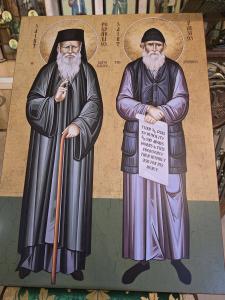
Food and St Paisios
Lessons from a Greek Festival
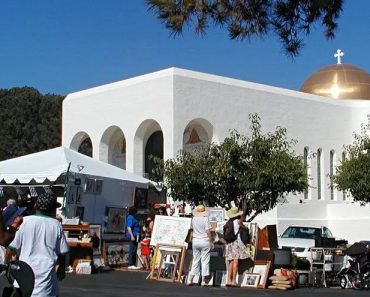
One of the great blessings of living in this tri-state area (Ohio/West Virginia/Pennsylvania) is the many national festivals that are celebrated during the year. People in this area are very aware of their family’s national and cultural background. Marty and I enjoy visiting as many festivals as possible. Several weeks ago we attended a Greek street festival at St. John the Divine Orthodox Church in Wheeling, West Virginia. We particularly appreciate the Greek festivals because of the amazing food that they offer. We do love our gyros! And the sweets! But this festival was about to provide a very interesting piece of history–a saint named Paisios.
First, the Food
A traditional gyro (pronounced YEE-roh) is a popular Greek dish made with seasoned beef or lamb that is cooked on a vertical rotisserie, thinly sliced, and wrapped in a warm flatbread. It is topped with Tzatziki sauce: A creamy, cool sauce made with Greek yogurt, cucumber, garlic, and herbs, diced tomatoes and chopped onions.
We also love the Greek seasoned wings with olive oil and feta cheese, the homemade lemonade, and the sweets! Traditional Greek pastries (siropiasta) feature crisp phyllo dough, rich honey or citrus syrups, chopped nuts, and creamy custards. Iconic specialties include flaky Baklava, custard-filled Galaktoboureko, shredded Kataifi, and warm breakfast Bougatsa.
We always buy some Baklava to eat with our meal, some to bring home for later, and some to give to friends who appreciate the cultural fare, as well. Baklava is a rich, sweet dessert made of many layers of paper-thin dough, walnuts, pistachios, or almonds nuts, cinnamon, and a sweet syrup made of sugar, honey, water, and lemon juice.
The festival also includes crafts, Greek dancing, and music.
The Church
This year as we sat enjoying our meal, we noticed that the church was open for tours. It is a historic church with a long-active congregation, so we decided to check it out. We met Fr. Demetrios Tsikouris, the parish priest of the church. He was ordained in 2014 by His Eminence Metropolitan Savas of Pittsburgh and has been serving at St. John the Divine ever since. He was very knowledgeable and gave us the tour of the absolutely stunning building.
Amidst the beautiful artwork, an interesting historical individual was introduced– St. Paisios. I had not heard his name before, but what really caught my attention was his inclination to teach using parables–not the same parables as Jesus used, but parables for a much more contemporary audience.
This was particularly inspiring to me because I had just finished publishing a series about the parables of Jesus. I love teaching by story-telling, so I was anxious to learn more about St. Paisios.
St. Paisios
I will quote here from the Orthodox Christian Network’s article “St. Paisios–A Saint in Our Lifetime”:
“Born Arsenios Eznepidis, he enlisted in the army during the civil war in Greece. Having completed his military service, he went to Mount Athos in 1950 and entered into monastic life. He was given the name Averkios. When he was tonsured a monk in 1954, he was given the name Paisios. He left Mount Athos for two years in 1962-1963 and was attached to the Monastery of St. Catherine on Mount Sinai, returning to Mt. Athos in 1964. He had a serious operation on his lungs in 1966, and during his hospital stay, he began a long friendship with the sisterhood of St. John the Theologian near Thessaloniki.
“Saint Paisios had the gift of prophecy, and his prophecies were written and published by Hieromonk Makarios of Mount Athos. He had many works published, and foresaw future events that have now come to pass. He was a man of intense prayer, and intense kindness. He suffered from various health challenges including cancer but kept receiving pilgrims even when he was in great pain. His renown as an ‘elder’ (Geronta) came as a result of his ministry to the sick and suffering people. He would sleep only two or three hours per night, maintained a strict regimen of prayer, and in turn radiated God’s grace through his humility and discipline to the many who came to him for prayer and counsel.
“His life was not easy, despite his prayerful state. He was beset with illness his entire life even to its very end, but demonstrated a spiritual strength beyond any of his contemporaries. When he passed away, thousands of pilgrims visited his tomb. Miracles have been attributed to this saintly man. Together with his writing, the humble spirit of this simple monk caused a cry for sainthood to come from the people. The life of St. Paisios was recognized by many as very pious and God-centered. His canonization as a saint took only twenty-one years, the second fastest process in recent history.
“The life of St. Paisios embodied the Fruit of the Spirit, which we read in Galatians 5, which is now the Epistle lesson read on his feastday. He demonstrated love to all who came to see him. He took great joy in his work, even though he suffered from many physical ailments. He brought peace to the world. He worked for peace as a soldier, sought the peace of God in prayer, and brought God’s peace to the troubled souls who came to him.
“We all know from experience that when we are tired, we struggle with patience. St. Paisios lived in a perpetual state of fatigue and yet he found patience to minister to every pilgrim who sought him out. In the same way, he demonstrated kindness, especially to those who were very sick, and became a ray of hope for many. Jesus says in Luke 18:19, that ‘No one is good but God alone.’ St. Paisios not only steadfastly believed in the goodness of God, even as he struggled with debilitating pain throughout most of his life, he was able to radiate God’s goodness even in his most challenging moments.”
When he taught, St. Paisios frequently taught through vivid, relatable parables to explain deep spiritual truths, just as Jesus did. The difference is that the parables of St. Paisios are probably more relatable to a modern audience. Here are some of his most well-known parables and teachings that offer practical lessons for daily life:
Modern Parables
The Parable of the Oak Tree (Dealing with Sin)
A spiritual father told his disciple to pull up a small blade of grass, which came out easily. Then he asked him to pull out a bush, then a small sapling, which required significant struggle. Finally, they came to a massive oak tree. The disciple could not budge it. Sin works the same way. If we tackle our faults when they are small “blades of grass,” they are easy to uproot. But if we let them grow into massive oak trees, it takes a miracle to remove them.
The Parable of the Fly (Judging vs. Loving)
People are like flies and bees. A fly lands only on garbage, ignoring the beautiful flowers in a garden. A bee, however, seeks out the sweetest nectar, ignoring the surrounding filth.
People who are critical and judgmental behave like flies, always looking for the faults and “garbage” in others. Loving and humble people behave like bees, looking for the good in every situation and ignoring the bad.
The Parable of the Rain and the River (Hesitation)
Two men stood on the bank of a mountain creek trying to cross it after a heavy rain. The “smart” man decided to wait for the rain to stop so the water would subside, but the rain only got heavier. The “dumb” man waded right in, getting wet but safely crossing the rushing current before it grew too wide.
This was often used by the Saint as a parable on marriage or stepping out in faith. If a person waits for “perfect” or risk-free conditions to make a life decision, they will often miss their opportunity entirely.
The Parable of the Radio Dials (Prayer and Humility)
The human heart is like a radio with two dials: one for tuning into the frequency of God, and the other for volume.
When we don’t feel joy in prayer or life, we have either hurt someone, or we are tuned into the “station of ego”. To feel the comfort of God, we must turn down the volume of our pride and turn our dial toward humility and love.
I am grateful to have “met” this humble, patient teacher. The Apolytikion of St. Paisios says, “Once the fire of love for the Lord was lit in you, through ascetical rigor you gave yourself to God. O God-bearing St. Paisios, for many you became consolation, giving counsel with God-inspired words, and by your prayers working wonder. And now, devout one, you intercede for the whole world unceasingly” (Trans. by Fr. Seraphim Dedes).
It is a fun fact that the saints and their stories do not all belong to times in the distant the past. There are saintly people who walk the earth today, who at some point will be recognized and canonized as saints. The story of St. Paisios reminds us of this.
Yes, I enjoyed the gyros; for sure, I enjoyed the baklava; but this year’s Greek festival at St. John the Divine Orthodox Church introduced me to a new hero–a man who, like me, enjoyed story-telling, a man who humbly walked with Christ, and represented Him well.
God bless you!