NUREMBERG, Germany – From Greece and Poland to Nuremberg, the music of Odysseas Konstantinopoulos seems to cross its own borders. With Greek and Polish musical traditions as constant points of reference, as well as a particular sensitivity to the history and culture of the Pontus region on the Black Sea coast, he has developed a personal compositional language in which the past engages creatively with the present.
The National Herald: I would like to begin, Mr. Konstantinopoulos, with your most recent artistic news, specifically the film ‘Lachtara’, which is soon expected to be screened at the Sarajevo Film Festival and for which you composed the music. Could you tell us a little about how this collaboration came about and how you approached the film musically?
Odysseas Konstantinopoulos: Five years ago, I received an invitation from the creator of the film Lachtara, director Sebastian Chondrokostas. We had previously worked together on a theatrical production, V. Katsikonouris’ ‘Milk’, in Warsaw. The subject of the film moved me because it concerns me in part. Refugee displacement and the Greek Civil War are subjects that have always troubled me.

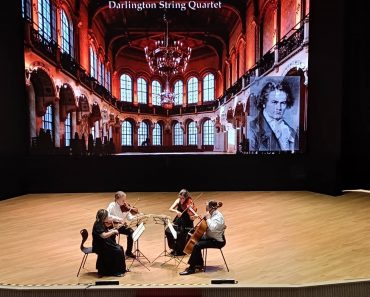
Scenes from past performances featuring works by Greek-American composer Odysseas Konstantinopoulos. (Photos courtesy of O. Konstantinopoulos)
“TNH: As a Greek-Polish expatriate yourself, who has lived in Nuremberg in recent years, how do you believe this dual background and your experience of migration have influenced or even shaped your artistic work?
OK: I must admit that I do not consider myself a person with a dual identity. I am happy that, as a Greek, I was born in Poland. One fact complements the other. One can perceive this by listening to my music. In all my compositions, the cultures of Greece and Poland can be heard. The two countries share historical experiences, including experiences related to the struggle for freedom of both peoples.

The Greek-Polish composer Odysseas Konstantinopoulos. (Photos courtesy of O. Konstantinopoulos)
TNH: You have devoted a significant part of your work in recent years to influences from Pontian music, beginning with the ‘Pontian Suite’ and subsequently with a series of other works, while maintaining close ties with the Association of Pontians of Nuremberg. What moves and fascinates you most about Pontus and Pontian culture?
OK: The history and music of Pontus have been an important part of my broader research into Greek music. The rhythmic element, which emerges from the Pontian dialect, and the spare melodies provide a wonderful starting point for composing a musical work. However, even in Pontian music, I try to offer my own personal perspective.

Scenes from past performances featuring works by Greek-American composer Odysseas Konstantinopoulos. (Photos courtesy of O. Konstantinopoulos)
TNH: Your career has been marked by important collaborations and compositions that have received international recognition. If you had to single out one artistic moment, what would it be?
OK: Certainly, a very important moment was the performance of the work ‘Trygona’ (the fifth movement of the Pontian Suite) in the Polish city of Katowice.
The presence of a delegation from the Cardinal Bessarion Association of Pontians of Nuremberg, together with the association’s president, Dimitris Lampropoulos, was particularly moving. The work was performed by the New Music Orchestra, conducted by Szymon Bywalec, at the Sala Kameralna of the NOSPR Concert Hall.
Equally important was the recording of both concertos for guitar and orchestra at the Karol Szymanowski Academy of Music in the same city, Katowice. These and other works can be found on the CD ‘Symbioza’.
TNH: What do you consider the greatest challenge for a contemporary composer, and what is your personal artistic goal?
OK: I very often say that my goal is for my music to unite the two cultures to which I belong completely. I think that this is both my artistic and political goal.