Hariklia Koundourakis boasts that her kourabiedes are the best.
The soft, buttery cookies, similar to shortbread, are made with ground almonds and dusted with powdered sugar. The popular dessert dates back to the early Ottoman Empire, with variations of the treat existing in countries across the Mediterranean and Western Asia. Koundourakis uses her mother’s recipe.
“Everybody says that my cookies are the best,” she said. “You might not think so, and that’s okay with me. But you’ll be the first.”
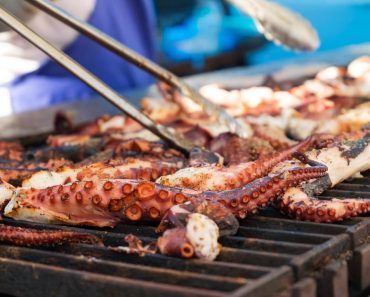
Koundourakis’ kourabiedes were for sale on Saturday, Aug. 15, as the Greek Orthodox Church of the Assumption of the Theotokos hosted its Greek Festival on state Route 23. Hundreds attended over the weekend for Greek food, live music, and religious observances.
The festival coincides with the Dormition of the Theotokos, an annual feast commemorating the death of Mary, the mother of Jesus, and her assumption into heaven.
The observances began Friday, Aug. 14, as churchgoers gathered for a procession carrying the Kouvouklion, also known as the Epitaphios of the Theotokos, around the church grounds. The ornate funeral bier typically holds an embroidered burial shroud or icon depicting Mary’s death.
“It’s almost like a makeshift tomb,” said Vickie Malegiannakis, the parish council president. “We carry it around the church outside, like a funeral procession.”

The church held a service Saturday before the festival began. Throughout the day, worshipers placed votive offerings, known as tamata, on an altar inside the church. The small metal plaques, made of tin, silver, or gold, are traditionally stamped with symbols representing a specific prayer, petition, or expression of gratitude.
“People make a pilgrimage,” said Malegiannakis, who lives in Ashland. “Let’s say you have a sick child, a sick parent, or maybe you just want to pray for the health of your loved one. You make an offering, a priest blesses it, and it’s passed to the congregation.”
The church, built in 1961, is decorated with motifs honoring Mary. Its congregation has 115 active members, and many live outside Windham. Weekly attendance numbers range from 10 to 40 depending on the season, and services are held in both Greek and English.
“In the summer, it swells, because we have the Floridians that come back,” Malegiannakis said. “Some people just want to get out of the city and they have their second homes but they don’t want to deal with three feet of snow.”


“But even in the winter, we’re here every Sunday,” she said.
The festival is a fundraiser for the church and an important gathering for a congregation that has grown smaller over the years.
“The Greek community was really active here, but as time progresses, European travel became easier for people and they started going back to the homeland,” Malegiannakis said. “A lot of people live less here now, but because it’s the feast day of the Dormition of the Holy Mother, we celebrate it because it’s the name of our church.”
The Greek Alps
Windham’s Greek community flourished in the mid-20th century around at least five resorts collectively known as the Greek Alps, that drew thousands of Greek Americans from New York City. Much like the Borscht Belt in Ulster and Sullivan counties, the Armenian resorts of Hunter, and the German resorts that dotted the lower Catskills in Cairo, vacationers sought affordable places where they could speak their native language and connect with family and friends.
“My uncle was one of the first of my clan that arrived,” Koundourakis said. “He bought a lot of property in Windham.”
Koundourakis, 60, grew up in New York City before moving to Ridgefield, Connecticut. She still owns a home on Old Road, where many of her family members purchased property in the mid-20th century. She said some locals affectionately referred to Old Road as “Greek Corner.”
“All the Greeks that came, that immigrated, they were either missing their mountains or they needed the beach,” she said. “A lot of them came up here.”

Much of the evidence of the Greek resorts in Windham is anecdotal, with little academic resources available and only a few mentions of the community on Facebook groups and fringe websites. Ads for the resorts, which would have existed in Atlantis, a Greek-language newspaper in New York City, are unavailable as the paper has not been digitized, according to Greene County Historian Jonathan Palmer.
Koundourakis remembers at least five resorts: Starlite, Kallithea, Olympia, Pindos, and Sparta Manor. While her family owned homes in Windham, she still went to the resorts for live music and entertainment. She has particularly fond memories of playing musical chairs at Kallithea, which she said was located near Hensonville.
“Everybody who had a house here, we used to go there for entertainment,” she said. “There was a live band, we used to play musical chairs, it was really a lot of fun.”
Denise Cecchini, 71, also grew up in New York City. A parish council member, Cecchini, who now lives in Rutherford, New Jersey, came up to Windham each summer. Her grandparents owned Sparta Manor, formerly located on Nauvoo Road.
“They could have accommodated 300 guests,” she said. “They had cabins, they had three main houses with rooms in them. This was the place to come and feel like you were part of Greece.”
From the day she got out of school, Cecchini’s family would drive up to Windham.
“Every summer, the last day of school we were in the car,” she said. “We didn’t go back to the city until Labor Day.”

For Cecchini and Koundourakis, growing up in the resort community is what has brought them back to Windham year after year despite living out of the area. “We just have a love for this church,” Koundourakis said.
However, the aging congregation is a concern for Malegiannakis.
“Every year it gets a little smaller,” Malegiannakis said. “We’re an aging community. We need youth, youth, youth.”
Even fundraising can be difficult, with some years the church only raising enough to break even. But the show must go on, especially for the locals.
“Around 85% of our traffic is local,” she said. “They wait all year. They want gyro, they want souvlaki, they want lamb. It’s something you don’t get every day.”
For now, the traditions remain, largely through that same food that brings the locals back to the festival each year. Especially Koundourakis’ kourabiedes.
They are, indeed, her mother’s recipe.
Connor Greco is a staff reporter for The Overlook covering Windham, Hunter, and surrounding Greene County communities. Send correspondence to connor@theoverlooknews.com.