
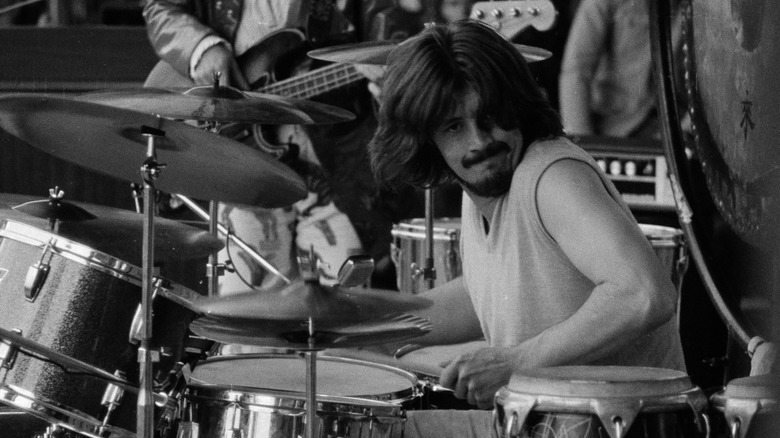
Since we already looked at the 5 best rock drum solos of the 70’s, we thought we’d turn the clock back another decade and check out the solo skin smashing of the swinging 60’s. There’s happy accidents at jam band recording sessions, jazz fusion explorations, musical musings on Greek tragedy, and a whole lot more to be found in the raucous runs laid down by these groovy, far-out cats.
The decade gave us some of rock’s most enduring music but it was also a time of transition. The basic rock ‘n’ roll formula established by Chuck Berry, Little Richard and Elvis Presley was rapidly evolving into a more complex, diverse, and experimental beast. Rock drummers were evolving right along with everyone else and so we wanted to honor those trailblazers that raised the bar from the drum throne. Commercial legacies vary but all of these drummers come from bands that defined the era and laid down solos that give the evolving rock genre added artistic legitimacy.
In-A-Gadda-Da-Vida — Ron Bushy with Iron Butterfly
What makes Ron Bushy’s solo on “In-a-Gadda-Da-Vida” stand out isn’t his technical capacity — he’s definitely no slouch in that regard, though — it’s his ability to construct a coherent extended musical idea with evolving motifs and melodic content all its own. By the time his turn comes around the band has been playing off each other for over six minutes, most of it solos. Through all of that there’s a pronounced emphasis on creating collective variations on the song’s iconic main riff and evolving more through interplay and musical dialogue — it’s the sound of a band that has honed its internal cohesion through countless extended jams and multi-hour sets.
Following the format established by jazz bands, the rest of the ensemble drops out altogether when it gets around to Bushy, leaving him to keep up the momentum all on his own. However, he’s not afraid of that moment of auditory nakedness. The kick drum goes into double time and he builds slowly with a set of gradually more complex fills that signal the song’s shift away from psychedelic walls of distortion and into a more ethereal, atmospheric headspace. When Doug Ingle finally comes back in, roughly three minutes later, we get the impression that his own concept of song has dramatically shifted. That all of this dialogue happened on the fly, in the course of an impromptu jam during studio soundcheck that became the unexpected final cut, makes Bushy’s communicative skills behind the kit shine even more brightly.
21st Century Schizoid Man — Michael Giles with King Crimson
“In the Court of the Crimson King” is a foundational recording in the development of progressive rock and Michael Giles’ solo on “21st Century Schizoid Man” demonstrates that the internal cohesion of the band, as much as the singular vision of guitarist Robert Fripp, was what made that possible. There’s a treasure trove of great chops to be found Giles’ runs but what really matters is how they interact with the larger ensemble.
After two verses of Black Sabbath style doom guitar and lyrical visions of a wartorn apocalypse, the band breaks into a feverish instrumental section that sees them trading licks like a finely honed jazz band. Though his proper feature moment comes later, Giles attacks the section’s opening salvo with patterns that lean so heavily into fills that it sounds less like he’s keeping time for his bandmates and more like he’s usurping the spotlight from the get-go. Where he does groove there’s a heavy emphasis on the ride cymbal which adds to the jazz fusion aura.
Fripp continues to lay down wailing guide tones as the rest of the band steps back to give Giles the floor. There’s sonic atmosphere, but it’s still very much his moment. Curiously, it’s here that he most heavily emphasizes into the underlying groove of the section. As a result, the fills and breaks feel more like variations on a theme than blind showmanship. What follows is a series of duets between Giles and the other soloists, each with its own unique accompaniment from the drummer. There’s a drumming masterclass there to be sure but the most impressive feat is reminding us that a great solo is a group effort.
The End — John Densmore with The Doors
While lead singer Jim Morrison’s lizard king poet personae dominates The Doors’ music and image, his jazz literate bandmates upstage him time and again throughout their catalog. For drummer John Densmore, an early and captivating example of that comes on “The End,” the haunting extended epic that closes the band’s self-titled 1967 debut album. Morrison’s captivating modernization of the Oedipus myth takes center stage but he’s surrounded on all sides by the raga-inspired guitar work of Robby Krieger, the funerary organ of Ray Manzarek, and, above all, the drumming of John Densmore.
We’re just over two minutes into the song’s near 12-minute runtime when Densmore takes command. A thunderous floor tom roll builds to an explosive interplay between drums and cymbals. It’s a short burst but one that outlines the dynamics Densmore intends to introduce throughout the piece. He leans on the hi-hat and ride cymbal, not the snare and the kick, removing the song from typical rock ‘n’ roll percussion, and instead only brings in the drums at dramatic accent points. By the time he erupts following the song’s legendary spoken word section we’ve been made accustomed to his underlying command of the situation and his solo runs land with as much devastating gravitas as Morrison’s theatrical vocals.
The three other Doors all accompanied Morrison’s sinister poetry in their own way. In the case of “The End,” Densmore’s tribal soloing most closely underscore’s the ferocious narrative perfectly. No wonder the song became the soundtrack to the chaotic opening scenes of “Apocalypse Now.”
Moby Dick — John Bonham with Led Zeppelin
Though Led Zeppelin as a whole makes some perfunctory opening and closing statements, “Moby Dick” is primarily a vehicle for drummer John Bonham to throw down a solo that occupies roughly three minutes of the track’s 4 minute, 20 second runtime. By the time the band recorded “Led Zepplin II,” Bonham had already had plenty of opportunities to grab the spotlight across the band’s self-titled debut. But just like Eddie Van Halen when he recorded “Eruption” or Cliff Burton when he laid down one of the best bass solos in rock history, there are times when a groundbreaking player needs more space to announce their arrival.
Bonham’s performance is notable for many reasons, the first being that he doesn’t use the existing momentum of the track’s opening ensemble jam to carry his solo. Instead, he allows that energy to drum away completely, indulging a defiantly prolonged moment of silence before counting in the solo and building back up from the metronomic hi-hat. The tour-de-force that follows offers a history lesson in percussion. Initial tribalistic opening statements segue into jazz rudiments. That becomes intercut by floor tom accents and rolls that echo the part of a timpani in classical percussion. Midway through the solo, Bonham begins incorporating elements of central and east Asian traditions with the kind of rhythmic give and take associated with tabla and taiko traditions.
“Moby Dick” sees Bonham adding his profound musical literacy to a genre that had spent the ’60’s demonstrating it was more than just throw-away adolescent entertainment. Small wonder Rolling Stone slotted him as the No. 1 drummer of all time.
I Can See for Miles — Keith Moon with the Who
While songs like “My Generation” off 1965’s album of the same name or “Bargain” off 1971’s “Who’s Next” give the impression that Keith Moon saw every song as one prolonged drum solo, it’s 1967’s “I Can See for Miles” off the cheekily titled “The Who Sell Out” that really gives him the proper moment in the spotlight. The rest of the band steps back, maintaining only sonic ambiance, and Moon builds up to one profound percussive statement after another.
Throughout the solo, Moon never stops crescendoing: He mounts the tension, climaxes, and mounts it again. There’s dynamic fills, but just as important, pulsating timekeeping on the toms that not only keeps us bated for the next onslaught but tightly inside the song’s psychedelic aura. What makes the performance so special is that uncharacteristic use of restraint. The more intense, intricate fills that erupt during the final chorus are all the more impactful because Moon delayed the payoff in his actual solo.
Keith Moon more than made his impact on the drumming world with Rolling Stone listing him as the No. 2 best drummer of all time (surpassed only by Led Zeppelin’s John Bonham and immediately followed by Neil Peart of Rush). That sort of achievement can only be borne out of extraordinary technical proficiency, but here Moon establishes something even more important: that he knows how to serve the song. Ironic that a drummer known for manic displays of dazzling chops would shine so brightly with a “less is more” attitude.