
The Northcote Festival may be grounded in Hellenic culture and Greek Orthodox tradition. However, there was no monoculture to be found when thousands gathered at the Holy Monastery of Axion Estin on Sunday.
Greek, Cypriot and Pontian dancers shared the program with performers representing Albania, Assyria, Ukraine and Romania, while food stalls served flavours from Greece, Korea, Turkey, Germany and beyond.
Even Catholic nuns were among the guests at the Orthodox celebration, alongside people of different cultures, faiths and backgrounds.


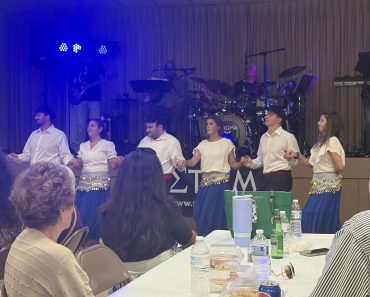
After Pontiaki Estia – celebrating its 50th year – took to the arena, the distinction between performers and spectators all but disappeared. An impromptu dance-off erupted as members of the crowd joined the dancers, turning the festival grounds into one large, exuberant dance floor.
“We are the Romanian group Aurora, and we perform dances from all over Romania,” one of the dancers said before the group brought another burst of colour and movement to the stage.
The two-stage program featured more than 25 performances, ranging from traditional dance and live Greek music to singing, children’s entertainment and magic. The festival culminated in a community glendi, ending with more dancing and a bonfire.


Among those attending were His Eminence Archbishop Makarios of Australia, State Member for Northcote Kat Theophanous, Evan Mulholland MP, Darebin Mayor Emily Dimitriadis and Darebin councillor Lambros Tapinos.
Tapinos said the festival played an important role in bringing Darebin’s many communities together.
“It is very important for our multicultural community,” he said. “Events like this unite us, and it is important that we continue these types of events in Darebin.”
Promises by Labor and Liberal
During the festival, currently in its third year, Theophanous announced that a re-elected Victorian Labor Government would provide $200,000 over four years to support the event. While not to be outdone, Shadow Minister Evan Mullholland, shadow minister for multicultural affairs, also made an announcement for $800,000 over four years to establish a Hellenic Festival Fund in partnership with the Greek Orthodox Archdiocese of Australia.

“This is so Greek Orthodox parishes around the state can continue to celebrate faith and can continue to celebrate culture with their community,” he said.
On her part, Theophanous said, “A re-elected Labor Government will provide $200,000 over four years to support the Northcote Festival and help this wonderful celebration continue to grow.”
Theophanous described the festival as both a celebration of Hellenic and Greek Orthodox heritage and a reflection of the broader multicultural community built around it.
“Here in Northcote, our diversity is part of everyday life,” she said. “It’s in the languages spoken with pride, the businesses that colour our suburbs and the traditions that centre us. That’s worth celebrating and protecting.”

The funding commitment, conditional on Labor winning the upcoming Victorian state election, would give organisers greater certainty to expand the festival’s reach over the next four years.
Theophanous acknowledged His Grace Bishop Evmenios of Chora, Father Phillip and the volunteers, performers, stallholders and community members who have helped transform the festival into an increasingly large multicultural celebration.
Olive oil, honey and football jerseys
Beyond the stages, the festival offered a showcase for emerging family businesses and young entrepreneurs.
Karina Tolios and Nikita Kypriotis, Fashion Football entrepreneurs, were selling football jerseys after launching their business at the Oakleigh Glendi last year.
“We started our first pop-up at Oakleigh Glendi,” Kypriotis said. “It’s our first year in business, and we’ve done a few festivals now. Business has been better than we expected. We love being around the community and meeting new people.”


For James Theodorokopoulos and Andrew Zikas of Olive Drops, Northcote was their first festival appearance. Their olive oil comes from Messinia, where relatives tend the trees and undertake the harvest.
“We import our olive oil from Kalamata, specifically Messinia, and sell it to customers in Australia,” Theodorokopoulos said. “We have relatives in Greece who do the picking and then send it to us. People love the products, and it is doing well.”

Nearby, Northcote-born mechanic Andrew Lekkas was introducing festivalgoers to Tears of the Gods, the olive oil he created from his family’s groves near Pylos.
“Axion Esti is my church,” Lekkas said. “We come from Messinia, about 15 minutes from Pylos. I go every year and press the olives with my grandparents. These groves have been in our family for three to five generations.”
After learning the trade over the past five or six years, Lekkas decided it was time to place the oil in a bottle worthy of its history. Its branding draws on his love of ancient Greek mythology, pottery and the terracotta colours and patterns seen on museum artefacts.
“I’ve always been interested in the myths we learnt about at Greek school, and I wanted to give the oil a name and an identity of its own,” he said.


His stall, staffed by girlfriend Nikita, sister Kathy, cousin Johnny and friends, was decorated with delightfully retro pieces retrieved from his grandparents’ home: 1970s “tsitsila mitsila”, as he affectionately described the ornaments that had previously gathered dust.
Lekkas said genuine olive oil should retain the character of the fruit.
“You should be able to taste the olives and the leaves, with that afterburn in the throat,” he said. “That is a clear indicator of good olive oil.”
“And the colour,” quips his sister.
He has no immediate plans to abandon his work as a mechanic, however.
“I wouldn’t quit my day job,” he laughed. “Then again, there’s oil in both. I work with other oils during the day.”

A family business with a bit of sting
The Grivas family was also out in force with its Meli Honey business, and its eye-catching dog, called Crypto.
Founder Sam Grivas, whose family comes from Tinos, said honey began as a sideline to his career in building and construction but had since become his full-time occupation.
“It was my honey job,” he joked. “We started five years ago, and now we sell to 80 stores around Melbourne and export as well. We have also won several international awards.”


The business emerged after a post-COVID visit to Greece, when Sam returned with a bucket of honey. The family shared it with friends and relatives, and demand quickly followed.
His son Nicholas is gradually taking on more responsibility.
“Dad and I started it together,” he said. “Working with family is fun 90 per cent of the time, but we occasionally have a few wars. It is moving forward.”
Sam’s daughter Stacey works as a pharmacist and his wife, Maria, works at a café in Kew, but both still contribute to the growing family enterprise.

A Festival with a large footprint
The event also drew visitors from well outside Melbourne’s inner north.
Duc, who travelled from Clayton after discovering the festival on Facebook, said a past relationship had introduced him to Greek culture.
“I used to date someone who was Greek, so I keep informed,” he said.
Community organisations also used the day to reach new audiences. Theodoros Constantinou, principal advocate of the Culturally and Linguistically Diverse Emergency Responders Network, said the organisation now represented more than 150 members from 35 nationalities.
“Our society is made up of about 46 per cent of people born overseas, but our emergency services are only around 15 per cent diverse,” said Constantinou, a CFA volunteer and former police officer.
He distributed more than 300 information cards during the festival.


Chris Vlahonasios, director of content acquisitions at Logos Cinema, described the streaming service as “the Netflix of Orthodoxy”.
“We have Japanese and Alaskan films from places where you would not necessarily expect to find them,” he said. “We have close to 3,000 subscribers, primarily from North America and Australia. This festival has been a great opportunity, and we have had a few sign-ups today.”
That combination of faith, heritage, enterprise and cultural curiosity was abundant as the Festival celebrated its Greek Orthodox roots without placing a fence around them. Instead, it opened the doors, turned up the music and invited everyone to dance.