
For John Koudounis, receiving the Order of the Phoenix brought together a long professional journey, a friendship stretching back to his college years and a Greek identity he credits with shaping far more than his career.
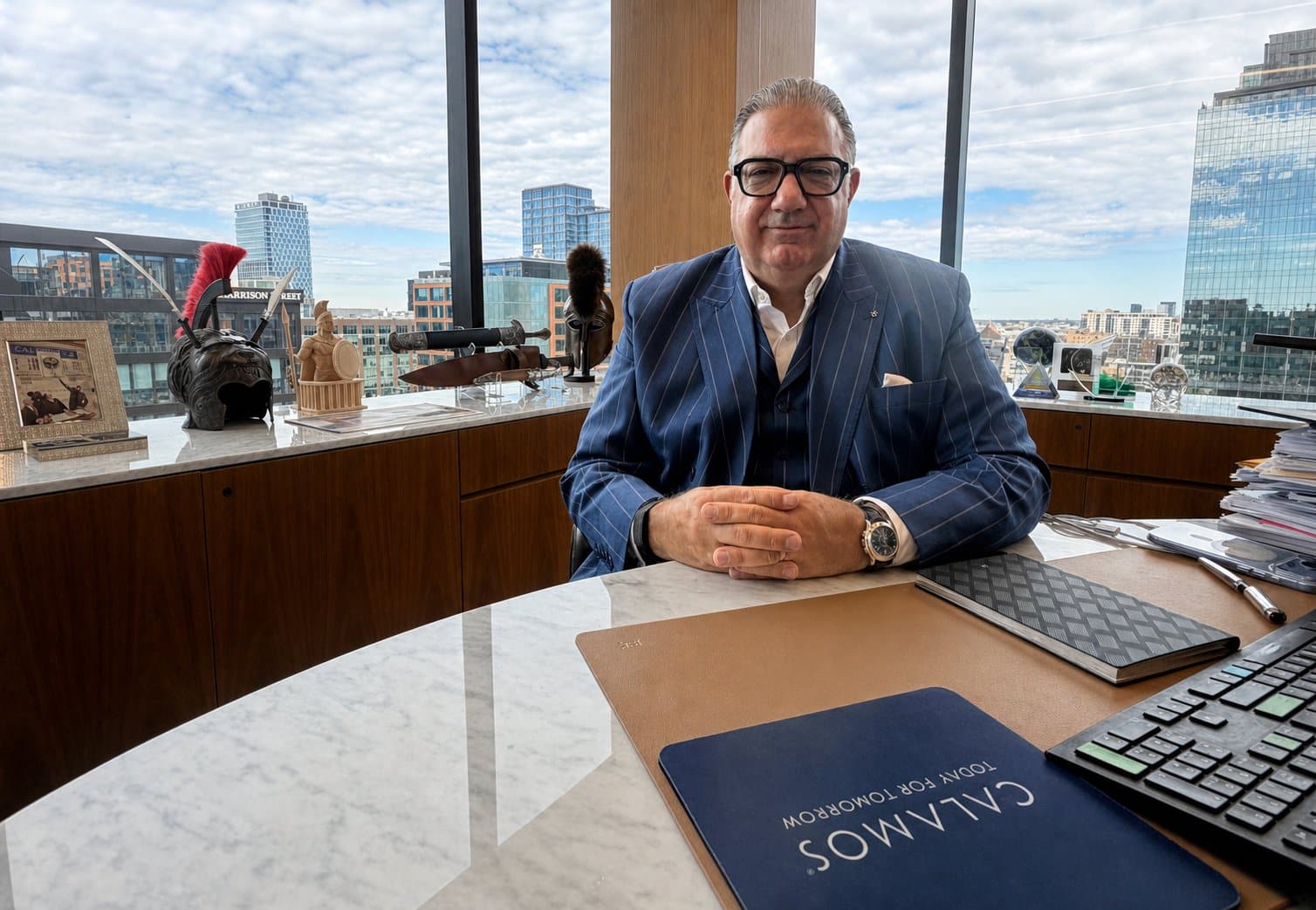
Speaking to Greek Reporter at the Calamos offices in Chicago on September 25, the Wall Street veteran described the honor in distinctly personal terms.
“I’m Greek. I’m very proud to be Greek. I’m very proud of my heritage and what that has given me,” he said.
A few days days earlier, Greek Prime Minister Kyriakos Mitsotakis had presented Koudounis with the distinction of Commander of the Order of the Phoenix at the “Oli Mazi” gathering in New York, where Greek-American leaders were recognized for their contributions to the community and ties between Greece and the United States.
“I was very honored and humbled to receive the Order of the Phoenix,” Koudounis said. The occasion carried the added significance of being honored by someone he has known since his college years.
But recognition, he emphasized, was never the motivation.
“You do things because you want to do things and not because you’re looking for any kind of awards or anything like that.”
That distinction, between seeking recognition and wanting to contribute, ran through a conversation that moved from his Greek roots and the diaspora’s growing cooperation to Greece’s economic recovery and the uncertainty confronting global investors.
John Koudounis: Greek roots, shared purpose
Koudounis has spent more than three decades in financial services, including as president and CEO of Mizuho Securities USA before joining Calamos Investments as CEO in 2016. His experience spans global capital markets and the leadership of major financial businesses.
Alongside that career, he has maintained commitments to Greek-American institutions. He is a founding board member of The Hellenic Initiative, which supports Greece through economic development and philanthropic programs, and a trustee of the National Hellenic Museum.
In explaining those commitments, he returned to the values he associates with his upbringing: his moral compass, his standards and his work ethic.
“That is the foundation of who I am,” he said.
For Koudounis, however, the community’s potential depends on more than individual achievement. Asked whether Greek Americans have become better at supporting one another and working toward shared goals, he welcomed the progress without suggesting the work was finished.
“We are doing better. We can still improve on that.”
He hopes the cooperation emerging through Greek diaspora organizations will draw more people into efforts that benefit both Greeks abroad and Greece itself. The goal is not simply to celebrate successful members of the diaspora, but to encourage them to accomplish more together.
Greece’s comeback and the confidence behind it
That discussion of collective effort led to a country whose recovery Koudounis regards not as a miracle, but as the result of difficult, sustained work.
“There was a lot of hard work that went into where Greece is right now,” he said.
He recalled the anxiety of the capital-control period, when restrictions on bank withdrawals made the country’s financial vulnerability part of everyday life. The controls were introduced in June 2015 and fully lifted in September 2019. Greece’s subsequent return to investment-grade credit ratings, including Moody’s upgrade in March 2025, illustrates how far its financial standing has recovered.
Koudounis gives Mitsotakis considerable credit for that transformation. His argument is rooted in the importance he places on predictability: investors, he believes, are more willing to commit capital when they understand the policy direction and expect it to endure.
“The markets like consistency. They don’t like surprises.”
Asked directly whether the markets like Mitsotakis, his answer was equally direct.
“The markets like Mitsotakis.”
His confidence in Greece’s prospects is closely tied to that assessment. Koudounis said another term for the prime minister would offer investors the prospect of a further period of policy continuity—something he believes could reinforce confidence in the country.
He also sees that confidence extending to the diaspora. A more predictable environment, he argued, makes Greek Americans and other overseas Greeks more comfortable investing in the country, rather than supporting it only through family connections or philanthropy.

He pointed to the investment flowing into projects across Greece as evidence of that change.
“And that’s not a coincidence.”
The market turning point he is watching
When the conversation shifted from Greece to the United States and global markets, Koudounis returned to the same underlying concern: uncertainty.
This time, however, his focus was on energy and particularly the relationship between the Iran crisis, oil prices and the bond market.
In his assessment, oil remains a central driver of the global economy. He believes an easing of the confrontation involving the United States and Iran could produce a sharp reversal in oil prices, with consequences for inflation, interest rates and bonds.
He described the oil-driven inflationary pressure as potentially “transitory,” arguing that progress toward a settlement could change the outlook quickly.
“I think once we have some news, once we have some settlement, I think that’s going to snap back and we’re going to see oil fall dramatically.”
His forecast is that cheaper oil would help bring interest rates and bond yields down, while supporting bond prices.
“Once that happens, you’re going to see rates come down and the bond market go up and the yields go down with that.”
Koudounis is confident in that outlook, with the timing tied to progress toward a resolution.
“When is that going to happen? That’s the big question.”
He believes the economic pressure on Iran could help bring that turning point closer.
“I don’t see Iran being able to sustain this economic pressure for that much longer,” he said.
He also expects alternative oil-export routes to reduce the region’s dependence on the Strait of Hormuz over time, although he does not see the waterway becoming irrelevant.
For investors, the implication of his outlook is that the turning point could begin with credible signs of progress. Koudounis believes markets could start responding as they anticipate and accept a less constrained energy outlook, rather than waiting for every element of the crisis to be resolved.
Iran, elections and Trump’s legacy
Asked whether the U.S. elections might help settle markets by removing some political uncertainty, Koudounis agreed that the outcome would matter.
“Uncertainty always creates volatility in the markets,” he said. “The elections are a big deal.”
But he sees Iran as a challenge that would remain central to Trump’s presidency regardless of the congressional election results.
“President Trump’s legacy is going to be this Iran situation,” he said.
Koudounis expects that concern to drive the president’s approach to the confrontation through the remainder of his term.
“I feel that he’s going to do everything in his power to clean it up before he leaves office because he’s going to be left with that stain.”
Even an election outcome that left Trump facing an opposition-controlled House and Senate would not, in Koudounis’ view, displace Iran as a priority. He believes preventing the country from acquiring nuclear weapons will remain a central objective.
“I think even if he loses both the House and the Senate, I think his main concerns are going to be making sure that Iran does not have nuclear weapons for the safety of the future, not just for the United States, but for the entire world.”