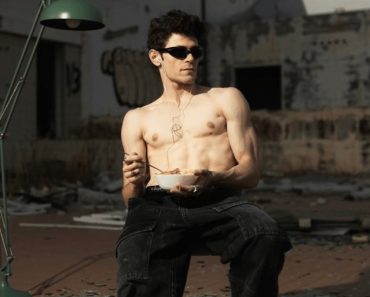
Late in the night, as one more fan shouted a request for Beck‘s first and best-known hit, the Los Angeles singer-songwriter gently teased him and anyone else who’d come to the Greek Theatre on Wednesday, Sept. 23 expecting that version of Beck to be there.
“I haven’t done a show in over 30 years where people aren’t yelling ‘Loser’,” he said. “Go to my Instagram. I told you what we were doing.”
This was what Beck later described as “our moody show.” With 23 songs across an hour and 45 minutes, it was a thrillingly different kind of Beck concert, mixing the beautiful melancholy of his new album “Ride Lonesome” with similar sounds and themes from records such as “Sea Change” and “Mutations,” a few deep cuts not played for many years, and yes, a few of those fan favorites, too.
-

Beck performs at the Greek Theatre in Los Angeles during his Ride Lonesome Tour on Wednesday, September 23, 2026. (Photo by Sarah Reingewirtz, Los Angeles Daily News/SCNG)


1 of 8
Beck performs at the Greek Theatre in Los Angeles during his Ride Lonesome Tour on Wednesday, September 23, 2026. (Photo by Sarah Reingewirtz, Los Angeles Daily News/SCNG)
“Ride Lonesome,” which arrived Friday, Sept. 18, is Beck‘s first album in seven years, a mostly acoustic reflection on love and loss and loneliness, in which hope flickers throughout. Created in the aftermath of his 2021 divorce, it’s seen as the third in a trilogy of similarly personal and introspective albums that began with 2002’s “Sea Change” and continued on 2014’s “Morning Phase.”
“In the Night,” one of eight songs off the new record in the set, opened the show and quickly established the creative narrative of this tour. Beck appeared, alone in a blue spotlight, a theater flat painted to look like a weathered old farmhouse behind him. As he sang, accompanying himself with finger-picked acoustic guitar, a string section played from the shadow of the wings almost out of sight.
Stagehands rolled the farmhouse flat into the wings before “The Golden Age” and “Paper Tiger,” both from “Sea Change,” arrived. A dining room table perhaps 40 feet long arrived before the new “For Your Love,” with Beck singing seated at one end, an empty chair opposite him in the distance.
This wasn’t a traditional rock show with the band and instruments and amps lined up on stage in the usual manner. Instead, as one song flowed to the next, it revealed itself as a kind of hybrid, mixing songs with theatrical trappings with each set change by the crew who worked silently in the shadows of the stage.
“It’s All in Your Mind” saw Beck, guitarists Jason Falkner and Wayne Foler, and a cellist seated at one side of the stage as the stagehands brought out rectangular panels to create a new setting on the opposite side. “The New Pollution,” one of three songs off Beck’s breakthrough 1996 “Odelay” album, followed in a slower, sparer arrangement that linked it to the musical vibes it followed.
After the new “Run Away,” Beck paused to talk about his history with the Greek, how a show there by Antonio Carlos Jobim was his first-ever real concert, how his second concert there was his first time sneaking a view from the bushes beyond its furthest seats.
“I was in the bushes right up there, right by Tree No. 17,” he said. “And the artist that was performing was Neil Young, playing by himself, acoustic, just like this,” Beck continued, playing a little bit of a Young song. “Something like that.”
We’ve heard him tell the story about the people in the bushes and Tree No. 17 before; but as he continued into a fuller version of Young’s “Old Man,” well, that was an entirely new delight.
“Now I’m gonna mosey over to my house,” Beck said, walking back to the panels angled behind his band. “It’s all I can afford in this neighborhood. It’s 150 square feet, but I call it home, and it can fit my whole [bleepin’] band.”
The audience laughed, and moments later cheered, as Beck and the band, standing like characters in this play, untethered by cords or the usual gear, slide into “Cold Brains,” a song off “Mutations,” which he’d not played live since 2006.
With film director Edgar Wright somewhere in the audience, Beck played “Ramona,” a song he’d written for Wright’s movie “Scott Pilgrim vs. the World,” which he and the band started over after some unnoticeable mistake.
“I can see the reviews already,” Beck joked. “‘Shambolic’ is the word they like to use.”
Sticking with the Hollywood theme, a cover of the Korgis’ “Everybody’s Got to Learn Sometime,” recorded for the soundtrack of 2004’s “Eternal Sunshine of the Spotless Mind,” followed, Beck singing with both hands in the pants pockets of a vintage suit, tie loosened, shirt unbuttoned, a saloon singer with one more heartache to drown.
With a wide riser at the back of the stage for Beck and the band, which included Gabe Noel on bass and James McAlister on drums, they dropped into “Devils Haircut,” another of the “Odelay” crowd-pleasers, as clouds of fog glowed ominously in the saturated red lighting.
A song or two later, Beck paused to riff on public parks, of all things.
“You know, I live near this park, and I’m really happy to have it,” he said. “It’s one of the few parks we have in L.A., and I’d like to take this moment to make my stand for Los Angeles. I mean, I was born here. I grew up here. And I love it, but we have some problems.”
The problem, admittedly not the biggest, Beck noted, has to do with “the soul of Los Angeles,” and how it suffers without more public parklands.
“Look at a map of Los Angeles,” he continued with an apology to his bandmates for going off on this tangent. “Somebody yelled, ‘Griffith Park.’ I love Griffith Park. It’s a mountain. Every green spot is a golf course. Can we take the golf courses back? OK, that’s my pitch for my mayoral run.”
The eternally gorgeous heartbreak of “Lost Cause” followed, the band now seated on a platform with a faux-campfire glowing orange at their center.
Other highlights late in the show included “It Ends Right Here,” another beautifully sad new one, staged with Beck singing directly in an eye-level spotlight at stage left, the band lined up in silhouette behind him, and “Ride Lonesome,” the title track of the new record, a brand-new classic with a ’70s folk rock feel.
The trickle of concertgoers more interested in beating the traffic than catching the end of the show grew to the point that it caught Beck’s attention on stage. “Don’t leave now, we’re about to play the songs you like,” he joked, and then did just that.
“Where It’s At,” which took me decades to stop identifying as “Two Turntables and a Microphone,” and “Loser,” the original Beck hit, followed, with the audience, which stayed seated for most of the mellower, melancholic material, happily rising to dance and sing along to these familiar tunes.
The encore of Daniel Johnston’s “True Love Will Find You in the End” left Beck as we’d found him at the beginning: Alone, but now hopeful for what the future may bring.