
A collection of ancient iron rings discovered across Greece may have been forged from meteorites thousands of years before ironworking became widespread, with new research suggesting the rare “celestial” metal was prized by the elites of Minoan and Mycenaean society.
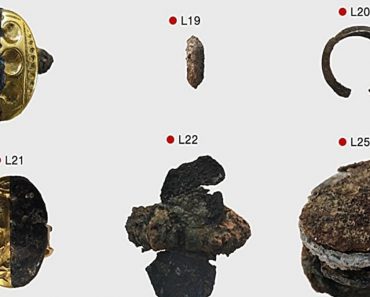
Scientists examining 91 Bronze and Early Iron Age objects from archaeological sites across Greece identified unusually high concentrations of nickel in 13 rings and ring fragments. The chemical signature indicates that at least ten of the objects are highly likely to have been manufactured from meteoritic iron.
– Advertisement –
Most of the rings date from between the 18th and 14th centuries BC and were recovered from wealthy tombs associated with some of the most important centres of Mycenaean civilisation.
The findings suggest that iron falling to Earth from space was not merely a technological curiosity. Instead, the exceptionally rare material may have been deliberately fashioned into prestigious jewellery worn by members of the ruling elite.
Scientists Analyse 91 Ancient Iron Objects
The research was conducted by astrophysicist and geochemist Matthieu Gounel of France’s National Museum of Natural History and archaeologist Eleni Mantsurani of the National and Kapodistrian University of Athens.
– Advertisement –
Their study examined 91 iron artefacts from 33 archaeological sites in Greece, now held across 19 museum collections.
Researchers used portable X-ray fluorescence analysis, a non-destructive technique that allowed them to investigate the chemical composition of the ancient metal without removing samples from the valuable objects.
The crucial clue was nickel.
Iron meteorites characteristically contain elevated levels of nickel and can include kamacite, a naturally occurring iron-nickel alloy formed within asteroids and other planetary bodies.
Thirteen of the objects analysed contained elevated nickel concentrations. Significantly, all were rings or fragments of rings.
Researchers concluded that nine were most likely made from meteoritic iron, while a tenth was also considered highly probable. A meteoritic origin remains possible for three additional rings, although further evidence would be needed to establish this more securely.
By contrast, most of the other iron artefacts contained little or no nickel and were classified as objects produced from smelted terrestrial iron ore.

Jewellery of the Mycenaean Elite
Where the rings were discovered provides another clue to their importance.
Almost all of the high-nickel examples came from wealthy tholos and chamber tombs at major Mycenaean sites, including Mycenae, Dendra, Vathyo and Kakovatos.
Such tombs were associated with wealthy and powerful members of Bronze Age society.
One notable exception came from the Minoan sanctuary at Anemospilia on Crete, where an iron ring was reportedly discovered on the finger of a man interpreted by archaeologists as a high-ranking priest.
Some of the rings were elaborate objects combining iron with precious metals including gold, silver and bronze. Certain examples may also have functioned as seals rather than purely decorative jewellery.
Two rings from a tomb at Dendra were reportedly discovered inside a gold vessel decorated with an octopus, further emphasising the prestigious context in which the objects were deposited.
The concentration of meteoritic iron rings in wealthy burials suggests the material possessed considerable social significance. Researchers believe such jewellery could have functioned as a visible symbol of authority, wealth or status.
Iron That Fell From the Sky
During much of the Bronze Age, producing iron from terrestrial ore was technologically difficult and had not yet become commonplace.
Meteorites offered a different source.
Iron meteorites arrive on Earth already containing metallic iron, meaning the material could potentially be worked without first developing the sophisticated high-temperature smelting processes necessary to extract usable iron from ore.
Its extreme rarity would have made meteoritic iron particularly valuable.
For Bronze Age communities encountering the material, its unusual properties — and perhaps an awareness that it had literally fallen from the sky — may also have given it symbolic or ritual significance.
Precisely where the Greek metal originated, however, remains uncertain.
Did the Meteorite Iron Come From Egypt?
Finding iron meteorites in Greece is difficult. The country’s relatively humid conditions encourage rapid corrosion, while its geography means many meteorites falling in the region would land in the Mediterranean Sea.
Researchers have therefore raised the possibility that the raw material used for the rings was imported.
One potential source is Egypt, where dry desert conditions make meteorites considerably easier to preserve and discover. Extensive connections between Egypt and the Aegean during the Bronze Age could theoretically have provided a route for such exotic material to reach Minoan and Mycenaean elites.
There is currently no direct evidence, however, proving that the iron used in the Greek rings originated in Egypt.
The rings appear to have become particularly prominent towards the later stages of the Helladic Bronze Age, when Mycenaean palace civilisation was flourishing.
By approximately the 12th and 11th centuries BC, the tradition of meteoritic iron rings appears to have faded at roughly the same time that the Mycenaean palace system collapsed and conventional iron production became increasingly widespread.
Researchers cannot yet say exactly why the jewellery fell out of favour.
The disappearance may reflect the enormous political and cultural upheavals accompanying the end of the Bronze Age. Alternatively, as people became increasingly capable of smelting terrestrial iron ores, iron itself may gradually have lost some of the exclusivity that once made it suitable for elite jewellery.
The latest research more than doubles the number of known archaeological sites in the eastern Mediterranean where high-nickel iron objects have been identified, according to the study.
The findings suggest that long before iron became one of civilisation’s most commonplace materials, metal originating beyond Earth may have occupied a distinctive place in the wealth, power and symbolism of Bronze Age Greece.
Sources : Athens News
– Advertisement –