
Closing out a busy first year at Michigan State University teaching and founding a record label with the Residential College of Arts and Humanities, Professor Austin Har is not slowing down. His nine-year opera project, “The Ghost – Act 1: Part 1,” took to streaming platforms on Friday, June 19.
After first learning philosophy and picking up music at the age of 15, Har went on to pursue a master’s in Ancient Greek philosophy and found the framework of Greek tragedy to be a good fit for his artistry.
In his studies, Har resonated deeply with Alexander Scriabin’s work, “The Poem of Ecstasy,” later referring to it as the “blueprint” for how to express his craft. Soon after, a radical Australian composer encouraged Har to turn his works into an opera.
In this mythological setting of the opera, Sélvehm, Har uses a variety of different vocalists, ancient Greek and Roman instruments, the cithara, field recordings such as raven calls, different languages such as ancient Greek, the mythological language of Sélvehm and characters to detail the journey of tragic hero Oliver as he navigates his masculinity and the ego-ideal.
The combination of music and story, which Har developed simultaneously, is supposed to evoke fear, pity, longing and the cathartic reversal of those negative emotions, such as within the opera when Oliver watches the demon turn into an angel.
Har hopes to connect with younger men navigating their sense of identity. Har noted that the “masculinity crisis” is a popular topic online currently, particularly the ideal of “having men be a whole person.” Har adopts the ancient Taoist belief of true and false yin and yang, noting that public male figures often adopt the false yin-yang energies of stagnation, aggression and violence.
“It’s both a duty and a privilege of an artist, because the artist has to on one hand go into these low parts of humanity, which is difficult,” Har said. “You have to be intimate with that, you have to feel that. But on the other hand, it is a privilege because it can help you, and hopefully help others, recognize the fuller richness of your nature. You have to be both intimate with and distant from this subject matter.”
Har delicately walks the line between introspection and society by noting the good and bad within complicated characters and stories.
“There’s also these positive states within us that we can be blind to,” Har said. “Just because you might identify yourself with negative aspects, or inner thoughts for sometimes, doesn’t mean you don’t have states for compassion as well.”
Har performed a piece similar to his opera and spoke at an MSU Museum panel on April 10 for the “Speculative Futures” event, which was part of a series of events to commemorate Asian Pacific Islander Desi American (APIDA) Heritage Month. MSU Museum Curator Val Berryman and English Professor Julian Chambliss referred Har to MSU Museum Education Coordinator Brittany Carter for the panel.
Carter said Har’s musical storytelling is “the heart of what Speculative Features is.” The event celebrates America’s 250th anniversary through a series of cultural heritage months with the goal of speculating on a better future.
“Throughout this entire process, we still want to honor the struggles that everyone has been through, but still work together to try to think of something for the future,” Carter said.
While serving on the panel, Har discussed representation of Asian American masculinity in media and enjoyed watching stereotypes and myths be shattered through representation.
“I think as an artist myself, it’s my duty to help, share more inclusive futures by writing male characters from these minority groups who experience this full range of human complexity, and also to champion examples of characters written by such characters written by fellow artists,” Har said.
Chambliss said musical works like Har’s are “accessible,” saying that many academics have a tendency to put out work that people may not take the time to read.
“They will listen to opera, they will listen to hip hop, they’ll listen to techno,” Chambliss said. “Every one of those sounds is a history lesson in itself; you just don’t always know the history.”
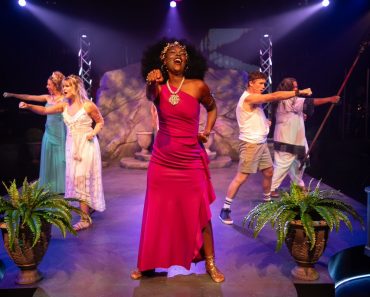
Outside of the MSU world, Har has been interviewing with classical music stations in the UK and hopes to eventually take the project from streaming to the stage. That dream is not too far off, as one of the artists featured on the album, Laura Wachsmann, has already performed one of the opera’s scenes, Mountain Witch, in Australia.
Support student media!
Please consider donating to The State News and help fund the future of journalism.
Discussion
Share and discuss “After nine years, MSU professor releases Greek-inspired opera project ” on social media.