
On Sunday, June 14, an event was held at the Pan-Macedonian Association of Melbourne and Victoria building, in collaboration with the Macedonian Citizens’ Association of Melbourne and Victoria. An evening dedicated to rebetiko singing, which filled the space with history, memory and Greek emotion.
The keynote speaker was the Vice President of the Pan-Macedonian Association, Victoria Papazoglou, who presented an analytical and highly documented historical review of rebetiko from the mid-19th century onwards.
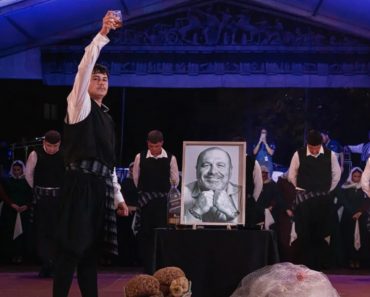
The event was accompanied by a dance group led by Christos Konstantinidis, while Elias Hatziemmanouil and Dean Georgalas participated musically, offering a lively traditional program that kept the interest of those present undiminished.
As Papazoglou explained, rebetiko – as an urban folk song – seems to have been born in a multicultural environment, centred in Izmir, where a particular musical style took shape around the middle of the 19th century. A style that carries influences from East and West, with European-style mandolins as well as orchestras with violins, santouria, outia, and political lyres.

The songs of this period spread rapidly throughout all Greek centres of the time. Important centres of development were Constantinople, Thessaloniki, Alexandria, but also the Greek communities of America, where valuable early recordings from the early 20th century have been recorded.
The movement of musicians from Smyrna and Constantinople to the urban centres of the Greek state also played a decisive role in the spread of the genre. These musicians performed in coffee houses, in the so-called cafe-amans, but also in madrasas and open-air stages, winning over the audience with a sound that brought with it the entire East. Cafe-amans experienced a particular flourishing in Athens at the end of the 19th century, peaking in the period 1886–1896. The term “amanes” came from the frequently repeated word “aman”, which in Turkish means “mercy”.

Ports were natural stations for the movement and development of rebetiko: Ermoupolis, Piraeus, Kavala and Heraklion in Crete were important centres where the genre took root and evolved. After the Asia Minor Catastrophe of 1922, the arrival of refugees—many of whom were great musicians—in combination with local artists, definitively shaped rebetiko as we know it today.
She also noted that the term “rebetiko” became popular relatively late, compared to other designations such as “mágiko” or “mortiko.” The word first appears on record labels around 1935, while the terms “rebetis” and “rebetiko” were gradually established during that period.

Referring to 19th-century literature, she emphasized that the realist writers of the time often described the marginal life of cities, using characteristic terms such as “mangas”, “alanis”, “mortis” and “vlamis”, without the term “rebetis” as we know it today having yet been formed.
Special mention was also made of the subject matter of rebetiko songs, which is extremely rich: romantic, humorous, professional songs, songs with female names, but also songs that touch on difficult social aspects, such as the world of drugs or historical events of World War II and the Civil War.
From the late 1970s onwards, rebetiko experienced a significant revival, gaining wider recognition and becoming the subject of study by sociologists, historians and musicologists.
As stated, rebetiko is not just music; it is a unified triptych of speech, music and movement, where song, sound and dance coexist as a living tradition transmitted from generation to generation. It is characteristic that Markos Vamvakaris never presented a new song without first “trying it out on the feet” of a good dancer.
Today, rebetika continue to be a valuable field of historical, sociological and ethnomusicological research, as it captures not only a musical idiom, but also an entire way of life, with its values, contradictions and memories.
Closing the event, the Association’s President expressed his pride in the Association’s contribution to the preservation and promotion of Greek culture. He emphasised that rebetiko is an integral part of Greek identity, deeply rooted in the soul of Hellenism, beloved by both Macedonians and Greeks around the world, underlining the importance of the ongoing effort to preserve this cultural heritage among Greeks abroad.