
It seemed as though everyone had Dolly Parton on their mind. Walking into The Greek Theater on August 25, 2026, before the opening act, a large black-and-white photo of Dolly with big hair, big hoops and warm blue eyes was displayed on the screen. The text read simply: “Dolly Parton 1946–2026.” Staying at work after hearing the news earlier that day had felt entirely wrong. Being at a Tori Amos concert surrounded by like-minded people, however, felt right. The crowd leaned older and was pretty chill. Most dressed in comfortable, whimsical attire and some fans wore Dolly t-shirts in quiet tribute.
After the first song, in a sad tone, Amos addressed the collective grief hanging over the venue. “Before I go too much further, I think we just need to take a second to honor the great Dolly… the great Dolly Parton, who’s affected so many people all over the world and done such good for humanity,” she told the crowd. “May she be blessed as she just twinkles in the sky tonight. All the love from all of us.”
Honoring Dolly’s passing set an emotional, deeply reflective tone for the rest of the night, beautifully underscored by her next performance: “Shush” off her album, In Times of Dragons. Amos performed while embodying the metaphorical half-dragon, half-woman themes of the track. Since she changes up her setlist every night, it was fun to try and guess what song was coming next. Fans would turn around to each other and shout out the titles the second they figured them out. The setlist masterfully bridged the eras of our lives, weaving newer material with classics like “Crucify,” “Silent All These Years” and “Little Earthquakes.”
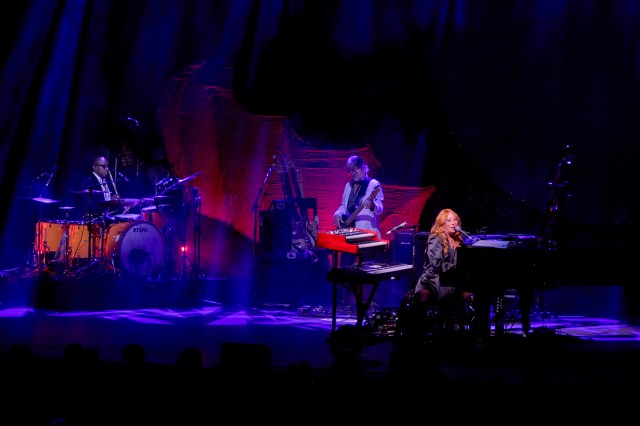
“Little Amsterdam” was fierce, with Amos bursting with emotion. The song title functions as a dark metaphor for a closed-off, corrupt micro-society where illicit deals, compromises and violence are buried, only to eventually “shut down” through tragedy. Musically, Amos went back and forth between her Nord keyboard in her stack with an electronic synthesizer, and her Bösendorfer grand piano. In between transitions, she would occasionally bang her fallboard to make a sharp, percussive exclamation point.
Hearing these songs, I felt a wave of nostalgia for a younger life once full of mystery and possibilities. Before the mindfulness era came, it felt like music was our singular space to feel and relate. In a stream-of-consciousness, emotionally vulnerable way, Amos sang about trauma, breaking patterns, and elusive truths. That raw honesty is exactly why Amos holds such a sacred space for her listeners.
My friend Linda Strawberry perfectly captured this lifelong impact, noting: “Tori Amos gave me permission through her honesty and her artistry to admit to myself how I really felt about life, sex, religion, etc. As a young artist, I became more honest with my true feelings and expression. She impacted the way I write lyrics- the way I play piano more freely and helped me be unapologetic about my wild free nature. I remember being a young teen conflicted about my emotions and my thoughts in a very conservative society when I saw her play ‘Icicle’ on TV and I was like wait—- where did SHE come from? I want to be that free. Where do the people like her live?- I think I need to go there.:)”
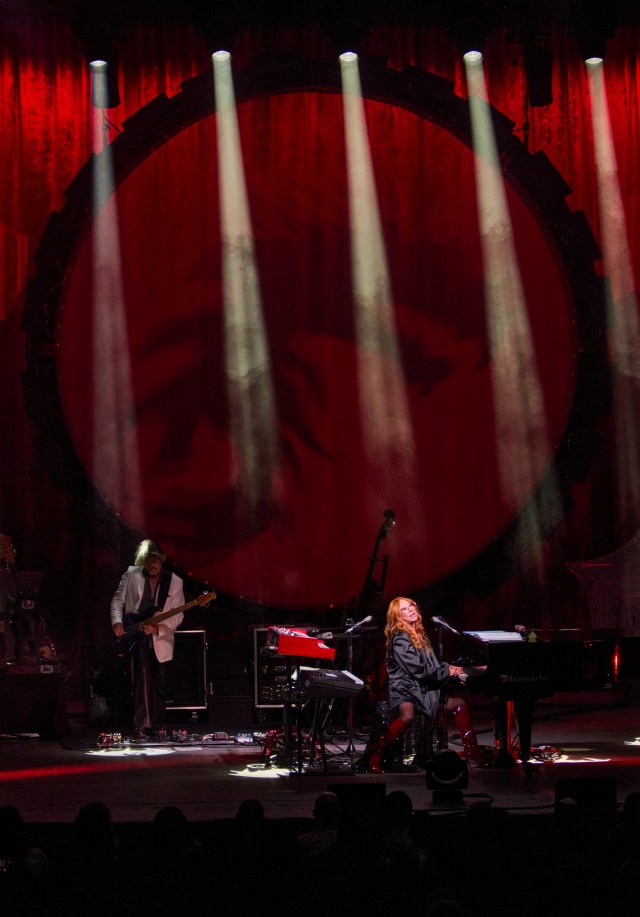
The stage production was moody, featuring a dragon visual at times inside the glowing circle behind her piano. Amos uses this imagery to represent a painful but powerful process of self-acceptance during major milestones. It is a multi-layered metaphor for major personal or bodily thresholds…whether it is a girl entering womanhood, gender identity exploration, or a woman navigating the complexities of menopause. Now, as the mother of a 12-year-old daughter, and as someone in my mid-forties navigating the uncharted waters of perimenopause, I can relate to her in an entirely new way. The brain fog is real!
Last year, video clips circulated of Amos performing “Josephine” and forgetting the lyrics. Instead of apologizing, she leaned into a brilliant “menopausal mind” jam, speaking openly and honestly about aging. In doing so, she gave her audience permission to do the exact same. At this Los Angeles show, her lyrics remained intact, but the performance was beautifully unvarnished. Her voice sounded hoarse at times, and with all of her bouncing up and down, shaking her head back and forth vigorously, and flinging her hair around, her glasses flew off mid-song during “Pandora’s Aquarium.” Touring musician and composer Jon Evans smiled and grabbed them for her; Amos smiled back at the audience and just kept playing. This was a perfect micro-moment of the chaotic, beautiful freedom that a Tori Amos show thrives on.
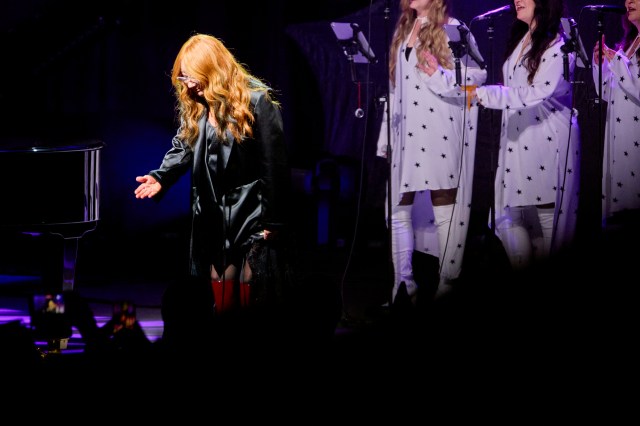
Due to hormonal changes, Amos’s vocal range has permanently shifted to a lower register, but she hired three amazing backup singers to carry the harmonies and nail the high notes. Word from her manager is that these singers are always laughing backstage, and that joyful energy carried onto the stage. Their rich harmonies, paired with the striking lighting and the smoky atmosphere, all contributed to a deeply mesmerizing vibe. It felt like a shared, meditative space where the music could breathe. Most of the crowd stayed in their seats, seemingly relaxed and in a trance. A few stood up occasionally with their hands in the air, swaying back and forth slowly.
I’m so glad we stayed for the full two-hour set. She ended the night with “Precious Things.” The circle behind her sparkled as the lights danced around the venue. Walking away, the grief of losing an icon like Dolly felt balanced by the immense gratitude of still having Tori. Decades later, she is still teaching us how to grow older without losing our wild, unapologetic edge.

September 2026 — $12.99