
Over the weekend, our family came together to celebrate two special milestones-my daughter’s 30th birthday and my own 60th (plus one). It was a wonderful evening surrounded by family and lifelong friends, but what made it truly unforgettable wasn’t the cake or the speeches. It was the music.
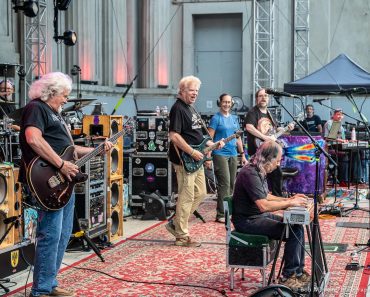
Without me knowing, my son had organised a surprise seven-piece Greek band and invited several of my old bandmates to join us. For a few hours, it felt as though time had stood still. Then came the moment none of us will ever forget.
My 92-year-old father stepped onto the dance floor as the band struck the opening notes of an old-school zeibekiko. Plates were smashed, flowers filled the air, family and friends clapped in rhythm, and for those few precious minutes, he wasn’t a 92-year-old grandfather. He was young again.

The smile on his face said everything. It was as though the music had transported him back to his youth, to another time and another Melbourne. Watching him dance made me realise something profound. Music doesn’t simply bring back memories-it brings back people, emotions and entire chapters of our lives.
As I watched my father, I found myself thinking about the Melbourne many of us were fortunate enough to experience during the 1980s. It also made me wonder whether today’s Greek community has lost something that once brought us all together.
Our story didn’t begin in the 1980s
It began with our parents and grandparents who migrated from Greece in the years following the Second World War. They left behind villages, islands and families with little more than hope for a better future. They worked tirelessly in factories, on construction sites, in cafés, milk bars and small businesses. They made enormous sacrifices so that their children could enjoy opportunities they never had. In doing so, they built one of the largest and most vibrant Greek communities anywhere outside Greece.
There were no mobile phones. No social media. No one is filming every moment for strangers online. People looked each other in the eye. They laughed together. They danced together. They belonged.
By the time the 1980s arrived, we were the generation fortunate enough to enjoy the rewards of those sacrifices. Greek schools flourished. Churches became the centre of community life. Sporting clubs, social organisations and businesses prospered. Melbourne had become a city where you could proudly be both Greek and Australian.
Nothing reflected that success more than our nightlife
Every week had its own rhythm. It often started on Monday nights at Billboards, before moving through venues like Lazars, Madisons, Chevron, Inflation, Fame, The Boulevard, Nottis, Spaghetti Graffiti, and so many others. Lygon Street was alive, with GTs cruising up and down the strip, music pouring from car windows and friends gathering before deciding where the night would take them. Then there were the hardcore Greek nightclubs.

From Monday through to Sunday, from around 10 pm until 5 am or 6 am the following morning, venues such as Neraida, Dilina, Copacabana, Asteria, Athinea, Diogenis, Cosmopolitan, Minore and many more became the beating heart of Greek Melbourne. These weren’t simply clubs. They were institutions.
Every night was a celebration
You walked through the doors and immediately heard the unmistakable sound of the bouzouki. Every table was occupied, every dance floor was alive, and everywhere you looked, there was someone you knew-or someone who knew your family. One moment the room would fall silent as someone danced an emotional zeibekiko. Next, dozens of people would join in.
There were no mobile phones. No social media. No one is filming every moment for strangers online. People looked each other in the eye. They laughed together. They danced together. They belonged.
For many of us, those clubs were where lifelong friendships were formed, where husbands met wives, where business relationships began and where an entire community celebrated life together.
For those of us who were musicians, however, those years meant something even more.
The nightclub circuit was our classroom. It was a school of hard knocks.

As a young bouzouki player and drummer, there were no online tutorials, no music academies teaching you how to survive a seven-hour Greek nightclub performance. You learned on the bandstand. Older musicians weren’t interested in hearing how good you thought you were. There wasn’t this attitude of, “I’m better than you.”
Music always came first
If someone suddenly called a rebetiko, you jumped straight in. You listened carefully, watched the experienced players, found the rhythm and trusted your instincts. You either kept up or you learned very quickly how to.
That was how respect was earned. Not through ego. Through humility, teamwork and showing up every night ready to play.
Looking back now, Melbourne was blessed with an extraordinary generation of musicians. Night after night they filled clubs across the city with music that connected us to our heritage while creating something uniquely Melbourne.
Some of those wonderful musicians have sadly passed on. Others are thankfully still with us, carrying memories of those remarkable years. Whether they are still performing or have long since left the stage, none of them should ever be forgotten. They weren’t simply entertainers. They were custodians of our culture, providing the soundtrack to our youth and helping preserve our identity for future generations.
Then, everything changed
As the years rolled into the 2000s, many of those iconic venues disappeared. Live bands became fewer. Technology changed the way we socialise. Streaming replaced live performances, and social media replaced the conversations that once filled those tables until dawn.
The Greek community remains strong, and there are still talented musicians proudly keeping our traditions alive. Festivals continue to bring us together and celebrate our heritage.
But those of us who lived through the 1980s know something difficult to explain. You can reopen a venue. You can hire a band.You can play the same songs. But you cannot recreate that era.

It wasn’t simply about the clubs or the music. It was about a generation of post-war migrants and their Australian-born children coming together to celebrate family, friendship and culture. It was a community at its cultural peak, united by music and by a sense of belonging that is increasingly difficult to find. That’s why those memories remain vivid.
This is my story, but I know it is also the story of thousands of Greek Australians who lived through those unforgettable years. The photographs that accompany this article are more than old images. They are reminders of an era that shaped us. They capture the faces, the musicians, the packed dance floors and the friendships that defined a generation.
For those of us who were there, they bring back memories that words can barely describe. For our children and grandchildren, they offer a glimpse into a remarkable chapter of Greek Melbourne that they never had the opportunity to experience.
Perhaps that is the real question for our community today.
The answer isn’t to recreate the 1980s. We can’t. Every generation writes its own story, and every era has its own soundtrack. But we can remember what made those years so extraordinary.
It wasn’t the buildings. It wasn’t the neon lights or the dance floors. It wasn’t even the nightclubs themselves. It was the people.
It was our parents who came to Australia after World War II with little more than hope and built a community that became one of the strongest Greek communities outside Greece. It was the musicians who played night after night, giving that community its heartbeat. And it was the thousands of ordinary people who filled those clubs, forged lifelong friendships, fell in love, celebrated life’s milestones and kept our culture alive through music.
That spirit of connection is the true legacy of the golden era
If there is one lesson those years leave us, it is that communities flourish when people come together – not just for festivals or special occasions, but simply to share each other’s company, stories and traditions.
Our children may never experience the Melbourne that we knew, where Greek music echoed until sunrise and every week felt like a celebration of who we were. But perhaps they can inherit something even more important: the same sense of belonging, pride and community that our parents built and our generation was fortunate enough to live.
Because if we lose that spirit, we lose far more than memories of a few famous nightclubs. We lose a part of ourselves. And that is something worth holding on to.