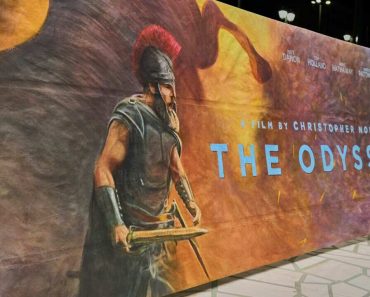

Christopher Nolan’s The Odyssey brings one of the oldest stories ever told back to the big screen. With its cast of legendary heroes, gods and monsters, the movie raises the question: how much of what it depicts is true to history?
The answer is more nuanced than a straightforward yes or no.
Though the adventures of Odysseus – portrayed in Nolan’s movie by Matt Damon – belong firmly to the world of myth, many of the people, places and political realities that underpin Homer’s epic have deep, authentic roots in Late Bronze Age Greece.
Below, we examine the historical and archaeological evidence, separate fact from myth, and reveal the extent to which Nolan’s blockbuster departs from the source material.
Warning: this article contains spoilers for the new Christopher Nolan movie
Is The Odyssey based on real history?
Taken literally, neither Homer’s Odyssey nor Nolan’s adaptation is based on a true story. No evidence has been found to suggest that a Greek king spent 10 years sailing home from Troy – let alone while battling cyclopes, sirens, witches and sea monsters.
But dismissing it as mere myth misses something important about the story’s historicity.
Many historians now see epics including the Odyssey as examples of cultural memory: stories that preserve fragments of genuine historical episodes long after the events themselves passed into legend. Even before the invention of written storytelling, oral traditions proved remarkably durable. In societies without widespread literacy, memories of important people, wars and migrations were passed down through generations of professional storytellers. Details changed with every retelling, but the historical core could survive.
This process is well documented elsewhere. The Icelandic sagas preserve memories of Viking settlements from centuries before they were written down; indeed, the Old Norse word saga means literally ‘what is said’. Early Irish literature contains echoes of Iron Age society despite being recorded in the medieval period. The Native American Klamath story, which tells of a fiery battle between gods that destroyed a huge mountain and created the cavity on Mount Mazama now filled by Crater Lake, may preserve a cultural memory of a real eruption 7,700 years ago. These are just a few examples demonstrating how oral traditions can transmit elements of major events across countless generations.

The same may be true of Homer’s epic poems, with archaeological evidence strengthening this interpretation. During the 19th century, many scholars regarded the Trojan War itself as entirely mythical – until German archaeologist Heinrich Schliemann excavated the site of what’s believed to have been Troy in modern-day Turkey. Though Schliemann’s methods were deeply flawed, later excavations confirmed that a major fortified city stood there during the Late Bronze Age and suffered repeated destruction.
Whether Homer’s account of the Trojan War reflects one historical conflict or is an amalgam of several remains uncertain. What is increasingly clear, though, is that he was drawing upon memories of a civilisation that had flourished centuries before his own lifetime.
That’s not to say that any specific event depicted in the Odyssey actually happened. But it is plausible that the story is woven around a historical core.
When was Homer’s Odyssey written?
The ancient Greek Odyssey was probably written during the late eighth or early seventh century BC, around four centuries after the collapse of the Mycenaean civilisation that forms its backdrop.
Modern scholars continue to debate whether Homer, the bard to whom the Odyssey is traditionally attributed, was a single poet, several poets, or merely the name later attached to a long oral tradition.
Before the Greek alphabet was adopted from the Phoenicians during the eighth century BC, stories were transmitted orally by singers known as aoidoi. These memorised and recited enormous bodies of verse using recurring formulae, repeated epithets and familiar narrative patterns that made long performances possible.
Homer’s Odyssey combines genuine memories of the Mycenaean world with the concerns of his own age. The political landscape of numerous small realms ruled by local kings described in the poem broadly resembles what archaeology has revealed about Late Bronze Age Greece.
Was Odysseus a real person?
There is no single character in the Odyssey who can be said with any certainty to have existed as a historical figure. But that doesn’t mean they don’t contain any seeds of historical truth.
Odysseus himself was almost certainly not a historical individual whose life can be reconstructed. No contemporary records mention him, and his adventures are unmistakably mythical. Nevertheless, he may represent an amalgam of one or more Mycenaean rulers whose achievements gradually merged through centuries of oral storytelling to shape the figure of a single legendary king.
Similarly, Odysseus’s wife, Penelope – portrayed in Nolan’s movie by Anne Hathaway – is unlikely to represent one specific historical queen. But, through her, Homer reflects the genuine political importance of royal women, dynastic marriage and household management within Bronze Age kingdoms.

What about the other characters in the story?
Other major figures depicted in both Nolan’s movie and Homer’s poem are more or less historically credible.
Helen of Troy (Lupita Nyong’o), whose kidnapping triggers the Trojan War, almost certainly owes more to legend than to biography, but her story may preserve distant memories of aristocratic marriage alliances between powerful Bronze Age kingdoms.
Agamemnon (Benny Safdie) is more perplexing. As the supreme leader of the Greek expedition against Troy, he may reflect one or more powerful rulers of the age, although no evidence identifies him with a specific king. Helen’s husband, Agamemnon’s brother Menelaus (Jon Bernthal), occupies similar ground: a legendary hero who may preserve echoes of genuine Bronze Age elites without being historical individuals.
Taken together, these characters are best understood not as historical biographies but as literary composites preserving real social roles, political institutions and distant memories of people who once lived.
What are the key differences in Christopher Nolan’s movie?
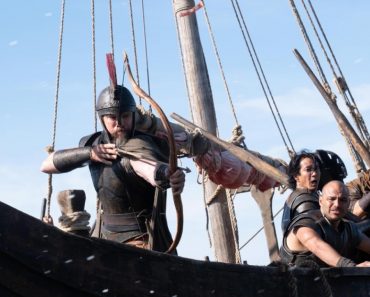
Even before its release, Nolan’s adaptation attracted criticism from some historians and online commentators. Much of the debate centred on casting decisions and modern-sounding dialogue revealed in the movie’s trailers, as well as aspects of costume and production design. Others even questioned whether the architecture resembled that of classical Greece more closely than the Mycenaean world.
But even if the movie’s stylistic choices deviate from the archaeological record, the spine of Homer’s poem remains intact. More than 10 years after leaving Ithaca to fight in the Trojan War, Odysseus is still trying to get home following the end of that conflict, encountering all manner of obstacles and enemies on the way. And, as in Homer’s text, he ends up stranded on the island of Ogygia as a captive of the nymph Calypso (played by Charlize Theron).
In fact, Nolan’s adaptation introduces many of the central characters within its first 15 minutes, in a flurry of timeline-hopping that not only depicts Odysseus’s departure for Troy and the aftermath of the war but also the events that have unfolded in Ithaca during his long absence. His palace is now filled with arrogant suitors hoping to marry his wife, Penelope, while his adult son, Telemachus (Tom Holland), is eager to set sail and seek news of his father’s whereabouts.
That said, Nolan frequently departs from Homer, combining numerous themes and motifs into single scenes. Whereas in Homer’s poem Odysseus and his crew encounter an island of lotus-eaters whose consumption of the fruit causes them to live in a state of forgetfulness, the movie instead has Calypso feeding lotus petals to Odysseus himself.

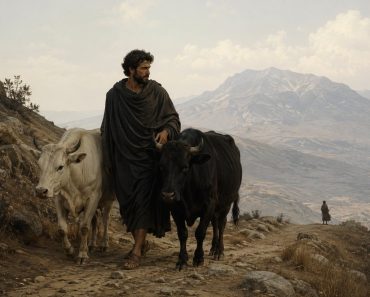
Similarly, in both Homer’s and Nolan’s takes, when Odysseus finally returns to Ithaca he is reunited with his loyal swineherd Eumaeus (John Leguizamo) and his dying canine companion, Argos. But in the new movie, Odysseus is also on hand to stop Telemachus from being murdered, killing the would-be assassins in a temple dedicated to the goddess Athena.
More minor plot points are tweaked in the movie, too. Odysseus proves his identity to Penelope not by demonstrating knowledge of the olive tree that forms their marital bed, but from the moment he triumphs in the archery contest she has set for the suitors. The man-eating cyclops Polyphemus (Bill Irwin) is maimed not only with a burning-hot stake but also by an arrow that Odysseus looses into his eye. The witch Circe (Samantha Morton) does transform Odysseus’s men into pigs, but she does not become the hero’s lover.
Which characters have been added to Nolan’s adaptation of The Odyssey? And who is absent?
Though Nolan’s epic clocks in at a hefty 2 hours and 52 minutes, it would have been a tall order to depict every single character from Homer’s poem. The messenger god Hermes, for example, does not descend from the heavens to deliver Zeus’s commands, while the spirits of Odysseus’s mother, Anticleia, and the fallen warriors Achilles and Ajax do not emerge when the hero travels to the underworld to consult the blind prophet Tiresias.

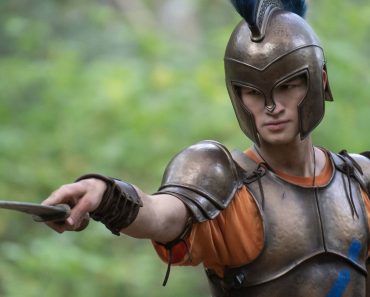
Conversely, Nolan introduces characters who are absent from Homer’s poem. Despite rumours suggesting that he had been cast as Achilles, the Canadian actor Elliot Page stars as a warrior named Sinon who, as told in flashbacks at the beginning of the movie, convinces the people of Troy to take into their city the wooden horse in which Greek soldiers are hidden.
Although his screen time is brief, Page’s character plays an important role in the story. During an underworld sequence, the spirit of Sinon emerges to scold Odysseus for leaving him to be killed by the Trojans, and to implore him to exact revenge on Antinous (Robert Pattinson), who betrayed Sinon as a child. Later, when Odysseus finally returns to Ithaca disguised as a beggar, he adopts the name ‘Sinon’ as part of his deception.
Did Odysseus’s kingdom of Ithaca really exist?
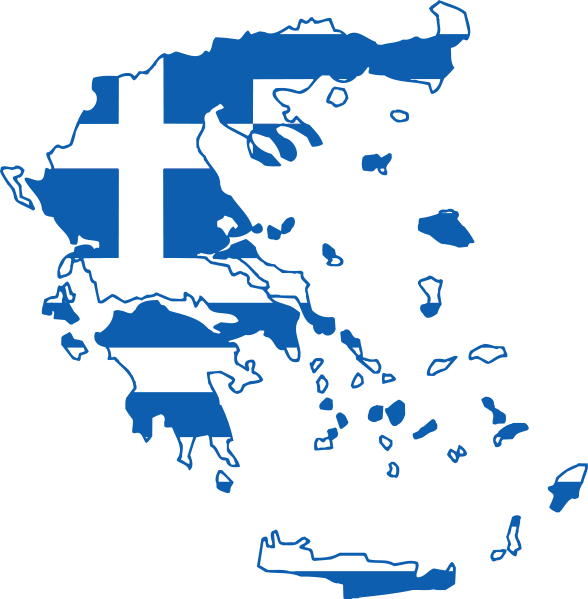
Yes. Unlike many mythical locations in Greek legend, Ithaca is a real island in the Ionian Sea that remains inhabited today.
Archaeological research has confirmed that Ithaca supported substantial settlements throughout the Late Bronze Age. Excavations at several sites have uncovered Mycenaean buildings, pottery, tombs and imported goods dating to the period traditionally associated with the Trojan War. None of these sites can be identified as Odysseus’s palace, though.
Excavations at the so-called School of Homer near the village of Stavros on Ithaca found a significant Mycenaean complex that some archaeologists believe could have formed part of a regional administrative centre. Other experts remain unconvinced, arguing that the evidence is insufficient to identify it as a royal palace.

The wider political landscape described by Homer is, though, broadly plausible. During the Late Bronze Age, Greece consisted of numerous relatively small kingdoms centred on fortified palaces such as Mycenae, Pylos, Tiryns and Thebes. A ruler controlling Ithaca and neighbouring islands would fit comfortably within this wider Mycenaean world.
How is the Trojan Horse depicted in Nolan’s movie?
The story of the Trojan Horse is among the most famous tales in all Greek literature, and inspires a suitable high-octane sequence in Nolan’s adaptation. After convincing the Trojans that they have abandoned their 10-year siege, the Greeks leave a large wooden horse outside the gates of Troy, which its inhabitants then move inside the city walls. After nightfall, Odysseus and his men emerge from the belly of the horse and open the gates, enabling Agamemnon and the returning Greek army to overrun Troy and slaughter its citizens.
In the movie, we see the tale unfold as a flashback, with the events relayed to Telemachus by King Menelaus, Agamemnon’s brother and the husband of Helen, whose abduction instigated the conflict years previously. But aside from introducing Sinon’s role in the deception, the differences in Nolan’s adaptation are mostly visual. Rather than being mounted on wheels and left outside the city gates, the Trojans find the horse half-buried on the shore and drag it up the beach on wooden rollers.
It is worth mentioning that the story of the Trojan Horse merits only a brief mention in Homer’s text, though is described in greater detail in Virgil’s Aeneid. By showing the deception and its brutal impact on screen, Nolan conveys the devastating effects of war on those involved. While some of his fellow soldiers boast of their victory over the Trojans, Odysseus struggles to come to terms with his role in the slaughter. Likewise, when Telemachus is introduced to Helen many years later, the beauty whose face “launched a thousand ships” is shown to be psychologically – as well as physically – scarred.

The Greeks’ brutality also sets up one of the film’s biggest revelations. Throughout the story, references are made to a mysterious group known as the ‘Sea People’, whose repeated violent attacks have spread fear across the known world. In studies of ancient history, ‘Sea Peoples’ is a term given to a loose confederation of seafaring tribes whose raids in the eastern Mediterranean are hypothesised to have contributed to the Late Bronze Age collapse. In Nolan’s adaptation, it is implied that the Sea People are the Greeks themselves.
Overall, how historically accurate is the Odyssey?
Both Homer’s poem and Christopher Nolan’s movie occupy an unusual space between history and mythology.
The broad political and cultural context – the network of Mycenaean kingdoms, the importance of kingship, palace economies, dynastic succession, long-distance seafaring and aristocratic warfare – is well attested to by archaeology.
Likewise, the social customs that dominate the story, including hospitality (xenia), gift exchange and household honour, reflect values that did indeed shape ancient Greek society. In Nolan’s adaptation, Odysseus frequently urges his men to uphold ‘Zeus’s law’ – to treat others how you would like to be treated – but is left racked with guilt when he fails to abide by this moral code himself.
At the same time, neither Homer nor Nolan has attempted to produce a documentary reconstruction of the Late Bronze Age. Homer freely combines details from different historical periods, while the supernatural elements of the story belong entirely to myth.
Yet both storytellers have created narratives that provide eye-opening insights into the eastern Mediterranean world of the Late Bronze Age.
Don’t miss our upcoming podcast series exploring the history of Homer’s Odyssey, featuring award-winning classicist and author Daisy Dunn. HistoryExtra members can listen to all four episodes from Sunday 19 July.