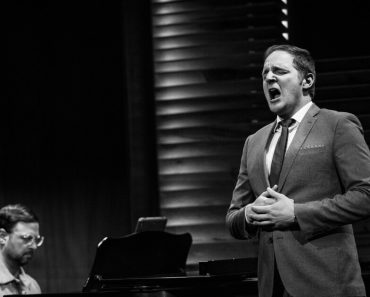

Georg Danek and Stefan Hagel have worked out a way to sing Homer, and Open Culture has their recording. Danek teaches at the University of Vienna and Hagel is at the Austrian Academy of Sciences. What they recorded is lines 267 to 366 of book 8 of the Odyssey, the passage where the bard Demodocus sings about the love of Ares and Aphrodite.
The epics were sung long before anyone wrote them down. A poet performing at a festival or in a city leader’s court could make up the tale on the spot as long as he knew the plot, fitting it to the six-beat meter of Greek verse and accompanying himself on a phorminx, a four-stringed instrument in the lyre family. Danek and Hagel say the bard invented the melody and the words together, so no performance repeated another.
The recording is “not to be understood as the exact reconstruction of a given melody,” they write, “but as an approach to the technique the Homeric singers used to accommodate melodic principles to the demands of the individual verse.” Their own site carries the abstract along with the musicological and linguistic evidence behind it.
Previously:
• For centuries, a cracked Egyptian statue sang at dawn
• Dirty translation of the Iliad, 1797