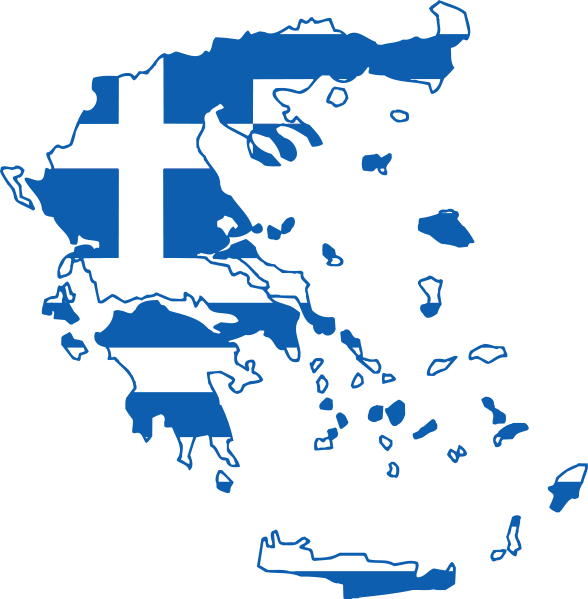

Hellenike Glossa, or Greek language, as the article’s title states, goes past the surface of Western thought. This ancient but living tongue provides the how across many different aspects. These include art, politics, science, language, and philosophy. Great Greek thinkers, writers, and mathematicians pioneered specific and systematic ways. These developed into templates (scientific method) that enriched Western thought.
The Power of Language
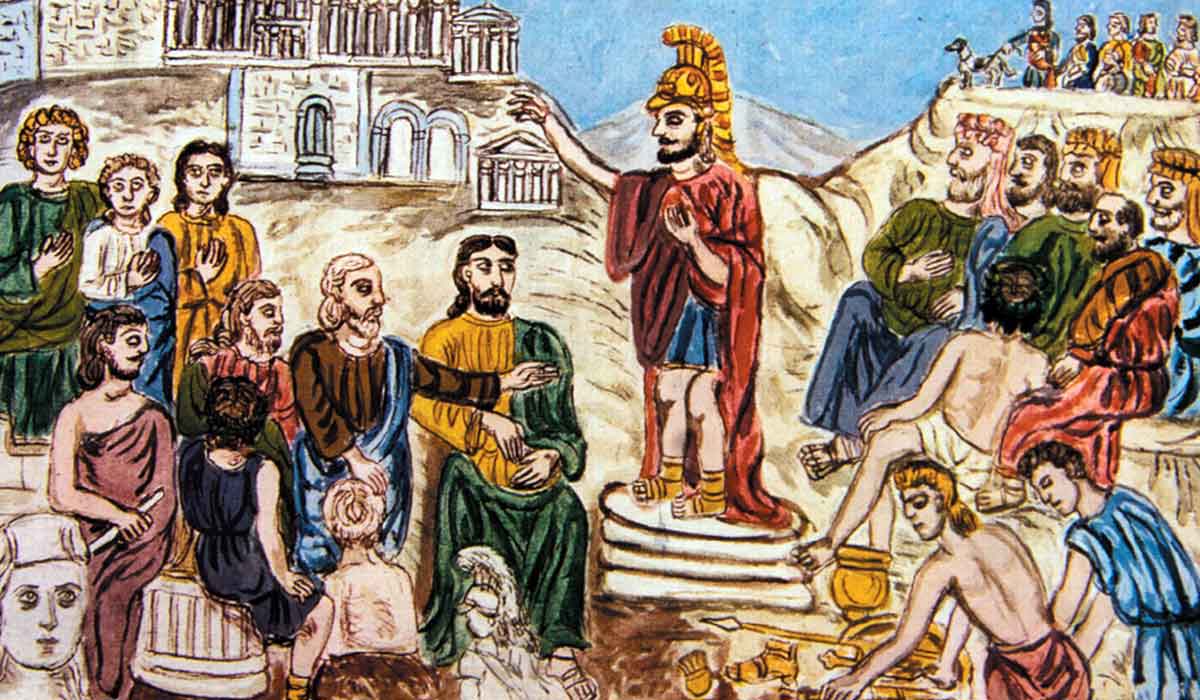
While language is used for communication, its uses are much greater. The Ancient Greeks saw this and created words that interpreted the abstract. Many common modern words have Greek roots, such as democracy, logos, and ethos. These represented ideas in morality, philosophy, politics, and science. Much debate and learning would result from using Ancient Greek.
The Greeks took words to a different level. Like building blocks, the words they developed became an outline for viewing the world. Even when written in Greek, individuals understand what the word represents. The following two influential words demonstrate this.
- Demokratia: This term combines two words: Demos (the people) and kratos (power). This style of governance appeared in Athens. The common people made the decisions, opposed to a sovereign or a privileged few, for nearly two centuries.
- Ethos: This concept may be the most powerful in Ancient Greek. This word finds homes in civic life, philosophy, and rhetoric. Its original definition is habit, custom, or character. To ancient Greeks, ethos defined how one should live and be virtuous. A descendant term is ethics, meaning moral principles people live by.
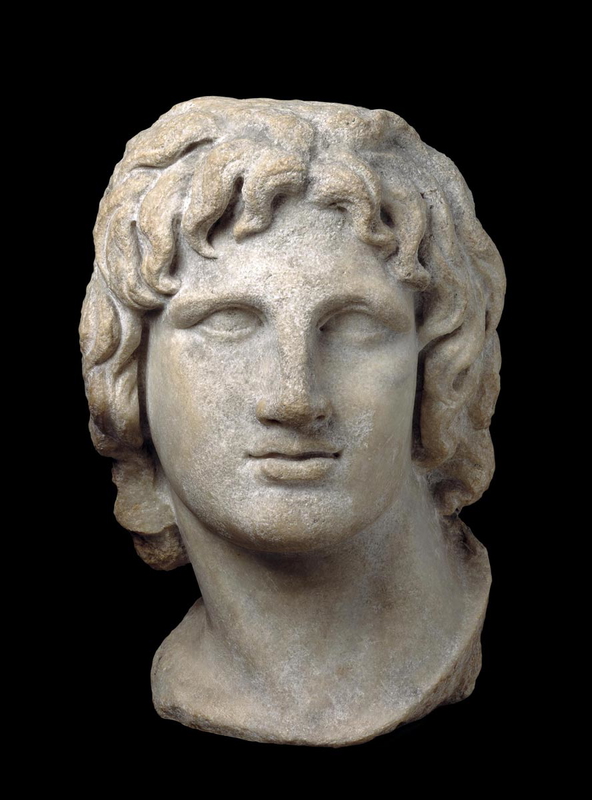
The primary vehicle for spreading these revolutionary concepts inadvertently landed on Alexander the Great. His conquests spread Greek across the Near East and Mediterranean.
Greek soon became a lingua franca. A simplified version, Koine Greek, emerged in the Hellenistic world, enabling easier understanding of Classical Greek. This also meant a diffusion of Greek concepts that has lasted centuries.
Looking at Philosophy and Logic
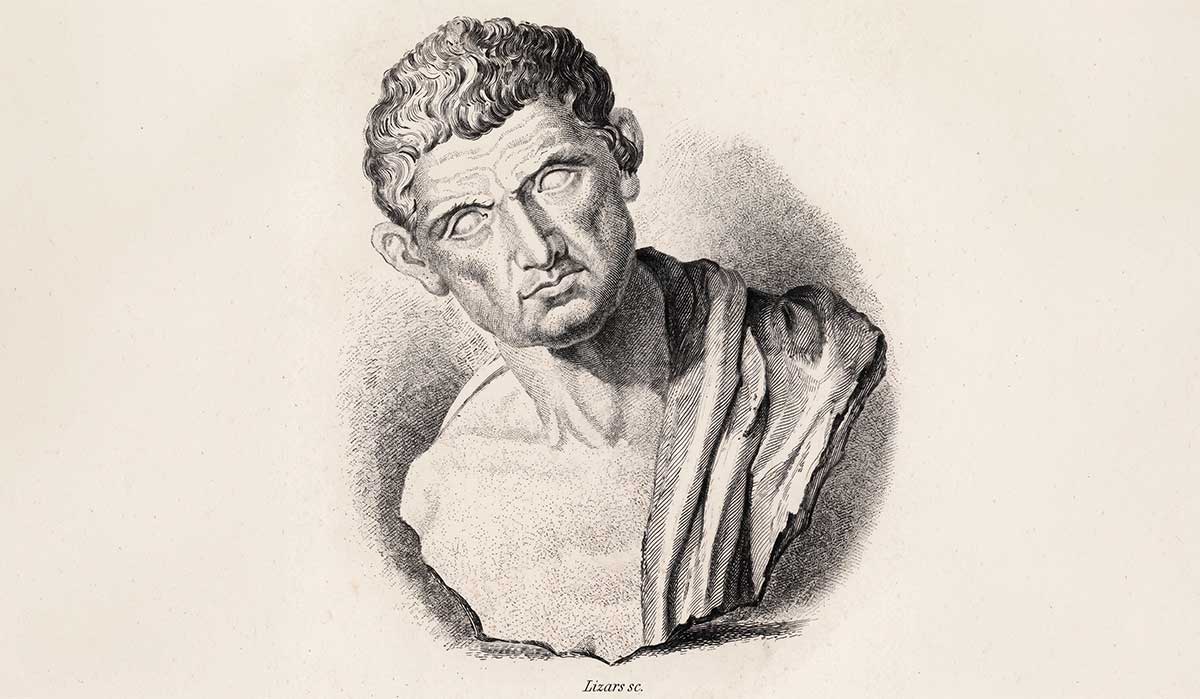
With a very intuitive language established, Greek creativity took off. Philosophers like Plato and Aristotle developed influential, long-lasting disciplines. Aristotle (c. 384 BCE) focused his thoughts on science, logic, and politics. He formalized logic, observation, and even government classification. From Aristotle’s empirical observations came the scientific method. He also categorized the three forms of government: monarch, aristocracy, and polity. Even biology resulted from his careful observations, dissections, and classification.
A thinker like Plato (c. 427 BCE) also has endured. He founded the Academy, the first Western university, which then created a model emulated for millennia. Plato is best remembered for his Theory of Forms and The Republic. The former dwelled on metaphysics, proposing that ideals like beauty were more real than anything physical.
The latter changed political theory. The Republic explored justice, authority, and how education changed society. These philosophers, and others, used Greek to create completely original concepts.
Politics, Civic Life, Plus Science and Mathematics
Ancient Greece encouraged rhetoric and public speaking, a unique Greek aspect. With such an atmosphere present, Ancient Greek shaped these by providing the terminology. Words like rhetorike techne, ethos, or pathos appeared. Later, rhetoric would be a discipline unto itself.
In the legal sphere, Greek shaped its central vocabulary of law. These would be used to create tenets familiar to Westerners. These included the rule of law, equality before the law, and public accountability. These ideas, in turn, influenced Roman and Western law.
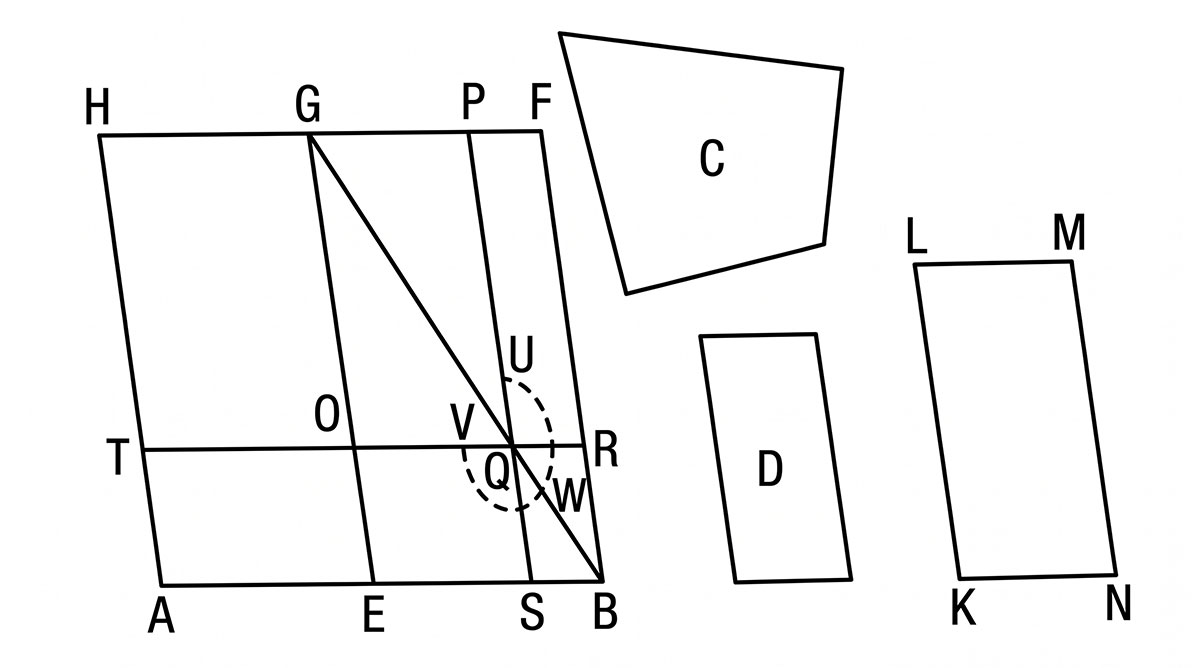
Ancient Greeks’ contributions to math and science also included technical vocabulary and knowledge. Familiar terms to many include mathematike, geometria, and astronomia. And, like rhetoric’s vocabulary, it enabled abstract thinking, leading to deductive proofs and more.
Euclid’s Elements, a thirteen-book mathematical treatise, built geometry and the like into complex math. All using Ancient Greek exactness.
Expressive Literature and Story Telling
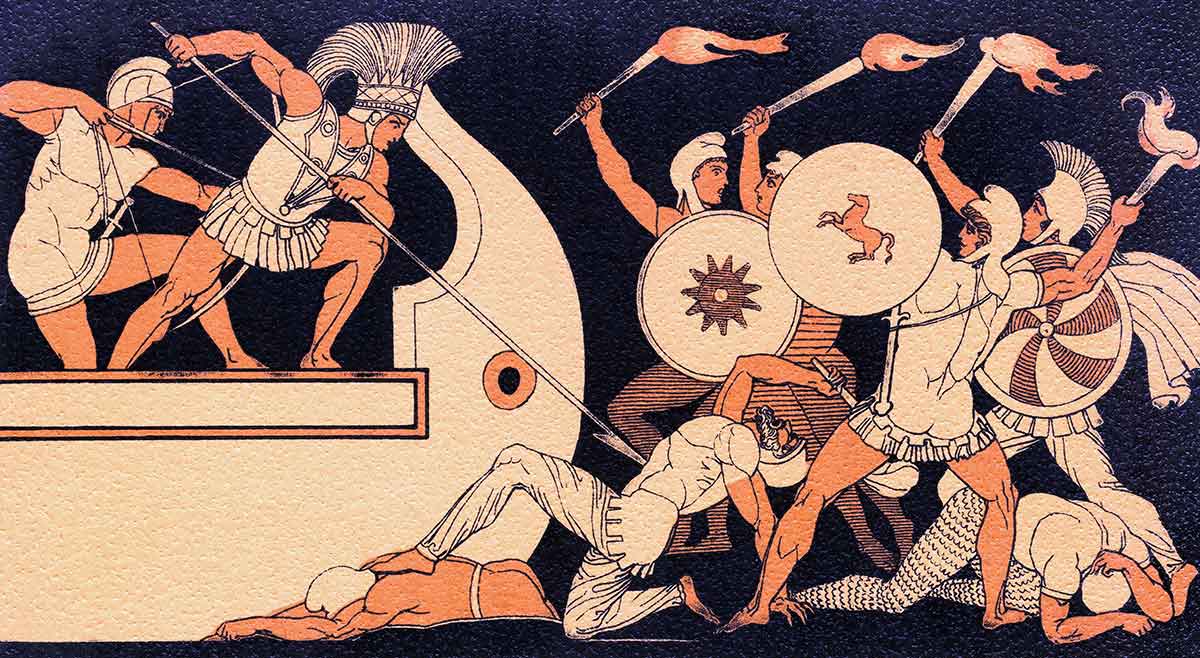
No article on the use of Ancient Greek can be written without mentioning Homer’s The Iliad. This epic poem is considered a masterful use of Ancient Greek’s flexible grammar and formulaic phrases. These traits let Homer create now well-known standards such as the hero’s journey, plus other themes.
Greek writers used to investigate subtle topics such as virtue, desire, and fate. As an inflected language, word endings decide the grammar, not word order. Combined with layered syntax, writers create forms that later Western theater inherited. Soon, future writers from Shakespeare to modern psychology, commentary, and narrative structure all feature Ancient Greek’s cleverness.
In short, Ancient Greek shaped Western thought and language. Adopted by the Romans, it spread across the West and became a foundation for Western reasoning and expression.