
There is something decidedly Cavafyesque about the spectacle of Victorian politicians assembling behind Parliament House to unveil a place intended to honour the contribution of the Greek community to this State, when the contribution selected took place in Athens some two and a half millennia before Victoria, Australia or, in any historically meaningful sense, Greek-Australia existed. Past and present are collapsed into each other until cultural descent begins to resemble historical participation and something inherited from antiquity becomes, almost imperceptibly, something we apparently accomplished here.
The distinction between inheritance and contribution is a significant one. Greek Australians can reasonably regard classical civilisation as part of the immense and often contradictory inheritance from which modern Greek identity has been fashioned. A contribution to Victoria is something else. It must arise from the encounter between Greeks and Victoria, from lives lived, institutions created, conflicts endured and changes wrought here. Democracy Place was expressly presented as recognition of such a contribution, yet its name commemorates an achievement for which no Greek-Victorian can plausibly claim responsibility.
The irony is compounded by the fact that the democracy bestowed upon us as an honour is already claimed by virtually the entire Western political tradition as part of its own inheritance. Parliament House itself belongs to a political culture that traces part of its democratic genealogy to ancient Greece. We are therefore being honoured with something the society “honouring” us already considers its own. Democracy belongs to everybody because it came from the Greeks and is then, for the purposes of multicultural commemoration, handed back to the Greeks as though it were peculiarly theirs.
Even the Premier’s generous proposition that democracy constitutes Greece’s greatest gift to the world warrants some qualification. The democracy invoked is principally Athenian, the product of a particular society whose political arrangements differed profoundly from modern representative democracy. Subsequent Greek history encompasses monarchy, empire, oligarchy, foreign rule, constitutional experimentation and dictatorship. To make democracy an essential attribute of Hellenism therefore requires one extraordinary moment to be extracted from a long and contradictory historical experience and allowed to speak for the whole.
The Premier’s further amusing suggestion that an ancient Greek god might eventually be placed upon the site is revealing for much the same reason. A space ostensibly dedicated to Greek Victorians immediately sends the commemorative imagination several millennia backwards in search of an unspecified deity capable of making it sufficiently “Greek.” If I were a classical scholar I would suggest a statue to the titular god of the cult of the eternal Epitimos Proedros, for that truly is a local, home-grown deity.
A counter-suggestion involving the erection of a likeness of St Paul addressing the Greeks recalls another formative strand of Greek historical experience and complicates the easy identification of Greekness with classical antiquity. Yet the exchange itself is wonderfully revealing. Pagan antiquity is answered with Christian antiquity, while Greek-Victoria remains conspicuous by its absence. One begins to wonder how far through the historical archive we must travel before a monument dedicated to Greek-Victorians finally encounters said Greek-Victorians themselves.
There is a reason classical democracy presents itself so readily. Western Europe progressively incorporated an idealised ancient Greece into its own civilisational ancestry, particularly with the emergence of bourgeois capitalist modernity. The paradox was that the West could claim the ancient Greeks as its forebears while treating living Greeks as uncertain heirs to a past it had already appropriated. Modern Greek nationalism embraced this classical genealogy in turn, and the diaspora inherited both its prestige and its contradictions.
Recognition, however, is also an exercise of power. Institutions inevitably influence which aspects of a culture become publicly visible and worthy of commemoration. Democracy Place thus illustrates how a complex community can become publicly understood through categories selected largely by those possessing the authority to recognise it.
Greek Australians have hardly been passive in this process. For migrants confronting prejudice and condescension, classical ancestry provided valuable cultural capital. The wog, factory hand or uncultivated foreigner could claim descent from the very civilisation the society patronising him had been taught to revere. There was dignity in that assertion and, under the circumstances, considerable strategic value as well.
Danger arises however, when this strategy hardens into a habit. A community repeatedly recognised through the greatness of its ancient past can become accustomed to approaching power through the forms of Greekness that power finds flattering: we are welcomed as the descendants of philosophers, democrats and the founders of Western civilisation, and learn to value recognition accordingly. Praise then begins to take the place of equality, while honours and affirmations make accommodation with prevailing structures easier to accept. There is something profoundly undemocratic in such a relationship. A democratic community engages power as an equal, capable of criticism, disagreement and demands upon it; it does not require power continually to assure it that it is ancient, exceptional and worthy before it feels recognised.
All of which makes the recourse to antiquity now unnecessary. Victoria has no shortage of Greek contributions of its own, although they possess considerably less marble about them. Greek migrants entered the labour movement and participated in struggles for workers whose language, migration status and economic vulnerability could leave them poorly represented. They entered politics, established welfare and charitable structures, created schools and cultural institutions and formed organisations through which newcomers negotiated an unfamiliar society. Slowly, unevenly and amid the arguments and schisms without which Greek communal life would scarcely be recognisable, survival acquired a civic dimension.
There is little purpose in replacing one consoling mythology with another and turning Greek migration into an uncomplicated progress from poverty to prosperity. Postwar Australian industry benefited enormously from migrant labour, while many of those providing it occupied positions of limited status and bargaining power, including people whose overseas qualifications counted for remarkably little. Exploitation was hardly confined to the Anglo-Australian employer either. Later prosperity can cast a flattering retrospective light over circumstances in which Greek migrants often occupied a distinctly subordinate position.
That subordination was sometimes reinforced from within the community itself. Greek communal institutions could be rigidly hierarchical, while established figures counselled migrants to remain deferential towards Australian authority, grateful for their acceptance and reluctant to challenge the social and political order around them. Those who rejected such expectations and sought to engage politically, challenge exclusion and demand equality could encounter considerable pressure and even repression. The struggle was therefore also over the place Greeks were entitled to claim in Australian society: whether they should remain compliant outsiders or participate as equals in shaping the society in which they lived.
It is the rejection of that marginality that belongs to the democratic history of Victoria. Greek Australians petitioned and challenged institutions, entered political and civic life and asserted a right to participate on equal terms. They now sit in parliaments, serve as ministers and councillors and participate throughout public life with a visibility that can appear unremarkable only because the struggles enabling it are receding from memory. Victoria’s institutions did not simply discover diversity. Rather, their transformation also reflects the efforts of those once kept at their margins to enter them and demand an equal voice.
This democratic engagement also extended to events in Greece itself. Greek Australians opposed the Metaxas dictatorship during the 1930s and, a generation later, organised against the military junta of 1967 to 1974, supporting resistance and campaigning for the restoration of democracy, while other sections of the diaspora supported or accommodated authoritarian rule. Both regimes invoked their own versions of Greek national authenticity, so those opposing them were choosing between competing visions of Greece and of the political values Hellenism was supposed to represent. Democracy was something argued over, defended and fought for, including against other Greeks. Had it simply passed through the bloodstream of Hellenism since the fifth century BC, these struggles would scarcely have been necessary.
Here lies the hollowness at the centre of Democracy Place, notwithstanding the evident goodwill with which the honour has been conceived. There is little reason to question the sincerity of the desire to acknowledge the Greek community. Indeed, that sincerity makes the assumptions behind the gesture more revealing. Commemoration acquires meaning through specificity. It tells us why particular people, in a particular place, matter. Ancient democracy asks little of the society doing the commemorating because everybody can admire it without being implicated by it. Migrant labour, assimilation, prejudice, industrial struggle, political mobilisation and welfare are less comfortable subjects, because Victoria must then enter the story as a participant rather than a benevolent spectator. Before we are honoured, we must all engage in a collective amnesia.
Premier Ben Carroll’s injunction that those assembled “should be proud” captures this economy of recognition particularly well. The State selects the symbol, provides its interpretation and even proposes the emotion with which it should be received. Greek-Victorian politicians can then be marshalled to authenticate the connection. After more than a century of organised Greek life in this State, we should possess sufficient confidence to appreciate the goodwill while still examining the terms upon which it is offered.
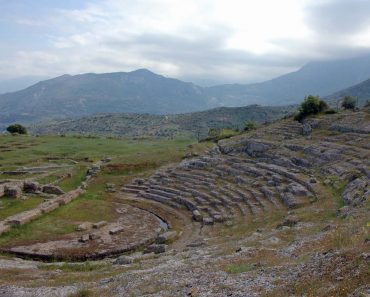
If antiquity must nevertheless be invoked, perhaps the wrong antiquity has been chosen. They should have called the place the Pnyx, after the hill upon which the Athenian popular assembly met and democracy was actually practised. For a Labor Premier, the democratic hill carries an additional resonance. Ben Chifley bequeathed to the Australian labour movement the enduring metaphor of the “light on the hill,” the distant objective towards which politics should strive in the service of a better life for ordinary people. There would be a pleasing symmetry in allowing Greek democracy a hill of its own behind Parliament, even if present circumstances might occasionally render the light difficult to discern.
The name Pnyx possesses further advantages. The word carries the sense of something closely packed or constricted, an etymological felicity of some relevance both to the Victorian economy and to anybody attempting to traverse Melbourne by road. To the modern Greek ear it also offers the irresistible phonetic association with πνίγω, to choke or strangle. Democracy Place could thereby unite two venerable political traditions: the Athenian assembly upon the hill and Chifley’s light shining from it. And whenever the economy constricts, the traffic congeals and another hidden tax materialises, the demos below might make its own modest contribution to democratic practice by gazing towards the hill and exercising that most direct form of popular sovereignty: «άει πνίξου».