
Recent digging at the ruins of ancient Mieza unearthed everything from a stadium to instruction rooms filled with frescoes and mosaics to multiple halls built specifically for drinking parties.

Hellenic Ministry of CultureArchaeologists in northern Greece discovered the school where it’s likely that Aristotle taught Alexander the Great and other Macedonian royals.
Archaeologists excavating near Naousa in northern Greece recently uncovered a roughly 2,400-year-old school complex, or gymnasium. The site, which stood in the ancient Macedonian town of Mieza, may have been where Aristotle taught in the 4th century B.C.E.
The storied Macedonian king Alexander the Great, as well as other Macedonian royals, were likely pupils at the school, where they were taught by none other than Aristotle himself. Although more research must be done before definitively confirming such facts, archaeologists hope the excavations will shed light on education in ancient Macedonia.
The Discovery Of This Ancient Greek Gymnasium Among The Ruins Of Mieza
The discovery, announced in a statement by the Hellenic Ministry of Culture, happened gradually, according to Angeliki Kottaridi, the archaeologist who directed the excavations.
“A few years ago, I identified the ancient remains next to the ancient theater of Mieza,” Kottaridi told Live Science. The excavations on the school complex began in 2024. However, some excavations occurred at the complex roughly two decades ago as well, digs that uncovered a monument dedicated to nymphs.

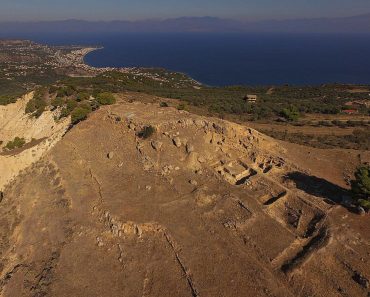
Hellenic Ministry of CultureExcavations began at this 30-acre site in 2024.
The school had been destroyed by the Romans in 168 B.C.E., following the second Battle of Pydna. But many of the plaster walls and stone floors have survived to this day.
Excavation of these remains began in 2024 and now cover 30 acres of land. So far, archaeologists have identified two banquet halls, a sporting arena with a covered running track that stretched about 200 meters, a stadium, covered hallways, classrooms, a roofed porch, and water systems.
They also found a palaestra, or a training room for wrestling and boxing. This year, archaeologists focused primarily on that section of the building complex.

Hellenic Ministry of CultureThe complex was decorated with mosaic floors that closely matched the floors of the palace in Aigai, the ancient royal capital of Macedonia.
The complex was decorated with columns and lavish mosaic floors that resemble those at the palace in Aigai, the ancient royal capital of Macedonia where Alexander the Great and his father Philip II lived.
Archaeologists were also able to identify rooms that were likely used for socializing, including drinking parties, given their inclusion of raised platforms that would have held couches.
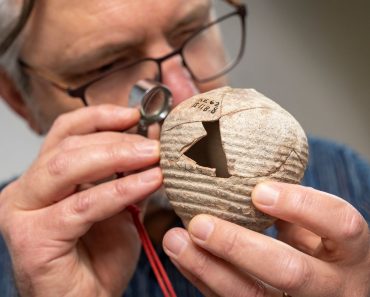
Among the larger ruins, archaeologists furthermore uncovered a wealth of small artifacts including coins, pottery, and writing styli.
What This Find Reveals About Alexander The Great And Aristotle
The gymnasium dates back to the 4th century B.C.E., during the reign of Philip II. Researchers believe that this is the school where Aristotle taught Philip II’s son, Alexander the Great, along with other Macedonian royals.
In his biography of Alexander the Great, Plutarch wrote that the young royal was educated at a school in Mieza by Aristotle. Plutarch added that Philip II commissioned the construction of the school “for the education of his son Alexander and the children of the noble Macedonians,” Kottaridi told Live Science.
According to legend, Alexander the Great rose to power by slicing through the formidable Gordian Knot, foretelling his takeover of much of Asia.

Wikimedia CommonsAlexander the Great conquered vast swathes of territory stretching from Greece to India.
But much of Alexander the Great’s early life left little mark on the archaeological record. The identification of his place of education could reveal much about the legendary king, whose mystery stretches even to the nature of his bizarre death at age 32 and the location of his tomb.
Elizabeth Baynham, a senior lecturer at the University of Newcastle in Australia who was not involved in the excavations, told Live Science that the quality of education that Alexander received from Aristotle would have been excellent.
“Alexander—who by all accounts was highly intelligent—was taught by one of the finest minds of the ancient world in terms of range and insight. Aristotle would have only been in his early 40s,” Baynham said.
She also noted that, due to the threat of political assassinations, the school was placed at a safe distance from Macedonia’s ancient capital, Pella. Baynham said that this was “far enough away to potentially give Alexander a chance for escape if his father was assassinated.”
Although more research needs to be done to confirm that this was indeed the place where Alexander the Great was taught by Aristotle, it should nevertheless provide fascinating insights about education and young life in ancient Macedonia.
After reading about the discovery of the school where Aristotle likely taught Alexander the Great, dive into the story behind the death of Socrates. Then, discover the mystery of the Lighthouse of Alexandria and its demise.