
There’s something almost too perfect about Liz Phair standing onstage at Los Angeles’ Greek Theatre, looking out at the crowd and asking, “Anyone here actually speak Greek?”
“I believe the gods are with us tonight,” she declared, before calling out one in particular: “Athena!”
For a night built around two artists who spent more than three decades challenging the rules of a male-dominated rock world, the goddess of wisdom and war felt like a pretty appropriate choice.
Liz Phair and Sleater-Kinney’s aptly named “Flannel and the Fury” tour arrived at the Greek as more than a double bill of ’90s alternative rock icons. Looking around, the crowd was younger than I expected, with a noticeable queer presence and multiple generations of fans.
It feels like part of something bigger happening right now. Bikini Kill reunited and found a whole new generation waiting for them. Major festivals like Daisy Chain Fields are putting generations of female artists together on the same bill. Music that was once considered disruptive, difficult or just too female for the mainstream is being rediscovered by young fans who weren’t there the first time around.
Sleater-Kinney made that point loudly.
Carrie Brownstein and Corin Tucker took the stage backed by a touring band made up entirely of women/nonbinary musicians. “Dig Me Out” was an undeniable highlight, although this fan would have also loved to hear more songs from that album.
At one point, Brownstein spoke about the importance of staying loud, even when it’s hard to speak up for what you believe in. Coming from a band whose history is intertwined with riot grrrl and feminist punk, it landed.
Sleater-Kinney emerged from the Pacific Northwest in the mid-’90s, part of a generation of women who weren’t asking permission to take up space in punk. Three decades later, Brownstein and Tucker aren’t treating that history like a museum piece. They’re still loud. They’re still political. And they’re still surrounded by a community that seems to be growing rather than aging.
I got a small glimpse of that after the show when I had the chance to meet Brownstein and Tucker. When I told them about Gritty In Pink and our work supporting women in music, they were genuinely interested in learning more and potentially getting involved. They were also just incredibly nice. It was a brief interaction, but it stuck with me. The women who helped push this movement forward decades ago still seem interested in who gets to carry it forward next.
Liz Phair occupies a different, and uniquely complicated, place in that history.
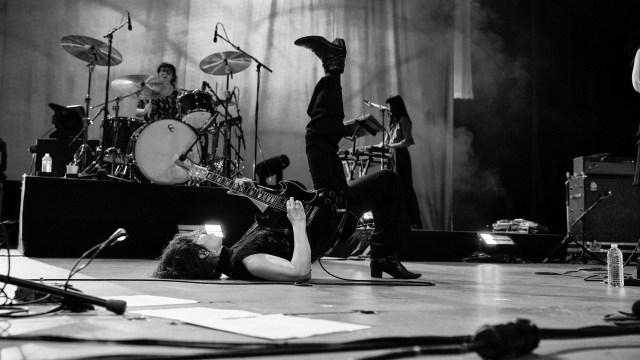
Long before the Greek Theatre, Phair was recording songs alone on cassette under the name Girly-Sound. Those tapes eventually led to 1993’s Exile in Guyville, the album that made her an indie-rock icon and caused plenty of controversy along the way.
Onstage at the Greek, the iconic open-mouth image from Guyville was displayed proudly on her drumhead. Seeing it there more than 30 years later, it was hard not to read it as a metaphor for Phair’s career. She opened her mouth, said what she wanted to say and never really closed it.
That honesty, especially about sex, has always been one of the things that makes Phair interesting. Her songs allowed women to be sexual, insecure, selfish, funny, messy and complicated without apologizing for any of it. She has always been very much herself in her writing, and hearing those songs now is a reminder of how unusual that still feels.
It also helps that you can actually hear every word she sings. Her diction was impeccable, her guitar was clear and her voice sat right out front.
“Extraordinary” was a highlight, with the crowd on its feet and Phair sounding confident and comfortable in material that has followed her for decades. Her set reached beyond the obvious songs, including material from whitechocolatespaceegg, and she also played new music.
Not every new moment landed with the same force as the classics. A song touching on dating a younger man and generational differences felt less penetrating than the material that has made Phair such an enduring songwriter. And for an artist whose work is so intimate, a little more conversation between songs might have made the performance feel even more personal.
But maybe there’s also something very Liz Phair about not giving the audience exactly what it expects.
She has spent her career being scrutinized for her choices, from the raw sexuality of Exile in Guyville to going unapologetically pop a decade later. Even her biggest commercial breakthrough came well into a career that had already been defined and redefined by critics several times over. At the time, the indie darling was scrutinized for going pop, and some of the same culture that celebrated her for breaking rules suddenly seemed offended that she had broken theirs. Personally, I love the song “Why Can’t I?” Why can’t she go pop and reach a bigger audience than ever before? More than 30 years after Girly-Sound, she’s still making new music and still doing things on her own terms.
In retrospect, there’s something fitting about it. Phair’s career has rarely followed the trajectory other people prescribed for her.
That’s what made pairing her with Sleater-Kinney so interesting.
Sleater-Kinney came out of riot grrrl and punk collectivism, turning feminist resistance outward with volume and confrontation. Their rebellion has been outward, loud, and political. Phair’s revolution was more intensely personal: one woman, a guitar and an almost radical willingness to say things women weren’t necessarily supposed to say out loud.
Both approaches changed rock. And both feel newly relevant at a moment when another generation is discovering that speaking loudly, whether politically, sexually or creatively, can still come with consequences.
Thirty-plus years after Girly-Sound and riot grrrl, women in rock shouldn’t still have to prove that their voices deserve space. But if Tuesday night at the Greek proved anything, it’s that the artists who fought for that space are still occupying it, and a new cohort is listening.
Sitting there surrounded by people who may not have even been born when some of these records came out, it was clear that this music isn’t stuck in the ’90s.
The flannel might be nostalgic. The fury isn’t.