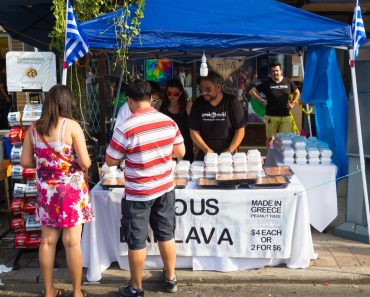
I just spent the entire previous weekend working alongside my fellow Greek Orthodox Christians at the Seattle Greek Festival. Aside from celebrating what turned out to be a record year for the parish, one theme kept coming back to me: “I can’t believe how many people, across all career backgrounds and ages, are setting aside their entire weekend to volunteer solely for the benefit of the Church.”
There were recent converts on their feet all weekend, longtime members of the Parish Council running each booth, dance groups of all ages entertaining audiences, and some of Seattle’s most prominent Greek families all working together, rolling up their sleeves, side by side, to put a slice of Greece on display for the Pacific Northwest’s biggest city.
“You can be flipping gyros next to an anesthesiologist, you know? Or a brain surgeon. And you can’t buy that experience,” said Chris Economou, a lead volunteer for the Seattle Greek Festival going back several decades.
This is not an isolated phenomenon, involving just Seattle’s Greeks. Every Greek Orthodox Church across America showcases this brand of ‘filoxenia’ – hospitality, and it’s a big reason why our annual festivals remain the financial lifeblood for so many Greek churches.
I’ve personally volunteered at Greek festivals in Los Angeles, Dallas, and Sarasota, Florida, and those weekends remain some of the best of my life for one reason: the people that make it possible.
“It’s not really about the numbers; it’s about the people here visiting us. The Seattle community is supporting us, just as much as we want to give something back to the Seattle community,” said Christine Karambelas, Seattle Greek Festival Marketing & Communications Lead.

Pork Gyros were added to the menu at this year’s festival, a smash hit that quickly became a visitor favorite. (Photo via Seattle Greek Festival)
It’s also an experience that my non-Greek friends are equal parts perplexed and delighted by when I bring them around to the gyro booth, where I typically work. Throughout the weekend, everyone pulls together to get our cuisine from grill to table – even the 80-year-old ‘pappoudes’ who have been doing this for 65 years.
It is both heartwarming and encouraging to see the Greek Orthodox youth of today learn the ropes from their parents, and grandparents, eventually becoming the backbone of our Parish Councils and lead volunteers. This past weekend in particular marked the first time where I realized there were more 20 and 30-somethings running the gyro and souvlaki booths than adults of our parent’s generation.
This is a development that shouldn’t be lamented; rather, it signals a new era of involvement and cultural torch-bearing that continues to sustain our ethnic and religious community.

The Saint Demetrios Young Adult Dance Group Entertains Hundreds at the Seattle Greek Festival on Oct. 3. (Photo via Seattle Greek Festival)
That’s not something you really see from any other ethnic community in the United States – at least not at the scale that is deeply entrenched in the Greek-American community. Many of my (now) Philhellene friends often remark to me, “boy, I wish you guys did a festival like this every weekend.”
That, in essence, is the magic of our beloved Church festivals. The Greek ‘kefi’, ‘filoxenia’, and tradition is alive and well, and shared with the greater metropolitan community for the Church’s benefit. Let us pray our parishes continue to facilitate these occasions, which have elevated Greeks to nationwide prominence across the last several decades.
After all, for the majority of festival-goers, Greek festivals in America represent but a few passing hours spent one weekend each year – but no matter the life you return to after the ‘souvlas’ have long gone out, you’re bound to leave with the flame of Greece in your heart.