Robert Moses was the 20th Century Master Builder/Destroyer of New York, the Power Broker, as his biographer Robert Caro wrote, and was behind 13 bridges, 14 expressways, 658 playgrounds, 11 monumental outdoor pools, dozens of public projects and cultural hubs like Lincoln Center.
But even he couldn’t match Greece’s unregulated and ruinous growth on popular islands, a trend that is spreading faster than kudzu and threatens to turn them into Disney versions of what they looked like before being overwhelmed with tourists.
Officials on some islands are complaining that laws limiting development are being ignored or overridden in the rush for revenues, especially the push to bring in the wealthy and super wealthy who demand exclusive resorts and villas.
That strained infrastructure and led to severe shortages and worry about water rationing, as the Ministry of Environment and Energy has declared a state of emergency on some islands, including Tinos, Alonissos, and Karpathos, while the surface reservoirs on Naxos have dried up.
You can forget trying to save Santorini, Mykonos, and Rhodes, which are so overrun there’s no turning back the clock – and there’s really no political will to do so because of the ‘cha-ching’! That’s the sound of electronic cash registers ringing up tourism euros.
What’s happening on the most popular islands – more of them are becoming so because so many visitors are looking for alternatives that they’re creating mirror images of Santorini and Mykonos on places like Milos, Paros, and Naxos – seems irreversible.
During the COVID-19 pandemic many island officials were praying for the return of tourists and now they’re getting what they asked for, so much so that they want to control something that can’t be controlled.
Just look at photos of people on the narrow streets of the Chora on Mykonos and see if you can tell the difference from Times Square in New York because it’s elbow to elbow on both places. It’s not exactly a charming Greek island any more.
A vacation should be going to where people aren’t, but this is the age of influencers, TikTok, Instagram, and social media creating flash mobs, and that lures developers and international chains and unscrupulous businesses building where they want.
Moses’ approach was to build first and dare New York’s government, activists, and the courts to try to stop him, knowing they wouldn’t order demolishing a bridge or a highway – and he was car-crazy and disdainful of the poor and racial minorities.
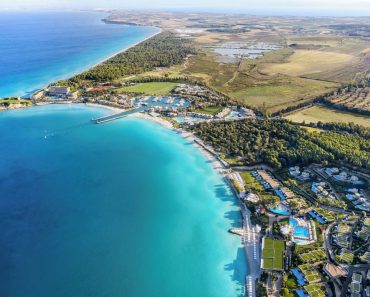
That’s the same attitude that high-end resorts have in Greece and they’ve been allowed to fence off public beaches to keep out the riff-raff and those picture-perfect and once tranquil spots on islands are disappearing.
Island officials, local leaders, environmental organizations, and residents have asked for stronger intervention from the government, warning that long term sustainability is at risk, said Travel and World Tour.
Other Cycladic islands are clamoring as well, complaining that large scale development projects are transforming parts of the traditional landscapes and putting pressure on limited natural resources, housing availability, and public infrastructure, the report said.
The government has introduced regulations to balance tourism growth with environmental protection but islanders aren’t satisfied. The water shortage problem is being exacerbated by prolonged drought, big drops in winter rains, and resorts sucking up water, including for swimming pools.
What’s really driving the difficulties though is the luxury resort and villa developments and past unlawful building has seen amnesty programs allowing the structures to stand in return for a fine – encouraging more unlawful building.
The government has a plan aimed at places like Santorini and Mykonos that will limit the number of tourist beds, but that’s already too late because there are so many beds on those islands that the damage has all been done.
More than 75.5 million euros ($86.01 million) has been allocated to island municipalities for new destination facilities and upgrades to water distribution networks – but continued development could undercut those efforts.
So what we’re left with are Greek islands that look like inner-city neighborhoods, jam packed, charmless, overrun – and not even remotely resembling the reason why people flocked there only to find faux island and plastic trinket shops.
There will be more lip service paid to the idea of balancing tourism with environmental protection, but the scale has long been tipped in favor of the money and not pristine and quaint settings favoring quiet or serenity.
Heavily saturated islands – such as Mykonos, Santorini, Skiathos, and Kos – face near-total restrictions on new large-scale tourism development, with severe caps placed on the number of available tourist beds.
Too late.
There are more than four tourist beds per every permanent resident on several Greek islands, according to a new study by the University of the Aegean’s Sustainable Tourism Observatory, putting pressure on land and resources.
Before recent reforms and plans for more, the state opened areas, including supposedly protected forested areas and public beaches, for private development – and unlawful buildings are still popping up on islands.
Environmental groups like WWF Greece have continuously warned that unchecked construction is destroying the traditional character and delicate ecosystems of islands but have not gone to court to stop it – nor have island officials.
So avoid Mykonos, Santorini, and the other islands now resembling them – but the university study was ominous about the fate and future of others, including Serifos, Schinoussa, Antiparos, Kastos, Irakleia, Kythnos, Kea, Sikinos and Ammouliani. Their sun has set.