This autumn, the Greek National Opera celebrates writer Nikos Kazantzkis with their Carnegie Hall debut on October 15 in New York. Kazantzkis penned numerous plays and poetry, as well as novels that inspired symphonic music, opera, theater, ballet and films, including classics like, “He Who Must Die” directed by Jules Dassin, “Zorba the Greek” which won three Oscars, and the scandalous “The Last Temptation of Christ”, which was condemned by the Vatican and, in 1988, adapted by Martin Scorsese. Inspired by the country’s most vital 20th-century author, the program at Carnegie Hall, entitled “Nikos Kazantzakis: An Odyssey in Music”, features selections from some of the most accomplished composers in Greek history.
A greater appreciation for the show and the writer can be cultivated by visiting his homeland and walking in the footsteps of Pericles, Plato and Odysseus at a time when the latter is the smashing box office records thanks to Chris Nolan’s summer epic “The Odyssey”. In addition to spurring new interest in the 3,000-year-old poem, the film has grossed nearly a billion dollars in ticket sales and is an early front-runner for next year’s Academy Awards.
Arriving in Athens, stay at NEW Hotel, an artsy boutique lodging that blends reclaimed local materials to create eye-catching interiors crafted by world renowned architects the Campana brothers. Dine on the culinary stylings of Chef Babis Kountouris, who offers what he calls “fine comfort”, re-imagining traditional dishes with a modern sensibility. His rooftop open air restaurant, Art Lounge, affords you an up-close view of the Acropolis while you dine.

Athena Temple in Athens, Greece.
Get closer with a morning hike to the ancient citadel dating back to 1600 BCE. In time, it transitioned from a Bronze Age Mycenaean fortress into a sacred sanctuary dedicated to the goddess Athena, eventually adding the Parthenon and the Temple of Athena in the 5th century BCE. The latter features a facade supported by delicately carved caryatids — copies of the originals are currently housed in the British Museum. Likewise the Elgin marbles that decorated the pediment of the Parthenon, a subject of heated dispute between the two countries. Luckily, countless artifacts remain intact and on display at the nearby Acropolis Museum, one of the world’s greatest repositories for classical Greek art.
Often overlooked and better preserved than the Parthenon is the Ancient Agora, which sits in the shadow of the Acropolis. This former bustling commercial and philosophical heart of ancient Greece is the site of a less crowded museum also containing ancient artifacts.
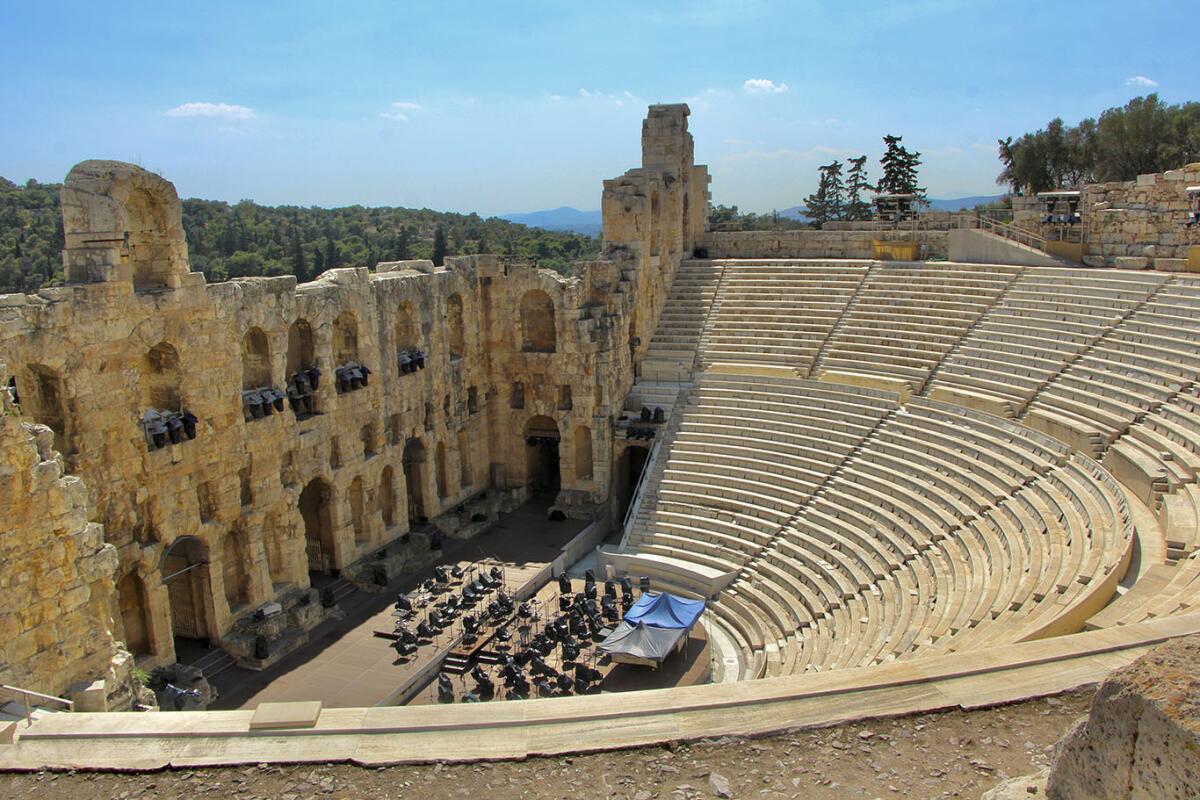
Between the two sites you’ll pass the Odeon of Herodes Atticus built in AD 161, which still hosts live performances today. A newer, more comfortable venue can be found in Kallithea, a few miles west, at the Stavros Niarchos Hall, home of the Greek National Opera. It was designed by Pritzker Award-winning architect Renzo Piano, famous for his Pompidou Center in Paris as well as his Resnick Pavilion and BCAM at LACMA. Not just for opera fans, it hosts a wide variety of performing arts, including last September’s premiere of “Nikos Kazantzakis: An Odyssey in Music”.
For a deeper dive into all things Kazantzakis, head to Crete, the author’s home island. Touch down in Heraklion, the capital, and stay at Creta Maris Resort, a sprawling all-inclusive retreat featuring white sand beaches, water park and pools the size of oceans — it even has its own movie theater. But if you’re looking for something more intimate, head two hours west to Chania, an irresistible 14th-century Venetian harbor town featuring seaside cafes and restaurants, an Egyptian lighthouse and a waterfront bathed by golden sunsets.
The Porto Veneziano Hotel is a perfect boutique inn with views of the harbor and an open air cafe where you can take your breakfast serenaded by seagulls. Stroll the quaint alleyways by day where you’ll explore Venetian mansions. And as the sun flirts with the horizon, head to Salis restaurant for farm-to-table Cretan and Mediterranean fusion dishes. Don’t miss their signature octopus carpaccio, miso cacio e pepe ,and rich buffalo ravioli, topped off, like all Greek meals, with a shot of raki — distilled and fermented grape pomace or raisins (suma), infused with aniseed, sweetened and aged in oak barrels. On the island of Crete, raki embodies the Greek spirit of hospitality, friendship, and social connection.

(Delphine Poggianti, Delphotostock / Adobe Stock)
A perfect day trip is Arkadi Monastery, which sits 1,600 feet above sea level atop Mount Ida, the childhood home of Zeus. It is here that, in 1866, amid a fierce siege by the Ottoman army, nearly 1,000 Cretan women and children took refuge. Rather than surrender to the invaders, they ignited a gunpowder magazine, blowing up the building and killing nearly everyone inside, an event that inspired Kazantzakis’ 1946 novel “Captain Michalis”. About 200 feet west of the monastery is a structure commemorating their sacrifice. A former windmill, it houses the remains of the dead — battle scarred bones, some pierced by bullets and sword cuts.
In Heraklion, head to the Historical Museum which holds 17 centuries worth of local history and culture dating from early Christians to modern times. Included in the collection are two paintings by Renaissance great, El Greco, “The Baptism of Christ” (1569) and “View of Mt. Sinai and the Monastery of St. Catherine” (1570). They are the only works by the native Cretan still on the island.
If you go in the morning, you’ll have time to hit Myrtia for the Nikos Kazantzakis Museum, only 25 minutes away. There you’ll find the novelist’s personal artifacts — eyeglasses, watch, diaries, writing desk, handwritten notes for works like “The Last Temptation of Christ” and his epic poem, “The Odyssey”, as well as correspondence with people like Albert Einstein and notables from the world of literature.
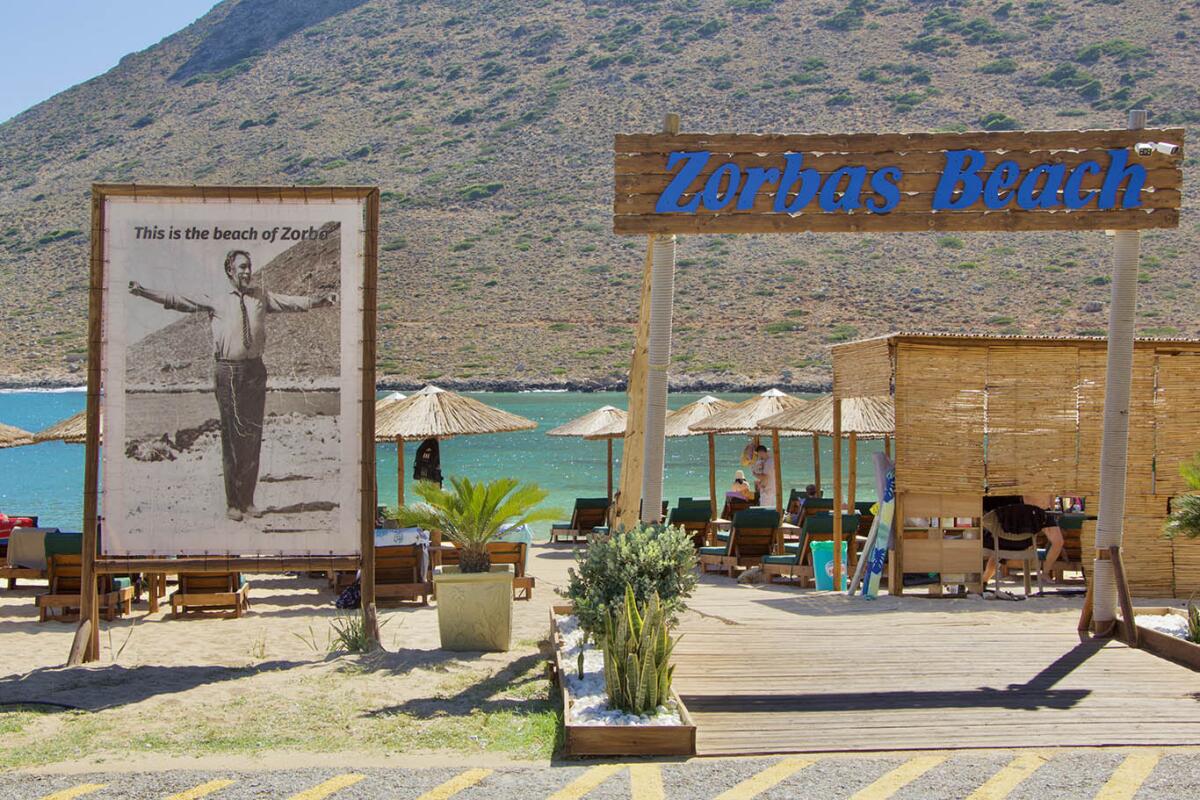
If it’s sun and sand you’re after, head to Stavros Beach, also known as Zorba’s Beach, where filmmaker Michael Cacoyannis shot much of “Zorba the Greek”. A picturesque crescent-shaped lagoon on the northern edge of the Akrotiri Peninsula, it features shallow turquoise waters and a dramatic backdrop of rugged mountains. For lunch, fresh grilled fish and seafood platters are top of the menu at nearby Almyriki, or stop at Yiasemi for classic moussaka and vegetarian options.
We all know the story of the Minotaur, half man, half bull, who hunted and dispensed with the youth of Crete inside his labyrinth. He really existed. Well, not the Minotaur exactly, but King Minos, a mythological figure even in ancient times. He lived not in a maze, but a 1,300 room palace that was so difficult to navigate it might as well have been a labyrinth. Today it’s known as Knossos, inspiration for Kazantzakis’ epic novel, “At the Palaces of Knossos”.
Its throne room features a splendid mural of heraldic griffins flanking the royal seat, with backgrounds painted in a shade of blood-red that persists throughout the ruin, coloring columns, as well as a relief mural of a life-sized bull, a symbol of divine power and fertility. Knossos is one of the island’s main attractions, though it’s mostly a sprawling ruin on account of an ancient volcanic eruption that occurred nearly 90 miles north at the island of Santorini in 1600 BCE.
The disaster there is what gives Santorini’s capital, Fira, its unique topography — a beach town that sits 850 feet above sea level on the lip of an epic caldera. With a dizzying vertiginous layout that challenges the law of gravity, Fira holds a unique splendor that remains unthwarted by its ample tourists and tchotchke stores.

Beat the crowds by checking into Noûs, a quiet five-star resort about two miles away with ocean view bungalows and multi-room suites where privacy is at a premium. Each comes with its own splash pool, patio, kitchenette and quietude broken only by whispering Aegean breezes. Designed by Divercity Architects, in collaboration with MplusM Architects, Noûs’ modernist style emphasizes clean lines, stark shadows and minimalist repose, making for a zen-like retreat.
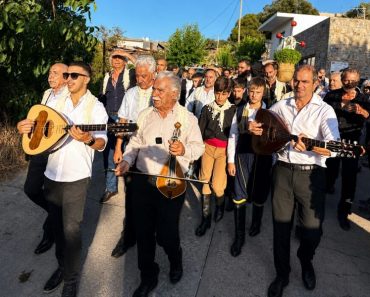
Before departing Crete, you might stop by Kazantzakis’ tomb, which lies atop Heraklion’s Martinengo Bastion. It’s the highest point of the 16th-century Venetian city walls, affording visitors stunning views of the city and the sea. Here, as the sun began to set, we were greeted by musicians playing classical Greek instruments — the Cretan lyra and laouto. We danced a “siganos”, a traditional step, in celebration of the author who was denied a burial in a consecrated cemetery by the Greek Orthodox Church. His final resting place consists of a simple stone and a wooden cross bearing the epitaph by which lived: “I hope for nothing. I fear nothing. I am free.”