
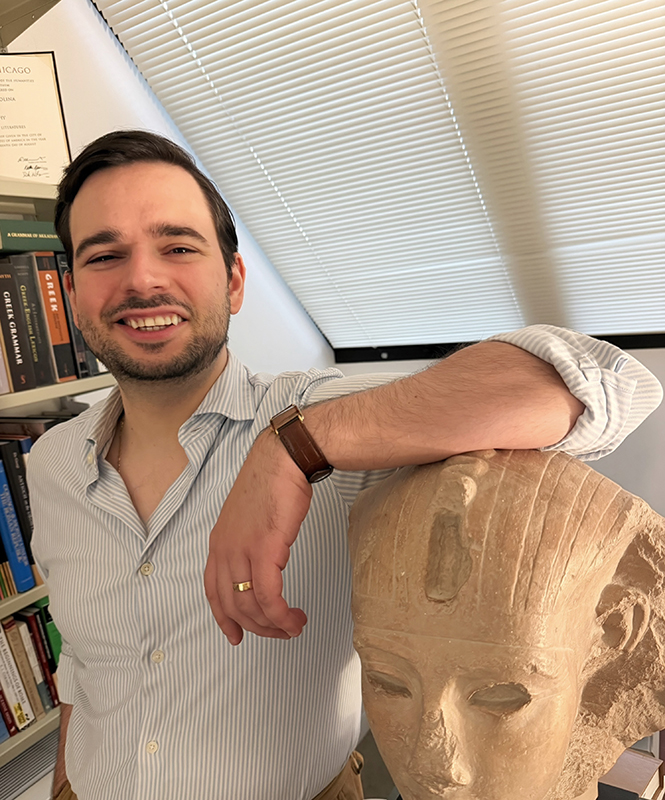
Filmmaker Christopher Nolan’s blockbuster film “The Odyssey” opened July 17, and the nearly three-hour-long interpretation of Homer’s epic poem was the top movie viewed that weekend. Nolan’s film garnered overwhelmingly positive reviews and already is projected to be an Oscar favorite. University of Illinois Urbana-Champaign classics professor Eduardo García-Molina is an ancient historian specializing in the Greek’s Seleucid Empire, and he teaches more broadly on ancient Greek culture, law and political history. He spoke with News Bureau arts and humanities editor Jodi Heckel about “The Odyssey.”
How does the film compare with Homer’s poem and the portrayal of Odysseus?
Nolan’s translation of the ancient poem into the modern medium of movies captures the epic feel and spectacle of the text. Today, we primarily read “Odyssey.” In antiquity, however, the text we have is the product of a long history of oral performances by bards. You have to imagine them making grand gestures, changing their voices to match the tone, the inherent musicality of the poem itself resounding in halls. Nolan’s cinematography and sound design tap into this history of performances with sweeping shots and impressive practical effects. He also pulls from various sources beyond Homer’s “Odyssey,” like the Roman author Vergil’s “Aeneid” for various story beats and art pieces like Francisco Goya’s “Saturn Devouring His Son” for his design of the cyclops Polyphemus, so we are watching the product of a much longer tradition of the reception of antiquity. While the film may not be a word-by-word translation, it certainly taps into the meta history of the poem and feeling of “Odyssey” as an evolving performance. We are gathering in theaters like the ancient Greeks would meet in taverns or hearths to listen to these tales.
Now, Odysseus. He is a (in)famously tricky figure to nail down; everyone has a different take on what Odysseus means to them. The adjective most associated with him in Homeric texts is πολύτροπος from the words πολύς (“many”) and τρόπος (“ways, turns, paths”). This word is his brand. You can take it literally as something like “well-traveled” or “wandering,” but even in antiquity it was used to describe the way his mind would turn over ideas and devise strategic plans, something like “crafty/resourceful/slippery/sketchy/sus.” It’s difficult to find one word that matches all these meanings, and it can be positive or negative depending on the reader, listener or translator. That’s what makes the character continually fascinating, both in ancient works like my favorite play, Sophocles’ “Philoctetes,” and in modern adaptations.
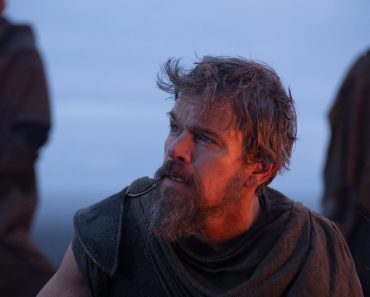
Matt Damon’s Odysseus is less complicated, less πολύτροπος. Nolan’s angle emphasizes the post-traumatic stress disorder the character suffers and the guilt of his actions that led to Troy’s fall and the later death of his men. He self-medicates for this pain with the lotus plant, forgetting this past. It is very much an Odysseus following the steps of the traumatized American action hero or returning war veteran rather than an ancient king, which makes sense for modern audiences. For instance, in Nolan’s “The Odyssey,” he shoots the largely mute Polyphemus with an arrow in silent anger over the cyclops eating his men. The Homeric Odysseus’ parting shot isn’t an arrow like Nolan’s, but a taunt when he shouts his real name. This act of boastful hubris then allows Polyphemus to pray to his father, Poseidon, for revenge against Odysseus. Damon’s Odysseus is more brooding, and we do lose something about Odysseus by making him this silent and stoic American protagonist.
Was Zeus’ Law something that was actually observed in the time of “The Odyssey”? How important was it to society then?
The tricky part here is nailing down what society it is. “Odyssey” as a text was written down at some point during the Archaic Period (c.800–480 B.C.) of Greek history when writing was re-emerging, but it had existed as oral performances earlier during a period when writing had disappeared and the quality of life was much lower, the so-called Greek Dark Ages (c.1100–800 B.C.). This period followed the collapse of the Bronze Age around 1200 B.C., and it is during this Late Bronze Age period that most think “Iliad” and “Odyssey” are set (the movie is set in this period too). However, the stories were then performed during the “Dark Age” and written down sometime in the Archaic period.
For the Greeks of the Archaic period and after, the concept of xenia (“guest-friendship/hospitality”) was important. Think about it. The Greeks were expanding across the Mediterranean and developing new networks of relationships and travel. Traveling took far longer and was more dangerous. You needed friends whose futons you could crash on or a cultural idea like xenia that assured your visit to an inn would be safe in the days before Google reviews. For elite families like that of Odysseus, hosting also served to strengthen bonds between houses. Nolan calls it “Zeus’ Law” instead of using the Greek, framing it as a sort of Greek Ten Commandments. This helps translate it for modern audiences, but Greek religion was not uniform, and it did not come as a book that canonized it like the Bible or Quran. So it was important for later Greek society, but its emphasis as a sort of Golden Rule simplifies the practical nature of its historical evolution.
What do you think about the decision to not have any onscreen presence of the gods in the film, other than the periodic appearance of Athena, played by Zendaya?
My eyebrow was raised ever since I saw the movie’s tagline on posters, “Defy the Gods.” If there’s one thing Greek mythology teaches you, it’s to not do this! The gods in Nolan’s “The Odyssey” can all be explained as natural and psychological (although other supernatural elements are present, like the sorceress Circe). I understand why Nolan chose to do this, using this ambiguity over the gods’ roles in the story to ask us to see how Odysseus can internalize and rationalize his feelings and process events. However, this realistic psychological grit takes away from the grandeur of the Homeric epic and the very human emotions and pettiness of the Greek gods. Nolan’s psychological take makes similar claims, that we reflect ourselves and our events within our rationalization of a higher power, but sometimes I want to see a big, bearded guy throwing a thunderbolt and KO’ing someone. Plus, in the Homeric “Odyssey,” it’s the gods that ultimately resolve the conflict between the returned Odysseus and the families of the suitors he has killed (unlike in the movie, Odysseus spares no one in his rampage). In Nolan’s “The Odyssey,” Odysseus oddly exiles himself to allow Telemachus to rule without the stain of blood on his hands. I like the Homeric ending a bit better since it teaches you that sometimes this trauma cannot be resolved by human means. There’s a certain mortal humility to that that I find oddly comforting.
What relevance does this ancient story have in today’s world?
Similar to Odysseus being read slightly differently by each reader, the relevance and messaging of “Odyssey” changes for everyone. For Nolan, one of the largest themes is the loss of decency towards strangers and foreigners and the collapse of civilization as a result of this loss of bonds. Our world becomes small and empty. I think that message is relevant today. The Homeric text is so rich that any reader can find some personal meaning. In my “Introduction to Ancient Greek Culture” course, in our lecture on burials and grief, I bring up a scene that wasn’t in the movie. When Odysseus approaches the Underworld, he meets the spirit of his mother, Anticlea. Stunned and grieving, he tries to hug her three times but fails. That too-human want to embrace our loved ones, the ultimate failure to bridge the gap between life and death, and our processing of this fact has helped my own relationship with death and grief. Beyond the grandeur of cyclopes, gods and magic, it’s these nuggets of humanity that I think ultimately explain why we keep returning to this story.
Editor’s note: To contact Eduardo García-Molina, email emg24@illinois.edu.