
On Tuesday night, Noam Bettan will take the Eurovision stage in Vienna, hoping to secure Israel a place in the final. As the delegation makes its last preparations, attention now shifts to the first semifinal and the rivals standing in Israel’s way.
Finland: ‘Liekinheitin’
The Nordic country, now exactly two decades after its first and only Eurovision victory, arrives this year as one of the strongest favorites to win. The duet titled “Liekinheitin,” Finnish for “flamethrower,” by violinist Linda Lampenius, also known as Linda Brava, and singer Pete Parkkonen, is a dramatic, fiery song with one violin front and center.
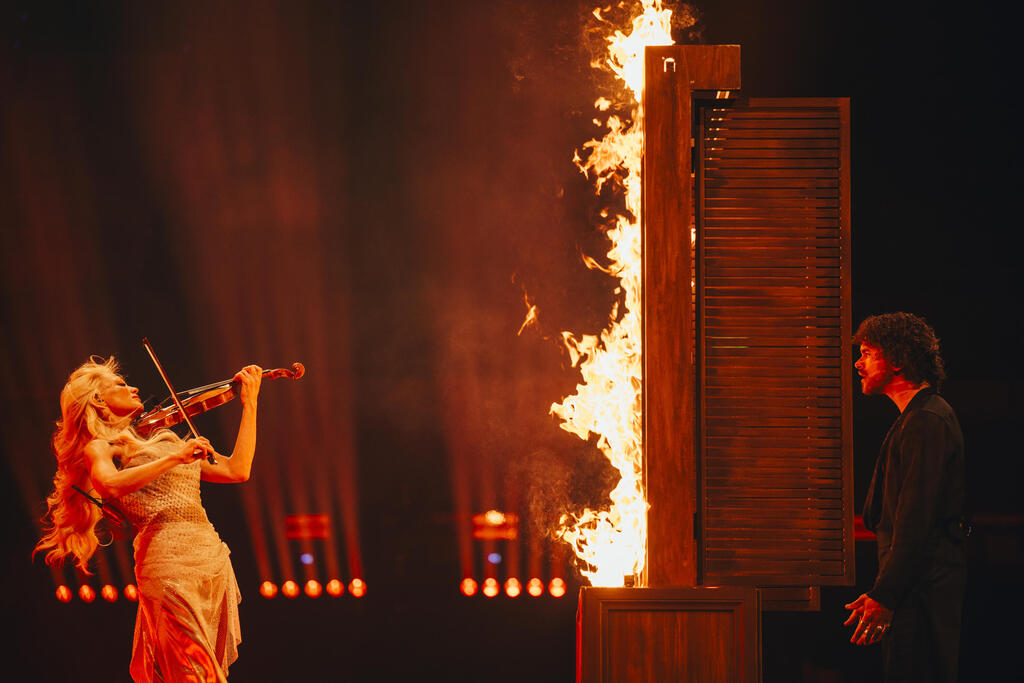
The song, which has led the betting tables for weeks, sounds like it was written to win. Placed seventh in the running order, it marks a strong, significant moment in the first semifinal, the one in which Israel is competing, and one expected to be tougher and more tense than the second.
Moldova: ‘Viva, Moldova!’
After years in which it became synonymous with some of the contest’s most colorful and unhinged moments, Moldova is back this year with a song competing for the title of the night’s most bizarre number.
It is a rhythmic dance-folk track with three lead singers and plenty of energy, somewhere between a self-aware wink and an over-the-top love letter to the homeland, just as the title suggests. At times, it sounds like Eurovision’s version of a new national anthem.
Greece: ‘Ferto’
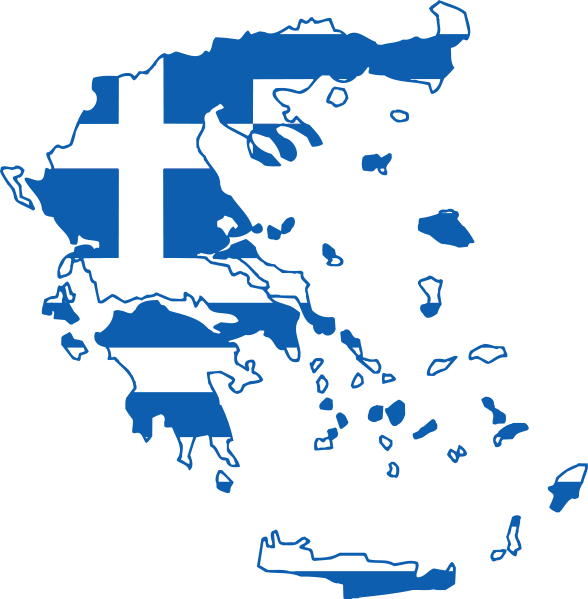
Greece continues its ethnic-modern line this year with singer Akylas and the song “Ferto,” Greek for “bring it.” It is a fast, electronic track mixing contemporary beats with the Greek lyra, a traditional string instrument heard here in its electric version. The result is intense, a little strange and highly addictive.
Akylas brings some eccentricity of his own, but what is really worth noting in the Greek song is its resemblance to Anna Zak’s new Israeli song “Yeled Shamenet.” While Zak rejects the gestures of a suitor who opens his wallet instead of his heart, “Seychelles? I don’t want it. Chanel? I don’t want it,” Akylas says the exact opposite: “Real estate, bring it. Tuna sashimi, bring it. Gold watch, designer glasses, I’m telling you, bring it!”

Alongside Finland, Greece is also one of the leading contenders near the top of the betting tables. And if the fight for victory does come down to the two of them, we may see a non-English-language song win. Maybe it is time Israel also returned to its roots.
Italy: ‘Per sempre sì’
With a nostalgic Italian ballad, singer Sal Da Vinci’s “Per sempre sì,” or “Forever yes,” delivers a simple but effective love story, even if it is more classic romance than Eurovision spectacle.

This is the kind of song that may not explode on first listen but slips under the radar and gains strength as the contest progresses, a privilege reserved for countries that qualify automatically for the final, though Italy will present its song in the first semifinal.
With familiar Italian charm and a precise performance, Italy once again fields a solid contender that could surprise, not necessarily by winning, but certainly by finishing high on the scoreboard.
Eurovision 2026 opens with two semifinals on May 12 and May 14, ahead of the grand final on May 16.