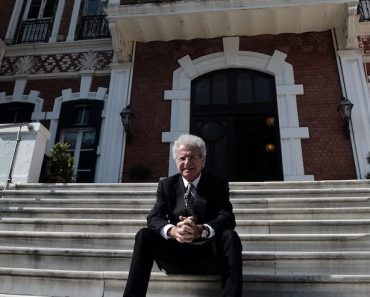


Dimitra Skandali has gone back to her roots in Paros. [Nikos Kokkalias]
Most who know multimedia artist Dimitra Skandali’s work have seen it in some of the major Athens exhibitions curated by Kostas Prapoglou.
Born and raised on Paros, she studied at the Athens School of Fine Arts and then spent several years in the United States before returning to Greece and settling on her native island. Hailing from a family of Cretans who took refuge there to escape a blood feud, Skandali is intrinsically linked to the seaside village of Alyki and its history. Indeed, half its residents are related one way or another. What’s more, her father and uncles operated a caique that carried out transportation services between the Cycladic islands – their maritime adventures are legendary.
Preserving memory, landscape and stories is something Skandali cares deeply about, so in 2022 she took the family’s old home, expanded it and transformed it into Cycladic Arts, a residency for international artists that has proved enormously successful. Visual artists and creative people from around the world go there to experience the magic of the Cyclades and the strength of a small community resisting mass tourism.
The situation on the increasingly overbuilt island became even more challenging this year after a wildfire tore through one of Paros’ unspoiled parts, came close to Alyki and reminded everyone that development carries its own relentless price.
Skandali, however, is fighting her own battle to preserve memory, beauty and purity. She does so not only through her works, in which she uses humble shrubs and Cycladic wildflowers as one of her materials, as well as pieces of traditional wooden boats, tools and other remnants of the island’s former way of life.
Recently, she opened an exhibition marking the 100th anniversary of the founding of her ancestral home. The journey back through the decades was an homage not just to the family itself, but also to the village as a whole.
On the opening night, people came from all around to see the photographs, remember and celebrate, because this house had given countless children and neighbors a place to sleep and food to eat; it had filled with the smell of eggs and potatoes frying on a gas stove, sheltered people from the waves, rain and cold, and witnessed births and deaths. Without running water or electricity, Skandali’s grandmother raised 12 children and dozens of grandchildren there.
More importantly, however, the house has been granted a second life as a place of creativity and community.