
Few stories in all of history are greater than the story of Western civilization. It began in the city-states of ancient Greece, where democracy, philosophy, and scientific inquiry first flourished. Those ideas matured in Rome, spread across Europe, and helped give birth to the United States 250 years ago.
Our Founding Fathers understood that inheritance. They studied Greek history and the writings of Plato and Aristotle, drawing on debates about liberty, citizenship, virtue, and self-government. The American experiment was new, but many of its guiding ideas were not.
Today, the United States and Greece have a strong military, security, energy, and economic partnership, which was on full display during Secretary of State Marco Rubio’s recent visit to Athens. Though stronger than at any point in recent memory, this alliance is certainly not new.
When Greeks rose against Ottoman rule in 1821, Americans rallied to their cause. Thomas Jefferson expressed his sympathy for the Greek people. Congressman Daniel Webster spoke in support of their struggle. American citizens offered assistance because they recognized in Greece’s fight for independence the same yearning for freedom that had inspired our own Revolution.
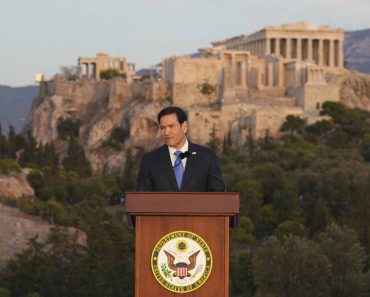
It was fitting, then, that Secretary of State Marco Rubio went to the birthplace of democracy to remind the West of what unites us. Speaking with the Acropolis as a backdrop, he reaffirmed the common heritage that connects America to Greece and the civilization that grew from its shores.
At the heart of that civilization is a refusal to accept the limits of what mankind can know or accomplish. It drove explorers across oceans, scientists to chart our place in the universe, and generations of thinkers to challenge the boundaries of human understanding.
Western civilization also teaches that a life well lived is not spent accepting mediocrity, but pursuing excellence in service of something greater: our families, our nation, and our faith. That restless ambition carried us from the hills of Athens to the surface of the moon.
Rubio’s Athens speech was both a critical history lesson and a call to action.
Across the West, we have allowed confidence in our own history and traditions to erode. Too often, defending our traditions, our borders, and our national identity is treated as something shameful. The results are clear: militaries weakened by the illusion of permanent peace, borders left vulnerable by failed immigration policies, and energy and industrial policies that raise costs, undermine growth, and leave us dependent on others.
But Greece is showing what a different course looks like. A dependable NATO ally, it hosts American military operations at Souda Bay and provides access to strategic ports like Alexandroupolis. During Rubio’s visit, our countries announced $4 billion in U.S. military sales to strengthen Greece’s defenses. Our growing energy partnership is also bringing American liquefied natural gas through Greece and into Central and Eastern Europe, helping our allies reduce reliance on Russian energy. Cooperation with Cyprus and Israel through the 3+1 framework makes the Eastern Mediterranean stronger and more secure.
Rubio called Greece a model ally and told Europe to follow its lead. He’s right. Our alliance is not built on nostalgia. It is built on shared interests, common principles, and a willingness to defend both.
As a proud Greek-American, I see our relationship as a powerful reminder that the ideals born in ancient Athens are neither distant nor outdated. They helped inspire America’s founding, united Americans with Greeks seeking independence, and continue to guide our partnership today.
Western civilization did not endure by surrendering its identity or abandoning its ambitions. America and our allies must defend our sovereignty, rebuild our strength, and restore the confidence to shape our own future. Our inheritance demands nothing less.
Nicole Malliotakis serves in the U.S. Congress as the representative for New York’s 11th congressional district.