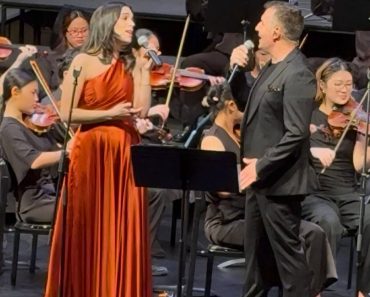

Nearly 40 years have passed since composer and lyricist Stamatis Kraounakis discovered Kostas Makedonas at Skorpios, a legendary Thessaloniki music venue that no longer exists.
Towards the end of the evening, a young but then-unknown Makedonas took to the stage and performed George Dalaras’ Ilie Mou, Se Parakalo (My Sun, Please). It was 1987. Impressed by the aspiring singer’s talent, Kraounakis invited him to Athens.
Two years later, Makedonas released his debut album, Den Eho Idea (I Have No Idea, 1989), with music by Kraounakis and lyrics by Lina Nikolakopoulou, marking the beginning of a career that has steadily flourished for more than three decades.
Across his 16 studio albums, there is almost always one song that becomes a standout hit. His secret, perhaps, lies in an unwavering commitment to quality—carefully selecting collaborators and placing meaningful, timeless songs above passing trends.
Now, another chapter has been added to his discography with Trampala (Seesaw), a seven-track collection featuring music by Giannis Christodoulopoulos and lyrics by legendary songwriter Lefteris Papadopoulos.
“You’ll hear laïko songs created with sensitivity, passion and craftsmanship. They’re contemporary in their outlook but grounded in deep musical knowledge. Lefteris and Giannis have given their very best, and I’m truly proud to have sung their compositions,” Makedonas tells Neos Kosmos.
When he is not in the recording studio or performing on stage, Makedonas can often be found thousands of metres above the ground. For the past 30 years, he has also worked as a commercial pilot—a parallel career that many of his fans are unaware of.
“It’s a second career. I’ve worked with several airlines in Greece and overseas. In recent years I’ve been flying for Cyprus Airways, and I’m very happy with that collaboration,” he says.

Trampala is built around the idea of life’s ups and downs. What inspired the album?
“The idea of the ‘seesaw’, as Lefteris Papadopoulos uses it, has timeless meaning. It symbolises the highs and lows of our lives, but also the balance we all strive for in every aspect of life. Once again, Lefteris has given us powerful lyrics, and they became the inspiration for this album.”
Giannis Christodoulopoulos is a younger composer, while Lefteris Papadopoulos is one of Greece’s most respected lyricists and is famously selective about collaborations. What made him trust you with his work?
“Giannis may be young, but he’s already an acclaimed composer who has given us many beautiful songs. Lefteris is a wonderful man who is incredibly generous with people whose talent and work he values. When he heard the first demos, he was thrilled and encouraged us to continue giving it everything we had.”
Many of the songs on Trampala revolve around love. Yet today, people seem to fall in love less easily while loneliness is becoming more widespread. Is technology to blame, or is it something else?
“Technology may have reduced distances in the literal sense, but at the same time it has led to alienation and a more digital way of living. Combined with the daily pressures of work and everything else we do just to get by, we’ve pushed love aside as though it’s a secondary need—and that’s a shame. Love nourishes us. It’s one of the most beautiful emotions, if not the most beautiful, that we can experience.”
From your new album, one lyric stands out: “Don’t be afraid because you’re down.” Have you ever found yourself in that place? Where do people find the strength and hope to rise again?
“Of course I’ve been ‘down’, just like everyone else. I was fortunate to have people by my side who supported me and gave me the strength to get back on my feet. But we should never forget that inner flame we all carry. We have to do everything we can to keep it alive. We must always believe in ourselves and never lose hope—and, with a little help from our friends, things really can become easier.”
Would you like to perform in Australia again? What stood out from your first visit?
“I can’t wait! It remains one of the most beautiful memories of my life. The welcome I received was incredibly moving, and the audience’s response was unlike anything I’d experienced. I was amazed by the turnout and by the enthusiasm of people who knew every song and every lyric. Australia is a beautiful country and that trip was undoubtedly one of the highlights of my life. I hope to return soon—hopefully with my family, whom I’ve told so much about it—so we can once again sing all our classic Greek laïko songs together. Until we meet again!”
Nearly 40 years have passed since Stamatis Kraounakis discovered you. What do you remember from that night?
“I remember everything. I remember how nervous I was knowing Stamatis Kraounakis was in the audience, the relief I felt when I’d finished singing—especially because I knew I’d done well—and, of course, the moment he spoke to me. That’s when I realised something important was about to begin.”
If he were standing in front of you today, what would you say?
“Thank you. I’ve told him that many times over the years, but I’ll never stop acknowledging the enormous role he played in my career and in my life. I owe Stamatis immense gratitude.”
What has changed in Kostas Makedonas? How does the young man from Skorpios differ from the man we see today?
“I’m more experienced, more fulfilled and more responsible. But I’d like to think I haven’t lost my enthusiasm for music, for beautiful songs and for meaningful collaborations.”
Thessaloniki has produced some of Greece’s greatest singers, from Rosa Eskenazi and Stratos Dionysiou to Marinella, Antonis Remos, Paschalis Terzis, Despina Vandi and Natassa Theodoridou. What makes the city’s music scene so special?
“Thessaloniki is such a beautiful city that it inspires you to create. It’s no coincidence that so many songs have been written about it. It has a rich musical tradition, as is often the case with port cities and places that have long been crossroads of cultures.”

Your career has been remarkably steady, without the dramatic highs and lows described in Trampala. Is that a reflection of your character?
“I’m grateful for the career I’ve built alongside so many wonderful collaborators. I’ve always chosen songs based on their meaning and lasting value, never chasing easy or short-lived success. I believe many of the songs I was fortunate enough to record first will continue to be sung and loved for many years without losing their freshness or significance.”
You’ve worked with many of Greece’s greatest composers and lyricists. Which album is closest to your heart?
“Every album tells its own story, and I’m proud of each one. But if I had to choose, I’d probably say Mono Mia Fora (Only Once). It was one of my earliest records, and together with its title track, it opened the doors to Greek homes across the country. I still perform many songs from that album in concert, including I Liza kai i Korniza (Lisa and the Picture Frame). Can you believe Lisa would be 35 years old today?”
Who has been your greatest teacher?
“I’ve had many teachers. Naturally, I begin with Stamatis Kraounakis and Lina Nikolakopoulou. But I also learned invaluable lessons from Christos Nikolopoulos, Giorgos Zikas, Giannis Markopoulos and Mikis Theodorakis. If I started listing all the singers who taught me something, we’d be here all day.”
Have you ever thought about writing more of your own songs?
“I’ve written a few. As a musician, it’s only natural that I would. I’ve also tried writing lyrics, and I’m still proud of Ekanes to Lathos (You Made the Mistake), which people still listen to today, along with a few other songs I’ve written. When songwriting isn’t your main profession, and a song almost writes itself, then it’s truly a song from the soul.”
What advice would you give a young person hoping to pursue a career in music?
“Talent and a love of music are essential, but they’re not enough. You also need hard work, patience, perseverance and a clear mind. And we shouldn’t forget the role of luck. It’s a difficult path, but it’s also an incredibly rewarding one.”
Alongside music, you’ve spent three decades working as a pilot. How do passengers react when they realise you’re flying the plane?
“People usually react very positively when they discover I’m their pilot. There have also been some funny moments, like when passengers have mistaken me for Kostas Makedonas’ twin brother—which, of course, doesn’t exist!”
“As I often say, flying helps keep my feet firmly on the ground. It brings balance to my mind and my life, and somehow my two professions complement each other perfectly.”
You were honoured at the Vatican for your charitable work. What can make the greatest difference for those in need—politics, compassion or stronger communities?
“Everything begins with solidarity between people. The strength of a community can work wonders. It would also help if we made better choices about who represents us, and if our politicians truly lived up to the responsibility of their roles.”
Looking at what’s happening around the world—and in Greece—what concerns you most?
“By nature I’m an optimistic person, but in recent years I’ve become increasingly concerned. Climate change, to which humanity has contributed enormously, worries me, as do widening economic inequalities. Greece has faced financial hardship for many years, and it’s affecting people’s quality of life. As a result, many young people continue to leave the country in search of better opportunities.”
Last year you lost your beloved ginger cat, Garry. Tell us about him.
“Garry was a cat I was especially attached to. We adopted him about 10 years ago—or rather, he adopted us. He gradually began visiting our garden until one day he simply became a full member of the family. We all love both cats and dogs, and there’s always one in our home because they’re wonderful companions. Soon after we lost Garry, a beautiful female cat appeared in exactly the same way, asking us to adopt her. Of course, we welcomed her with open arms.”