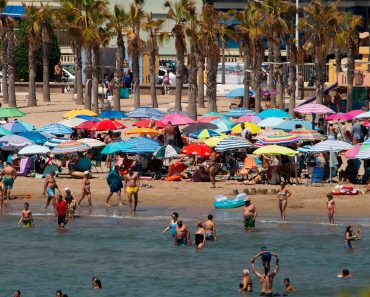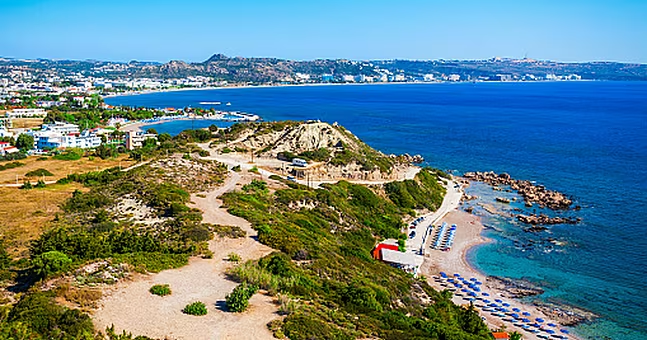

Not war, not high fuel costs, not rising prices on airline tickets, not the remaining volatility over the tense cease fire between the United States and Iran, not notorious pickpockets, not frequent protests and transportation shutdowns, nor heat waves.
None of those – with summer just started, Greece hasn’t heated up yet after a 2025 season that brought a day that reached 45.8 degrees Celsius (114.4 Fahrenheit) – is keeping record numbers of tourists from coming.
And neither has repeated fires, especially the 2007 wildfires that killed 85 people – 67 in August alone, including teacher Athanasia Paraskevopoulou and her four children, trapped in their car near their Peloponnesian summer home, a real Greek tragedy.
Nothing is keeping tourists away, the Bank of Greece reporting a 27.1 percent increase in arrivals in the first four months – the slowest – but still seeing 5.24 million visitors and receipts of €2.79 ($3.16 billion.)
So far, there haven’t been any major fires like those of 2024 and 2025 when devastating blazes swept through regions including Attica, the country’s second-largest island Evia, and Dodecanese islands.
Those forced scary evacuations of tourists, on beaches on Rhodes, and burned 221,430 acres, frightening scenes seen around the world on TV, the Internet and social media – but it didn’t keep the hordes from continuing to come.
While tourists aren’t thinking of fires, the Greek government is and has significantly bolstered its firefighting forces and capabilities even if tourists have shown not even the videos of flames licking at resorts will keep them away.
Greece’s firefighting capabilities for the 2026 season are highly prepared, with more firefighters and the European Union’s largest coordinated wildfire deployment in history. Authorities are utilizing new drone surveillance, deploying an augmented international aerial fleet, and stationing hundreds of pre-positioned European firefighters across high-risk regions, said GTP Headlines.
The government of Prime Minister Kyriakos Mitsotakis has devoted almost as much attention to preventing and fighting fires as it did in building an arsenal of defense against any Turkish belligerence.
In May, the civil protection strategy that was outlined focused on protecting forest areas near major urban centers – fires two years earlier had reached the outskirts of some Athens neighborhoods – and having forces ready to scramble like fighter pilots.
The effort took off in 2022 through the Forest Service and the 2026 plan set aside 864 million euros ($981.84 million) for prevention and funding for restoration works and environmental studies, the site noted.
Homeowners, including those with island or village residences, are required to clear brush away from their structures, as are municipalities, the failure to do so previously responsible for much of the devastation.
Greek law and the Constitution have allegedly prohibited developments on burned land but loopholes and legalizing unlawful construction – for a fee – allowed building where there had been forests, making arson profitable.
After the July 2018 wildfire northeast of Athens killed 104 people and almost wiped out the seaside village of Mati, then Prime Minister Alexis ‘Clueless’ Tsipras – who took only “political responsibility” for failing to have a disaster plan or even text alerts – said unlawful buildings that contributed to the toll would be demolished.
There was a fake show of some efforts to do so to fool the public again – it always works – but it wasn’t long before it was back to business as usual and the country is still packed with buildings erected unlawfully, including on protected lands.
The practice of building where you want and ignoring the law is known as ‘afthereta’ and those structures in Mati blocked escape routes and trapped victims, including 9-year-old twins Sofia and Vasiliki Philippopoulou and their grandparents, four of the 26 people found dead on a cliff overlooking the sea.
Four former top-ranking fire and civil protection officials – but no government officials – were jailed after a court overturned leniency that would have allowed them to pay off their sentences for 10 euros ($11.36) a day.
The elderly man who started the blaze in the neighborhood of Penteli, Konstantinos Aggelopoulos, was found guilty of arson through negligence for burning wood scraps and garden waste on his property on a windy day. No jail though, just 10 euros a day.
Greece isn’t in Tsipras’ hands anymore, although he wants to return to power so he can try to finish ruining the country, and while there’s no stopping arsonists, accidents, heat waves, and high winds from spreading fires, at least there’s a higher readiness level.
That includes using drones and high-tech to scout hills, including around Mount Penteli which has burned 14 times since 1981, including a 2009 conflagration that destroyed 200,000 acres and thousands of trees.
But danger remains.
Forestry officials said there is still understaffing despite the beefing up of the service, and they’re worried about the effects of climate change that created conditions that let wildfires rampage despite huge containment attempts.
The European Union has given Greece hundreds of millions of euros to pay for more firefighters but the 2010-18 austerity measures during a financial crisis severely weakened the ability to deal with wildfires.
“It is not always easy to fill within two or three years a gap made over two decades,” Stathis Stathopoulos, who runs the forestry service at the Environment Ministry, told Reuters. He added: “Anyone who says that they have the magic wand to eliminate fire as a phenomenon is probably not telling the truth.”