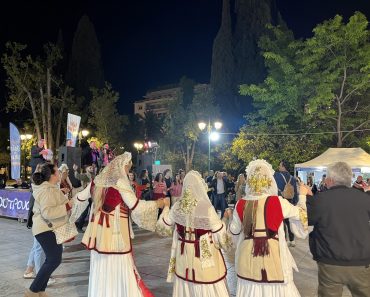

The 11th annual Greek Jewish festival brough huge crowds to the short narrow block of Broome Street between Eldridge and Allen Streets on May 17. This was no ordinary street fair, however. With temperatures in the 80s, a musical stage, dancing, a couple dozen culturally specific food, art, history and other booths, as well an abundance of Greek, Israeli and American flags, it felt more like summer in the agora than springtime on the Lower East Side.
While Jewish celebration has been a familiar neighborhood story since the late 19th century, these Jews are different, they and their synagogue, Kelina Kedosha Janina (KKJ) at 280 Broome St., are representatives the Romaniote tradition of Greece, which dates back to the time of Alexander the Great in the 4th Century B.C.
The importance of Greece—and Hellenistic culture generally—in the histories of Judaism and Christianity can’t be overstated. Yet, such are vicissitudes of migration, KKJ is the only Romaniote synagogue not just in New York but in the western hemisphere. Their settlement here wasn’t easy. Besides being immigrants, the Greek-speaking Romaniotes weren’t readily accepted by the the dominant, Yiddish-speaking Ashkenazi Jews from Eastern Europe, let alone the older generations of well-established Middle European Jews.
With help from sympathetic Sephardic Jews from Spain, Portugal, the Mediterranean and North Africa, who were themselves also relative outsiders in New York, KKJ was organized in 1906. The congregation has occupied its present modest three-story edifice since 1927.
As KKJ approaches its centennial, the Romaniotes travails have clearly turned to triumph for as crowded and loud as this year’s festival was, that too is part of this block’s history.
When KKJ opened its doors, the elevated Second Avenue IRT subway line ran above Allen Street, just steps away. Even when the elevated ceased operation in 1942, KKJ’s neighbors were the five and six-story tenement buildings that remain here today, with ground floor shops, including its neighbor, Greenberg’s Cafe and Restaurant, whose neon signage alone was three stories tall.
Today, , KKJ is itself an attraction, not just as a house of worship also a museum, which opened on the building’s second floor women’s gallery in 1997. Though Romaniate Jews aren’t numerous, KKJ still holds regular Saturday services, boosted by Sephardic Jews, who have no local temple and whose rites overlap with the Romaniotes, and curious Jews from other traditions, including Ashkenazi. KKJ was designated a New York City Landmark in 2005 and held its first Greek Jewish Festival in May 2015.
Today, among KKJ’s Board of Trustees, are President Marvin Marcus, a retired Brooklyn public high school teacher; Marcia Haddad Ikonomopoulos, who also serves on the board of the Lower East Side Preservation Initiative (LESPI); and Hazzan and Treasurer, Chaim Kofinas, a KKJ bar mitzvah boy and Certified Public Accountant. Theo Canter, a recent Oberlin College graduate and Fulbright Scholar in Athens, Greece, is KKJ’s face of youth as multi-lingual, multi-instrumentalist musician and Community Engagement Fellow.
Greek Jewish Surf Music & A Pinpoint Map of the Diaspora
Judging by the teeming, happy crowds that jammed Broome Street body to body, curb to curb, the trustees are performing their roles well. The festival officially ran from noon to 6 p.m., with metal barriers set up outside Allen and Eldridge Streets and private security guards at these entry points and at KKJ itself, which was open for guided tours throughout the day. There was no formal screening to enter the block, which was notable, given the many Israeli flags and other pro-Israel messages seem among the festival attendees.
Outside the barrier on Allen Street, this included a silver-haired man in a brown and yellow Israel Defense Forces t-shirt and an Israel ball cap, holding an Israeli flag in one hand and a United Jewish Appeal (UJA) printed sign reading PROUD New Yorkers Jews Zionists,” with the Star of David replacing the “O” in PROUD.
A stage set up just inside the Allen Street entrance played host to musicians and dancers, the latter including invited performers, like the St. John’s Hellenic Dancers of Blue Point, and people from the crowd when various bands were playing. A highlight among these groups was the Noga Group featuring Avram Pengas.
It’s difficult to say exactly what kind of music Pengas, who is himself Romaniote-Sephardic and a highly skilled guitarist, bouzouki player and singer, and his band play because it’s such a rich stew of styles. Somewhere in there are the sounds of Greece, Israel, Turkey, Armenia, the Levant and more, which at times came out sounding like the instrumental parts of the revered 1970s New York band Television, or some kind of Middle Eastern surf music. This isn’t a contradiction, as surf guitar progenitor Dick Dale’s was of Lebanese descent and influenced by Levantine Arabic music.
Just how complex this heritage is was demonstrated by a large map of Greece and its surrouding regions affixed to the rolldown gate of a Broome Street store. “Trace the roots of your ancestors,” it read. “Show us where your family is from,” with the provided dot stickers. The locations with the most dots were Ioannina and Thesalonki in Greece but many other Greek cities are also marked, as were localities in today’s Albania, North Macedonia, Turkey and Bulgaria.
Other expressions of cultural pride included souvenir KKJ and “With a Sephardi It’s Always a Party” t-shirts, and various Romaniate and Sephardic books for sale. Among the many community partners, the Saint Barbara Greek Orthodox Church at 27 Forsyth St., adjacent to the Manhattan Bridge in today’s Chinatown stood out, not just as an example of interfaith Greek soliditary but because, when it opened in 1892, it was as the Kol Israel Anshe Poland synagogue. Opa!