Love songs are, almost by definition, dreamy things. It doesn’t matter if they’re about romance gone right or very, very wrong, so long as they capture that heady feeling you get when thinking about the more intense side of love. What matches that expansive, disorienting experience better than Greek mythology? On first blush, there might not seem to be much in common between a love song and the fabled tradition that gave us a half-bull monster in a maze and the brutal events of the Trojan War. But the connections — longing, connection, and loss — are very much there. No wonder so many modern musicians have been inspired by Greek myth.
Think about Odysseus, the wily hero of Homer’s “Odyssey” who spends years dodging divine hazards to get back home to his wife, Penelope. Of course, there’s also the ancient myth of Persephone and Hades, the god of the dead. Despite modern finagling with the details of just how Persephone got to be queen of the underworld, her story still contains a rich vein of dark romance for musicians to mine, millennia after reed and ink first put it to papyrus. These stories have real power, moving musicians to write their own myth-tinged love songs calling back to the tales of our deep past.
Song to the Siren — Tim Buckley
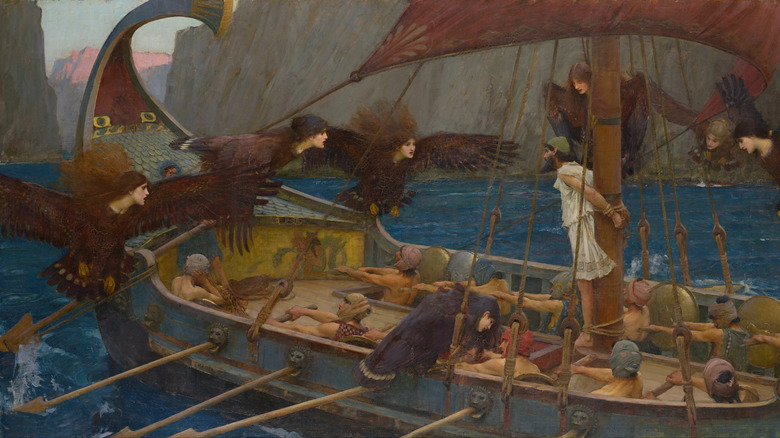
As described in Greek myth, sirens are half-woman and either half-bird or half-fish — and definitely not mermaids. Despite the alarming look, their voices are so entrancing that sailors are compelled to follow — never mind if that ends in drowning or shipwreck. In the “Odyssey,” Odysseus and his crew know they will be sailing past the sirens’ haunt, so he directs his sailors to plug their ears with wax. Ever curious, he has himself tied to the ship’s mast so he can hear the song and survive.
This is all pretty heavy stuff for a love song, but then love is so often a complicated, even dangerous thing. Lyricist Larry Beckett and musician Tim Buckley clearly knew this when writing “Song to the Siren.” Here, the sailor knows exactly what he’s in for. “Now my foolish boat is leaning / Broken, lovelorn, on your rocks,” sings Buckley. He performed it on, of all things, the last episode of “The Monkees” in 1968. But, stung by teasing over one line — “I’m as puzzled as the oyster” — Buckley refused to record “Song to the Siren” until it was rewritten. Alas, that meant Pat Boone got in first with a 1969 cover, which turned a haunting meditation on love and longing into a goofy embarrassment.
Despite Buckley’s early death in 1975, the song got another chance when Elizabeth Fraser recorded a 1983 cover with This Mortal Coil. Originally meant as a B-side, it sold around 500,000 copies and led to even more renditions from infatuated artists like George Michael, Sinead O’Connor, and Robert Plant.
Sunlight — Hozier
At first, Hozier’s “Sunlight” might seem like another of his dreamy, complex love songs, but take another dig through its densely metaphorical lyrics. Yes, right there, where he sings “Oh, your love is sunlight” and “Know that I would gladly be / The Icarus to your certainty.” He’s ready to take flight, knowing what fate has in store. “Death trap clad happily,” Hozier sings. “With wax melted, I’d meet the sea / Under sunlight, sunlight, sunlight.”
As for the inspiring myth: Daedalus, a brilliant inventor, was imprisoned by King Minos of Crete (yes, the very same guy who kept the Minotaur imprisoned in a labyrinth). Daedalus comes up with a plan that will allow him and his son, Icarus, to escape: They will fashion wings out of feathers and wax. The scheme actually works, though Daedalus warns Icarus not to fly too high, lest the warmth of the sun melt the wax and send the young man plummeting in a flurry of feathers. Icarus, overcome with the joy of flight, ignores the warning and meets that very fate.
For generations, English teachers and classics professors have used the story of Icarus to hammer home the concept of hubris. But where’s the fun in simply repeating all that? Plenty of artists have taken the Icarus myth and used it as the basis for new work, from paintings to poetry. Hozier’s version goes beyond youthful overconfidence, infusing the song with greater understanding, even if the singer acknowledges that romantic oblivion waits.
Calypso — Suzanne Vega
The “Odyssey” is ripe with potential love stories, though any romance will have to contend with the peril and grief that also weave themselves through the work. That sort of tension makes for a pretty interesting love song so long as you have a tolerance for downbeat endings. Case in point: singer-songwriter Suzanne Vega’s “Calypso.” In the epic poem, Calypso, one of the legendary nymphs of Greek myth, rescues Odysseus but holds him captive for years. When it becomes clear that he still longs for home and his family — despite an idyllic island setting with luxuriant foods and promises of immortality — she releases him.
As the poem hints and Vega’s song makes clear, this is a pretty one-sided love affair. “And though he pulled away / I kept him here for years,” Vega sings. “… I will stand upon the shore / With a clean heart and my song in the wind / The sand may sting my feet / And the sky will burn / It’s a lonely time ahead / I do not ask him to return.”
The song ends there, but other accounts couldn’t help but embellish the tale. Roman poet Propertius wrote in his “Elegies” that Calypso watched Odysseus go, then descended into extravagant sadness, “mourning for many days with unkempt hair, pouring out speech to the cruel brine.” Vega at least gives the nymph more dignity, with a dreamy, heartbreaking song that leaves her on that distant beach.
Persephone — Tamino
There’s been a rosy retooling of the Persephone myth, but don’t believe the lies — the original tale is starkly brutal. In the “Homeric Hymn to Demeter,” one of the earliest known texts to tell the story, Hades “seized her against her will, put her on his golden chariot / And drove away as she wept.” The harvest goddess Demeter searches desperately for her daughter, generating a grief so tremendous that humanity nearly starves.
Hades tricks Persephone into eating pomegranate seeds in the underworld, so when Demeter finally tracks them down, Persephone must spend part of the year amongst the dead. Hades tells Persephone that at least she will be a powerful queen. “Do not be too upset, excessively so,” he says in the hymn. “I will not be an unseemly husband to you, in the company of the immortals.”
All of this is to say that Tamino’s dark love song, “Persephone,” is far more suited to the source material. Sung from the perspective of Hades (or at least someone who fancies themselves as such), this is a love that’s fractured and possessive. “And then I made sure / You would always return / You still know of dawn / But you always return,” he sings. He also acknowledges that he’s done wrong: “But in your sacred air I am full of light / Your loving arms are the true delight / To which I’m lost.” It’s darkly beautiful, with haunting music and Tamino’s compelling, moody voice — but let’s hope that this sort of love never comes to take one of our daughters away.
The Origin of Love — Hedwig and the Angry Inch
The 2001 film “Hedwig and the Angry Inch” tells the tale of Hedwig, a singer who left East Berlin, underwent gender reassignment surgery, and found themselves in Kansas (though at least with a killer fictional rock band). With its mish-mash of musical influences and grubby punk aesthetic, you might be surprised to see Greek mythology pop up — but it makes total sense.
For “The Origin of Love,” Hedwig draws on Plato’s “Symposium,” written sometime around 380 B.C.E. In fact, she’s basically retelling the story. But though Plato’s text might traditionally be interpreted as a way to hold up stereotypes about gender and love, “Hedwig and the Angry Inch” openly questions such assumptions. In “Symposium,” the playwright Aristophanes says that, originally, there were men, women, and a combination of the two. He goes on to say that each consisted of two people essentially mashed together back-to-back. “Terrible was their might and strength, and the thoughts of their hearts were great, and they made an attack upon the gods,” Aristophanes relates.
The gods considered deadly lightning bolts (it had worked against the giants, after all) but didn’t like the idea of missing out on human worship. The compromise was to split the creatures in half, with the assurance that Zeus would do it again if the god-bothering continued. Thereafter, people would always be searching for someone else to complete them. It’s not exactly romantic in Plato’s hands, but Hedwig turns it into a gorgeous song of love and transformation.