A viral TikTok is raising a question that has puzzled historians for centuries: Why does one of Christianity’s most beloved saints appear with the head of a dog?
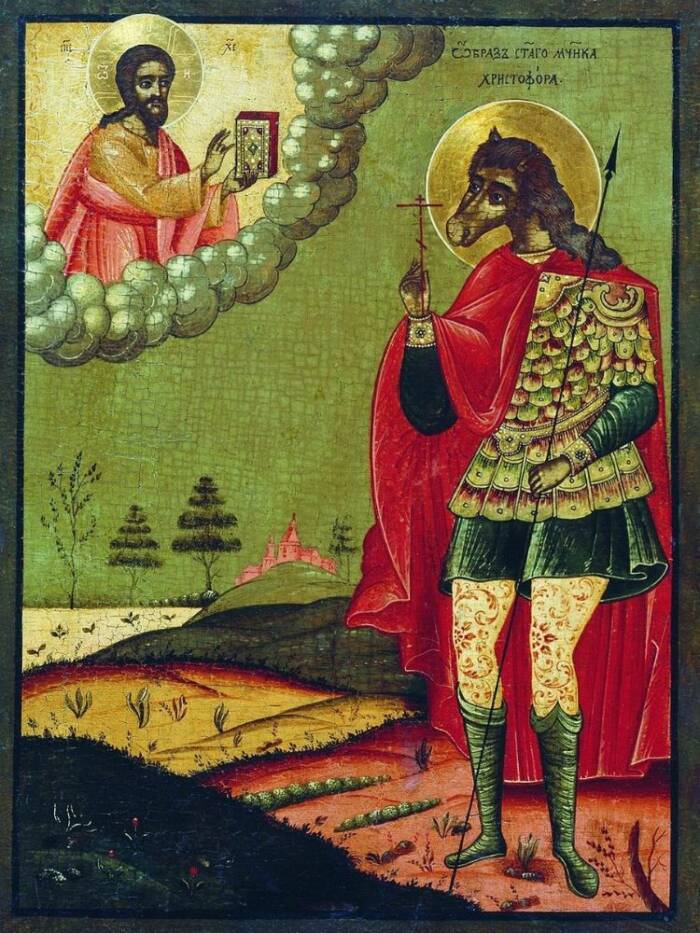
Public DomainAn 18th-century Russian painting depicting St. Christopher with the head of a dog.
If you’ve spent any time in an Orthodox church or down an art history rabbit hole, you may have seen an odd-looking saint, robed and haloed with the head of a dog. That’s St. Christopher, the patron of travelers.
TikTok creator @thedoctorregenerated recently went viral for pushing back on the popular explanation that St. Christopher ended up with a canine head because a medieval scribe confused the Latin word Cananeus (Canaanite) with canineus (dog-man).
That theory, @thedoctorregenerated argued, is too neat. If a single copying error could turn a saint into a dog head, why do similar dog-headed figures (referred to as cynocephali) appear across cultures with no connection to each other, from ancient Greece to Egypt to Peru?
The Ancient World’s Obsession With Cynocephali
Cynocephali, which translates literally to “dog-heads” in Greek, weren’t obscure figures. Writers from Pliny the Elder to Marco Polo filled the edges of their maps with societies of dog-headed folk. Ancient Greek historians described them as living at the far reaches of the known world, and they were even said to bark.
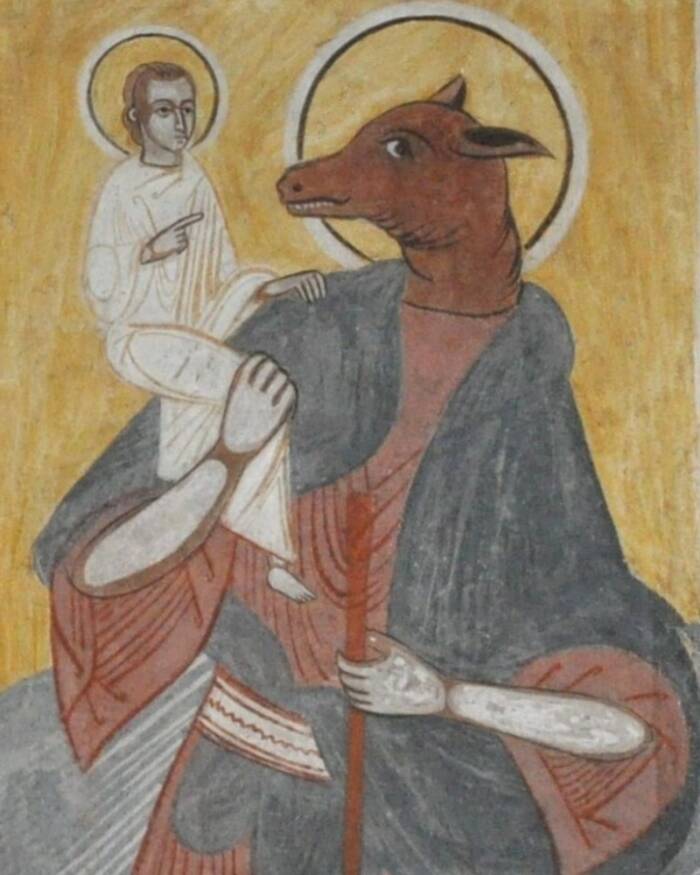
Țetcu Mircea Rareș/Wikimedia CommonsAn 1806 fresco in a church in Romania featuring a dog-headed St. Christopher carry Christ across the river.
By the time Christianity was spreading across Europe, cynocephali were already a deeply established part of how people conceptualized those who were different from them, who lived at the very edge of civilization, beyond the boundaries of the known world.
It also created the question: If dog-headed people existed, did they have human souls? If so, did that mean Christians had a duty to try to convert them?
The Legend Behind St. Christopher
According to legend, Christopher was a warrior cynocephalus, a dog-headed man from Canaan who was taken from the far end of the world, converted to Christianity, and was martyred by a Roman emperor.
His journey with Christianity began when a white-robed intermediary appeared to him and breathed into his mouth, granting him the power of speech, according to JSTOR Daily. With his conversion came a new name: Christopher, meaning “Christ-carrier.” In the western version of the story, he becomes a giant who helps people cross a river, one day carrying a child who grows heavier and heavier until Christopher realizes his passenger is Christ himself.
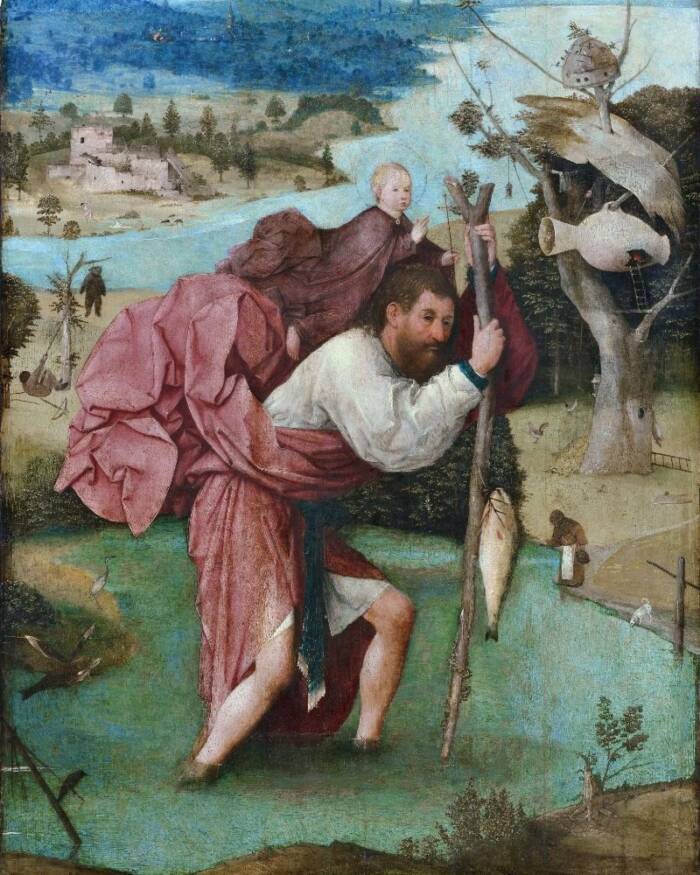
Public DomainSaint Christopher Carrying the Christ Child, Hieronymus Bosch (circa 1500).
In the Orthodox tradition, this dog-headed warrior saint persisted in iconography for centuries, even as the Western Catholic Church eventually settled on a more conventional image of a large, bearded man wading through water. The dog-headed figure was formally banned in Russia in the 18th century, but it never disappeared entirely. In parts of Eastern Christianity, it survives to this day.
The “mistranslation” explanation misses all that context.
In medieval Christian thought, the cynocephali represented the ultimate outsider, someone living at the absolute margins of humanity, beyond language, beyond civilization, beyond the reach of “the gospel.” The dog head was a statement that even the most monstrous, foreign being could be transformed by faith.
Other Animal-Headed Figures In Religious History
The idea of a holy figure with an animal head wasn’t strange to most of the ancient world. Egypt alone was packed with them.
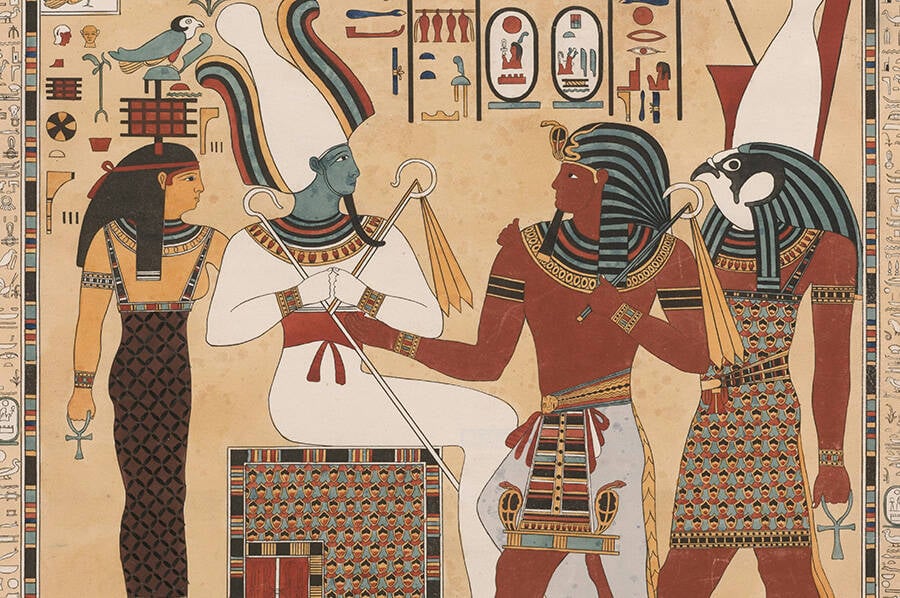
New York Public Library/UnsplashMany Egyptian deities are depicted with animal heads, such as the falcon-headed Horus.
Egyptians transferred the qualities they observed in animals directly into their gods. Anubis, the jackal-headed god of the underworld, presided over mummification and the dead. Sekhmet, with the head of a lioness, was the goddess of war. Horus, a falcon-headed god, represented the sky and divine kingship.
Hindu iconography gives us Ganesha, the elephant-headed god of beginnings and patron of intellectuals and scribes who remains one of the most widely worshipped deities on Earth today. Greek mythology produced the bull-headed Minotaur, the half-horse centaur, and Pan, who is half-man and half-goat.
These deities add to a long tradition that links animals and religious figures — and to the complexity of St. Christopher’s story.
After reading about St. Christopher and the ancient legend of the cynocephali, go inside the stories of seven Christian martyrs. Then, discover 33 of the most fascinating mythological creatures from around the world and the ancient fears they embodied.