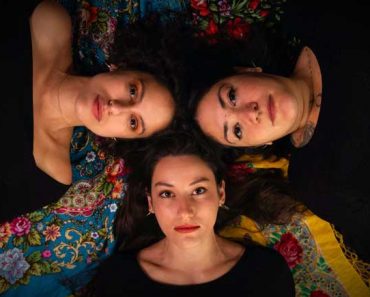

Watching a creative truly come into their own is always something special. Some spend years waiting for the moment they finally stop holding back, ready to leap headfirst into the fullest expression of themselves. Others find comfort in the safety of familiarity, reluctant to step beyond the lines they’ve drawn around their creativity. For Georgian-born, Greece-based artist Tamta Goduadze (better known as Tamta) it was a collision of both. Beneath the polished pop persona, there had always been a quieter urge for reinvention — a desire to break open and step into something more honest, more instinctive, more her. Buried for years, it eventually demanded to be heard.
Expressive freedom has always pulsed beneath Tamta’s work. Born and raised in Tbilisi, she left behind her life, her friends and everything familiar, finding solace in music along the way. In 2004, she entered Greece’s Super Idol, the televised talent competition that would alter the course of her career, ultimately winning second place. The platform propelled her into pop stardom, leading to more than 250 million combined streams and views, and cementing her status as one of Europe’s most enduring pop figures. Since then, her career has stretched across global stages — from bringing Greek music to audiences through events like the Eurovision Song Contest, where she represented Cyprus, to commanding Pride stages with the same unapologetic energy.

For years, Tamta’s sound was rooted in conventional pop melodies, largely delivered in Greek and threaded with international influences that travelled far beyond national radio. But with the release of her 2023 album, Identity Crisis, a clear shift began to emerge. Darker textures crept in. Edges sharpened. The polished pop exterior gave way to something more experimental, more emotionally exposed, prompting one obvious question: where did this transformation come from? “I introduced myself as a new persona, but this persona was always inside me,” says Tamta. Leaning further into alt-pop, post-punk and electronic distortion, her latest single, ‘Autotapinosi’ (Greek for ‘self-humiliation’) captures that evolution perfectly.
Here, Tamta sits down with us to unpack the creative awakening behind her sonic reinvention, and how she finally embraced the most liberated, fearless and occasionally chaotic version of herself. A transformation well worth witnessing.
Tell me a bit about your childhood and where you grew up. How did you decide to become a music artist?
My connection to music started very early. I was in a children’s singing group from the age of six. I also played the piano which was mandatory when growing up in the Soviet Union. Back then, I went through many auditions and singing competitions, so in a way I was well-trained and prepared from a very young age for what I’m doing now.
During my childhood I had a lot of intensity and big life changes which meant I had to grow up quite fast, both personally, because I had a huge responsibility of being a mother, and politically because of the situation in my country during the ’90s. So I think that shaped how I experience emotions and how I deal with things in general.
For that reason, for many years in my career, I didn’t touch those deeper emotional parts in my music. Maybe I was placed more in the space of a pop artist that mainly served an uplifting, lighter side of pop music. I loved it, but I stayed in that safety net for a long time.
When I moved to Greece, Super Idol came into my life. I won second place in 2004 and that’s how it all organically started for me.

Moving from Georgia, how did you situate yourself in the Greek music landscape?
I didn’t come to Greece to be a singer. I left my hometown for many reasons and just moved to Greece to be with my mom. I had no idea what I’m gonna do in Greece nor that I would have moved there permanently. One day, my mum came home and told me: “I’ve heard about an audition for Super Idol“. I was like, “Mum, are you crazy? I don’t even speak Greek”. She was like, “Please do it for me and you will see”. Those were her words.
I just went to the audition without knowing almost any Greek at all. At the time, a Greek singer did the remake of ‘Torn’ by Natalie Imbruglia in Greek. I decided to write down the Greek lyrics in Georgian and I was just holding them in front of me and singing the song during the audition. Not knowing Greek also helped me at some points during the process because it meant that I couldn’t understand the negative comments either. I was just happy to sing, really. That experience totally changed my life — I didn’t care about what people were saying. I was just living my dream.
You launched THE VILLAIN HEROINE last year, a noticeably different take on music than your previous releases, and a far more alt-pop one. What sparked that shift?
I was always a crazy one. I always wanted to do different stuff and to experiment. Greeks love their traditional music, which I also love and respect very much, but unfortunately I didn’t grow up there, meaning that it didn’t come as easy for me. To be honest, for the longest time I was happy to survive in Greece by doing the things people wanted me to do.
I came from a very difficult background, so as long as I was singing, it didn’t really matter to me. I didn’t really think much about what music I was making back then, because I was just happy to be able to go to the studio and perform. Because of my childhood and all the situations I had been through, I was always on survival mode. I felt like I just had to do things to survive, to sing songs that radio stations wanted me to sing, so they could play my music.
Don’t get me wrong, I love everything about what I did as it’s made me what I am now. But then the pandemic happened and everybody had time to sit at home and think. For many years I had to work to support my family, so I was afraid to get out of the box. By the time my daughter was 25 years old, I knew she could stand by herself — she’s very smart and I’m a very proud mother. For the first time, I was able to tell myself: “Now you can do whatever you want to do, and if it doesn’t go well, I’m gonna survive because I know that my daughter is fine.”
That was one of the main things that made me think about starting from the very beginning to build and reinvent myself, which I love doing. That’s where the Identity Crisis album started, which was released in 2023. I introduced myself as a new persona, but this persona was always inside me. I didn’t just wake up one day like that. Now, I’m so grateful to have the opportunity to express myself the way I want to. It’s a very big deal for me and for every artist.

What were the sources of inspiration you tapped into when going through this transition?
At the time, I was pretty depressed and my friend and producer TEO.x3, who I have been working with for many years, said to me, “Let’s think about what we can do, and I’m here to help you”.
I was in that box creatively for almost 20 years, so it was not easy to change radically. In my life, I had to battle multiple times with fear, but I felt ready then. I am fortunate to be working with a super talented team of writers. Every four months we do music camps together and it was during one of those that we started to explore my music outside the box. There wasn’t really an artist looked up to for reference, we simply set ourselves free.
Since THE VILLAIN HEROINE, there have been more experimental sounds in your songs, blending electronic effects and post-punk elements. Why did you feel that was needed in your music?
They came from mine and TEO.x3’s crazy minds. To be honest, I’m not a technical kind of a girl, so I can’t really talk about the technical stuff that TEO.x3 is doing. When we are at the studio, I usually explain the sounds I imagine using my hands and he simplifies things for me.
Overall, I’m a very creative person and I like to evolve with the times. I have done a lot of English songs before. I love listening to different languages and the music itself. There are two kinds of listeners, for example, especially in Greece, they are very into lyrics. For me, music comes first. So my aim was to do Greek pop music, which I think didn’t really exist.
Let’s talk about ‘Autotapinosi’. How would you define the word?
It sounds pretty provocative as a word, but is not meant literally. For me, it’s about the moment where someone consciously gives away power because of desire. It’s quite a sexual song, placing a woman basically at the centre of attention.

In ‘Autotapinosi’ there are phrases like ‘I control’ and ‘obey’. What message did you want to convey here, and how does it fit into what female empowerment means to you?
It’s about female empowerment and also awareness — knowing what you’re doing and chasing your position in the dynamic. It’s about having ownership. Moving between control and surrender without losing yourself. As women, I feel like we’ve all somehow been in this situation at different points in our lives.
To be honest, with female empowerment, I can’t believe we’re still in this position. Personally, as a woman, I have been through things that I don’t think there is a man who could have handled. If we compare women with men, I honestly think that we’re more powerful. It’s not about the muscles and strength, but rather about what is inside.
We’ve seen some amazing fashion appearances from you. What is your main source of fashion inspiration?
My greatest fashion inspiration is my mom. When I was young, she used to make my clothes, which really made me stand out. At school events, parents were asked to dress us in just a white shirt and a blue skirt, but my mom refused to have me dressed exactly the same way as the other children.
If I wasn’t working in music, I would have definitely studied and done things related to fashion. Most of the time I style myself for my performances or music videos. I like to dare and play with a lot of different styles. Even back when I was making more pop music I would wear some extraordinary clothes for Greece. It’s funny because when brands gift me clothes, they always choose their craziest stuff because of that. But really, it’s all about the aesthetic. It can be minimalistic or maximalistic. But I’ve always been experimenting and reinventing myself fashion-wise.

Who are some of your favourite fashion designers you’ve worked with, and who would you like to be dressed by in the future?
I’m drawn to fashion designers with a strong identity — people who are not trying to be safe or predictable. There are a lot of extremely talented and truly creative designers nowadays. Just to name a few, I am a huge fan of London-based George Keburia, Berlin’s Berhasm and Georgian Lado Bokuchava, God-Era, Situationist, Institution, Invasive Modification, and of course, now Gucci’s creative director Demna Gvasalia. Of course, I am really proud of Greek designers, as well, including the likes of 240791ke by Eleni Kavada, Aarcivess and Sailorsmelody.
You’ve given some great performances at Pride events. What does your musical presence at LGBTQ+ events mean to you?
It means a lot to me, because from the very beginning of my career, the community has supported me like no one else. I’ve always felt a real connection there. I’m a pop artist and there’s a level of openness and freedom in those spaces that feels very honest. I don’t take that for granted. We stand by each other with respect and support all the way.
What can we expect next from you?
I am coming back to London in October to perform at Colours Hoxton for the second time. Performing is part of my psychotherapy, because I’m not a very expressive person in my life. When I get on stage, I go through every emotion. It’s the place where I express myself honestly and freely, so I can’t wait for that.
At the moment, I am also performing at the Smut in Athens every other Sunday. It’s a queer techno club, which is something totally different from what Greek people are used to. I’m having the best time of my life there.
There is also my next album coming soon. This one will be mainly in English. It’s heavily inspired by heavy metal music, but as always, it remains pop at its core. I’m really excited to share it with all of you soon.
- WriterMaria Papakleanthous
- Photo CreditsLena Knappova