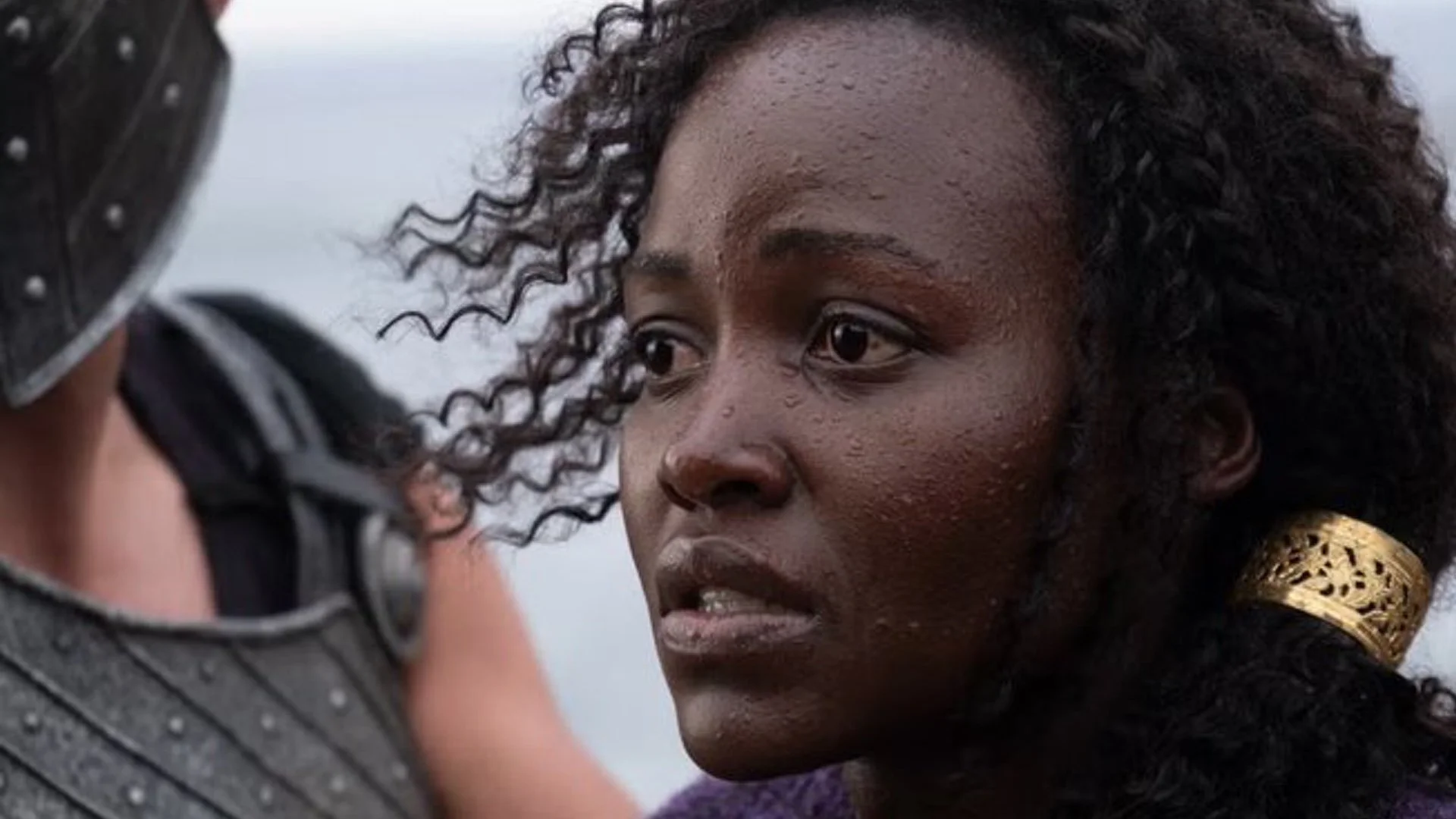

Helen of Troy probably was not imagined by the ancient Greeks as a black woman.
We can acknowledge that openly without pretending the surviving literary and artistic traditions from antiquity suggest otherwise. Homer’s descriptions, later Greek art, and the broader literary tradition surrounding Helen point elsewhere.
But is that really the issue?
What we should ask ourselves is whether or not Christopher Nolan is actually doing anything especially radical here.
He is doing what storytellers, playwrights, painters, filmmakers and audiences have been doing with Greek mythology for thousands of years: retelling it through the lens of their own era.
And judging by the online reaction, you would think he set fire to the Parthenon.
Elon Musk weighed in. Various online commentators weighed in. Social media transformed into a symposium on the racial authenticity of a possibly fictional Bronze Age queen whose story has already been rewritten continuously for nearly three thousand years.
The argument was familiar by now: Hollywood was abandoning “historical accuracy” in favor of modern identity politics. Almost all of them gave the inevitable response:
“Then cast a white actor as Malcolm X or Martin Luther King Jr.,” they all said.
But that comparison collapses almost immediately.
Malcolm X’s Blackness is not incidental to his story. Neither is Martin Luther King Jr.’s. Their racial identity is inseparable from their stories: segregation, civil rights, anti-Black violence, and the historical reality that shaped their lives and legacy. Remove that reality and the story itself fundamentally changes.
And this is where the conversation becomes more nuanced than social media usually allows.
A few years ago, I strongly criticized the portrayal of Cleopatra as a black woman in a popular documentary. Not because race-swapping automatically destroys a story, but because Cleopatra’s Greek identity was historically central to who she was. Cleopatra was a Greek woman ruling Egypt as a member of the Ptolemaic dynasty that emerged after Alexander the Great. Her Greekness was inseparable from the political and historical reality of her story.
Just like Malcolm X and Martin Luther King “must” be always portrayed as black, so must Cleopatra always be portrayed as Greek.
Helen of Troy is different.
Helen’s story is not fundamentally about race or ethnic identity. Her race or ethnicity were not central to her story. Helen’s story is about beauty, desire, vanity, blame, war and power. Her appearance matters because she is meant to embody irresistible beauty. But her racial identity is not the engine of the narrative in the same way it is for Cleopatra, Malcolm X, or Martin Luther King Jr.
That distinction matters.
And it becomes even more interesting once you remember that the ancient Greeks themselves constantly reinterpreted their myths.
Take Helen herself. The very woman everyone is now arguing about.
In Homer’s telling, Helen goes to Troy. Later writers changed that entirely. The poet Stesichorus famously claimed Helen never went to Troy at all. According to his version, the gods created a phantom Helen while the real Helen remained safely in Egypt during the entire war. Herodotus entertained similar versions. Euripides later transformed this reinterpretation into an entire play called Helen.
So before modern audiences began debating what Helen looked like, the ancient Greeks were still debating whether she was even physically present at the Trojan War in the first place.
And this was hardly unusual.
Greek myths evolved constantly depending on the writer, the century, the politics, and the audience hearing the story. Aeschylus, Sophocles, and Euripides routinely reshaped the same myths differently. Heroes changed personalities. Villains became sympathetic. Entire plotlines shifted.
The myths were alive. That is precisely why they survived.
And the reinvention never stopped. Christopher Nolan is simply the latest storyteller inheriting these myths and reshaping them through the anxieties, aesthetics and conversations of his own era.
The Romans reinvented Greek mythology for Rome. Renaissance Europe painted Greek figures as Italians. Victorian artists transformed Bronze Age warriors into pale aristocrats dramatically posed in oil paintings. Hollywood spent decades giving Ancient Greek warriors British accents.
The Coen Brothers transformed The Odyssey into O Brother, Where Art Thou?, relocating Homer’s wandering hero to Depression-era Mississippi with bluegrass music, escaped convicts, corrupt politicians, and a one-eyed Bible salesman standing in for Homer’s Cyclops on a dusty southern roadside.
Disney turned Hercules into a wisecracking celebrity teenager surrounded by gospel-singing muses. The Amazons became Wonder Woman.
Achilles has appeared as everything from a blond Hollywood warrior to an anime hero to a psychologically tortured antihero wrestling with masculinity and identity.
Then came Broadway. Orpheus and Eurydice became Hadestown, a Tony Award-winning musical filled with jazz, folk music, labor politics, and industrial capitalism.
I do not recall anyone collapsing into outrage when an Irish actor, Colin Farrell, portrayed the Greek warrior Alexander the Great while Angelina Jolie— barely a year older than him— played his mother.
Historical purity, it seems, can be remarkably flexible.
Greek mythology absorbed all of it.
Because mythology was never meant to remain frozen.
But the fury surrounding Nolan’s casting says something interesting about who suddenly becomes deeply invested in “historical accuracy.”
Greek mythology has survived anime Achilles, Irish Alexanders, Broadway Orpheus, comic-book Amazons, gospel-singing muses and every imaginable artistic reinvention for generations.
Yet somehow, for some viewers, this is the adaptation that suddenly threatens historical integrity.
That tension is difficult to ignore.
Christopher Nolan is not breaking Greek mythology. He is participating in the oldest Greek tradition there is: reinterpretation.
And frankly, the people demanding rigid historical purity from mythology are asking something the ancient Greeks themselves never demanded.
These are stories where gods transformed themselves into swans, bulls and birds. Prophecies destroyed bloodlines. Monsters lurked at the edges of the world. Entire wars began because of wounded vanity and divine manipulation.
The ancient Greeks understood something modern outrage culture often does not.
Myths survive because they evolve. And Greek mythology will survive a black Helen of Troy, too.