
Greek cinema achieved a historic milestone at the 79th Cannes Film Festival as Eva, directed by Greece’s first female director, Maria Plyta, became the first restored Greek film ever selected for the prestigious Cannes Classics.
This 1953 drama is considered a cinematic work ahead of its time. The film tells the story of Eva who, trapped in an unsatisfying marriage and living a monotonous life on an isolated Greek island, is swept up in a summer romance with Antinoos, bringing her into direct conflict with the strict social norms of her community.
Written by Andreas Lambrinos, the film’s cast includes Nina Sgouridou, Alekos Alexandrakis, Manos Katrakis, Aliki Georgouli, and Dinos Iliopoulos. The movie also featured the very first film score ever composed by the legendary Mikis Theodorakis.
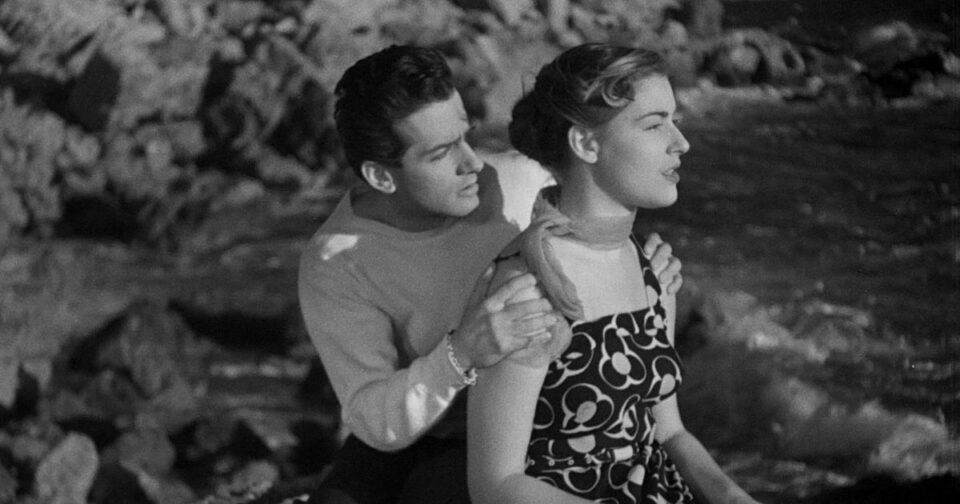
Nina Sgouridou (Eva) and Alekos Alexandrakis (Antinoos)
Plyta’s film bodly tackled the grim reality of Greece’s post-war society, which upheld patriarchy, family and monogamy. The film was also radical in its representation of female sexual desire, and the exhibition of the male body as an object of visual pleasure and lust.

Maria Plyta
Born in Thessaloniki on November 26, 1915, Plyta had already established herself as successful novelist and playwright before stepping into the world of Greek cinema in the midst of the civil war gripping the country.
She initially worked uncredited or as an artistic director on films like Marina (1947) and Marinos Kontaras (1948). Plyta made her directorial debut in 1950 with the movie T’ Aravoniasmata (The Engagements), a drama featuring set designs by the famous Greek painter Yannis Tsarouchis.
Over the course of her film career that spanned two decades, Plyta directed a total of 17 feature films, most of which did very well in the Greek box office.
But for decades, however, Plyta’s contribution to Greek cinema had been dismissed, and her legacy forgotten, due to the deeply entrenched gender bias that characterized not just Greek cinema, but also Greek society as a whole at the time. Indicative of this is the fact that Greece’s most powerful producer, Filopimin Finos, had famously declared that “a woman can’t be a director.”
Plyta’s career should have made her a household name in Greece, but only a handful of people attended her funeral when she died at the age of 91 in 2006.
Now, thanks to a restoration journey led by Professor Betty-Despina Kaklamanidou and her project titled Plyta’s Unknown Cinema, Plytas’ masterpiece and legacy have been brought back to life.
The film was restored by The Film Foundation’s World Cinema Project and Cineteca di Bologna at L’Immagine Ritrovata, in association with Alatas Films and Betty-Despoina Kaklamanidou, and in cooperation with the Greek Film Archive. Funding for the restoration was provided by the Hobson/Lucas Family Foundation.