
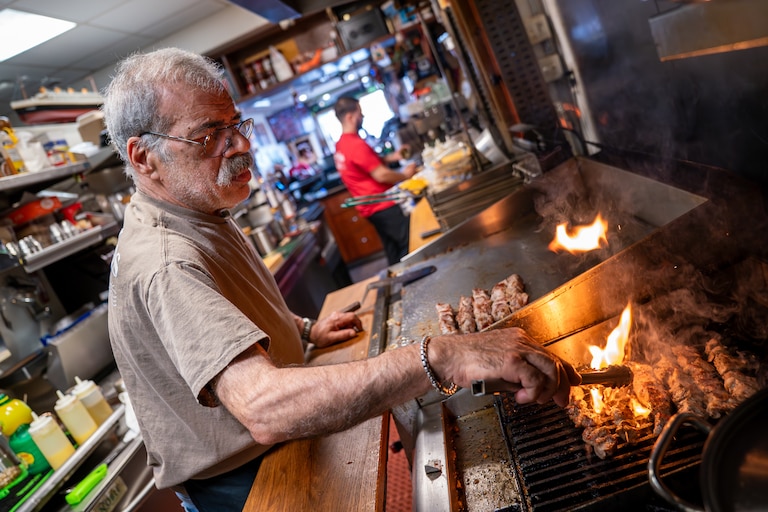
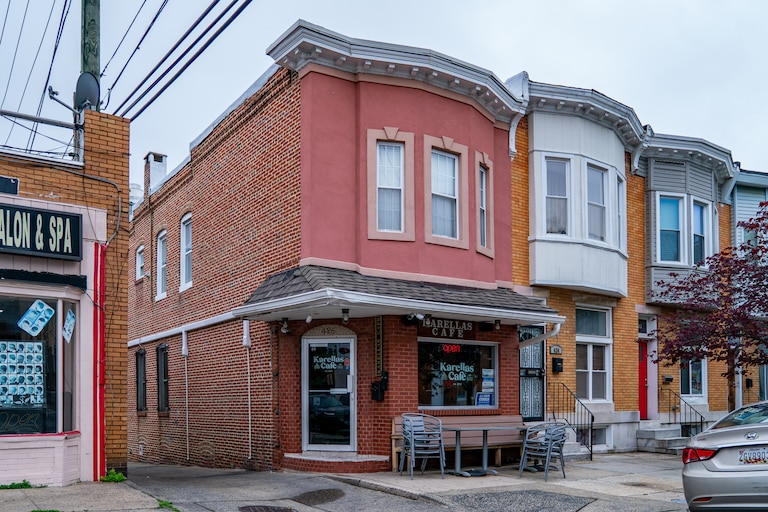
Over the last 15 years, not much has changed inside Karellas Cafe, a tiny Greektown tavern squeezed between rowhomes just off Eastern Avenue.
Owner Emmanuel Karellas, 68, still wanders in around 8 a.m. from his home across the street to chop tomatoes and fry pitas in a kitchen only he and his wife can fit in. His son, Nikolaos, 28, preps salads and readies the register to make way for a stream of customers — familiar faces that yell at sports coverage on the large television on the wall and grab beers from behind the counter as if they, too, own the place.
But outside, the neighborhood is changing. Customers call Karellas “the last leg” of a Greektown dining culture defined by local family-run eateries that were made to serve the community in which they were built. Here, conversations stretch across tables and communal eating is commonplace. There’s no delivery app or second location to find the Karellas’ food — it’s made for the people who are willing to show up.
“Whenever I’m missing Greece, I pick up Karellas and it feels like I never left,” said Despina Kranis, a Greektown Neighborhood Association board member and longtime resident of the community. “It provides an authentic Greek dining experience.”
In the 1930s, Greektown was a home base for the culture. Blue and white murals and kafeneios, or traditional coffee shops where older Greek men gathered, dotted the main drag along Eastern Avenue. Well-known family-operated restaurants Ikaros, Acropolis, Zorba’s and Samos, otherwise known as “The Big Four,” thrived, creating a culinary destination.
The largely immigrant community boomed in the early 2010s, and with it came a rising Hispanic population. The diversity led to new businesses and a shift in the neighborhood’s identity. As the pandemic hit, older eateries and bars that had just been scraping by disappeared. Only one of the Big Four, Samos, remains.
Some eateries shuttered because the generations who built them didn’t have heirs willing to continue, said Ian Wolfe, vice president of the neighborhood association. New players like Estiatorio Plaka, a younger, upscale eatery and bakery on Eastern Avenue, are emerging alongside other businesses that are “not obviously Greek” but involve a Greek partner or property owner, he said.
“I wouldn’t want people to think it’s a simple story of the ‘Greek’ leaving Greektown,” Wolfe said. “Change is inevitable, but this [Greektown] is still a focal point of the Greek community in Baltimore.”
Karellas Cafe, which began as a kafeneio in 2010, stayed open during the pandemic and switched its focus to food.
As a longtime produce deliveryman, Emmanual Karellas knew where to find fresh ingredients at affordable prices, and leaned on his past experience working in the kitchens of Captain James Seafood Palace and Sip & Bite diner. He also owned the 426 S. Newkirk St. building — one of his first investments upon immigrating to the United States in 1976 — allowing him to keep overhead low.
Karellas used family marinades for pork souvlaki and gyros, which spin until crisp on a vertical broiler (and are the closest I’ve tasted to a late-night gyro from Greece in Baltimore). Ask any customer about the cafe’s cold-pressed olive oil and you’ll receive a spiel about its unmatched thick texture. It’s used to drown octopus, salads and pillowy hummus in a thick, almost butter-like sauce.
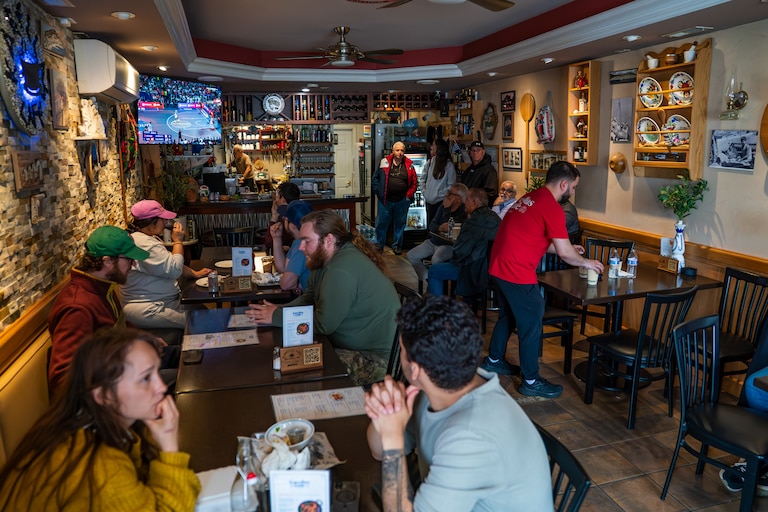
The restaurant became the “new kid on the block,” Nikolaos Karellas said, even though he had been working front-of-house and translating for his father, who still struggles with English, since childhood. He began using the company’s social media to reach larger audiences. “Many places around here didn’t do that,” he said.
Pictures of the food, the neighborhood and cartoon versions of Nikolaos and his father endeared the old kafeneio to a new generation. It caught the attention of Ravens quarterback Lamar Jackson, who stopped in for a bite in 2022 and posed for a picture with Emmanuel Karellas. The photograph featuring Karellas’ proud, toothless smile sits alongside Greek flags, a laminated poem and gifts from community members.
“There’s really not places like this [in the community],” said customer Woodrow Hillen. He roamed the space on a recent visit, pointing out how the tomatoes glisten on a platter — “You don’t see this anymore!” — and the olive oil cans on display — “You can taste the olive!” — as if he’d picked them out himself. It’s that community pride, or what Emmanuel Karellas calls “the glory,” that drives the business forward.
They promise to keep prices affordable on their small menu of platters, dips, coffee and liquor, but they also rebuke any question about skimping on quality or portions. And though delivery services like DoorDash or Uber Eats would broaden their reach, they would lead to lower-quality, less fresh meals, Nikolaos Karellas said.
“We don’t want to gentrify the business,” he said. The 28-year-old said his family also turned down a stall at Lexington Market since it would require them to take time away from their Newkirk Street community.
“We can’t afford to have a down year,” he said, adding that the business is currently profitable.
And Emmanuel Karellas shows no signs of slowing down. He said he wants people to feel nurtured in his restaurant, as if his food can project the gratitude the his words fail to convey.
Try to hold a conversation with him, and he’ll disappear into the kitchen, returning with several plates that no one ordered. On a recent visit, he sat quietly, biting into freshly grilled octopus — a neighborhood favorite — and thinly sliced cuts of chicken, seasoning them with fresh lemon and salt as he ate. When asked whether the food was the best in town, his brows furrowed.
“You decide,” he said.