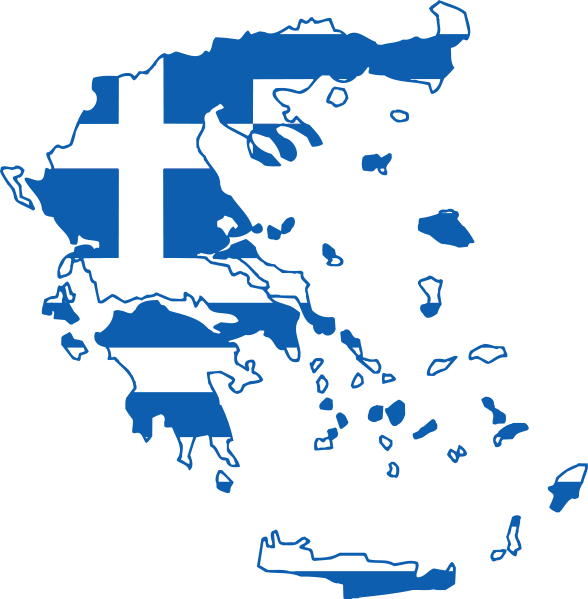

A study reveals how two archaeological sites in the Eurotas valley explain the sense of belonging of a people that existed before and beyond Sparta.
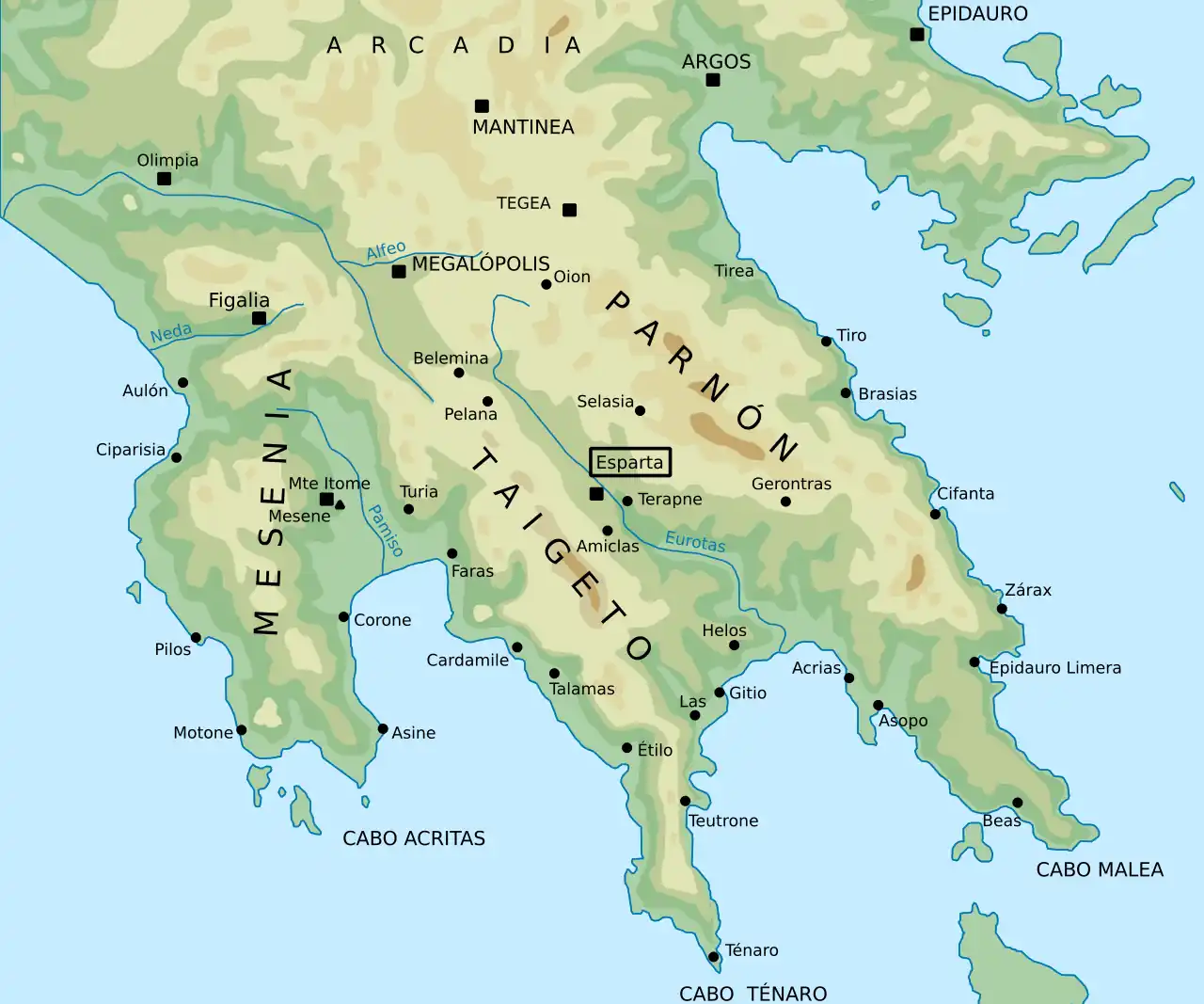
Imagine a fertile valley in the Peloponnese, crossed by the Eurotas river. There, more than 3,300 years ago, a Mycenaean palace rose, controlling the territory. Seven kilometers to the north, on a hill, the inhabitants held religious rituals. That landscape, now dusty under the Greek sun, witnessed the birth of a people: the Lacedaemonians. Not the Spartans, at least not only them. They were their ancestors, their neighbors, and for centuries, their traveling companions.
Historian Hans Beck, from the University of Münster, has just published an extensive article that turns upside down what we knew about these peoples. His work combines the latest archaeological finds with a fresh reading of ancient texts. The conclusion is clear: the Lacedaemonians were not a fixed or closed group. They were a fluid, changing community that found in two specific places the glue that united them: first a palace, then a sanctuary.
Until recently, experts debated where the center of Mycenaean power in Laconia was located. Some bet on Terapne, near modern Sparta. But excavations at Aghios Vasileios, near the village of Xirokambi, have changed the map.
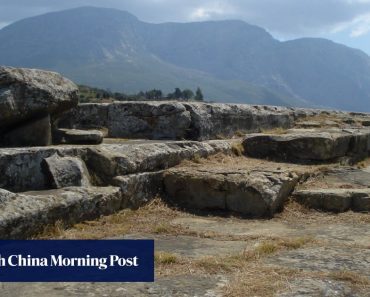
The site is impressive. A hill rising about 30 meters above the Eurotas plain, with panoramic views. There, archaeologists have unearthed the remains of a Late Bronze Age palatial complex. They have found high-quality frescoes, a collection of 21 bronze swords, and most importantly, an archive of tablets written in Linear B.
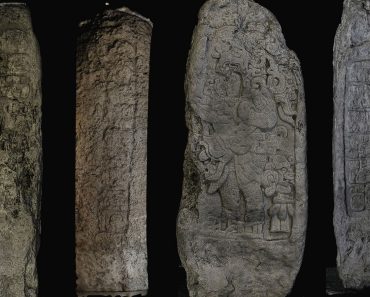
This writing system, the oldest in Europe, was only used by Mycenaean kings to keep the accounts of their kingdom. At Aghios Vasileios, 204 tablet fragments have appeared. In quantity, the site already ranks fourth among all Mycenaean palaces, only surpassed by Knossos, Pylos, and Thebes.
Among the texts, one has drawn particular attention. It is a clay label bearing the sign wa-na-ko-to, which specialists read as belonging to the wanax. The wanax was the king, the highest religious and political authority. As Beck says in his article: The wanax of the Lacedaemonians now has a new home.
But who were these Lacedaemonians? To the surprise of many, they already appear in the Linear B tablets found in Thebes, far from Laconia. In those documents, dated around 1200 B.C., people identified as lakedaimonioi or “children of Lacedaemonians” are mentioned. They were not a later invention. They already existed in the Bronze Age.
A Sense of Belonging Born in the Palace
Beck introduces a key concept to understand this story: the sense of belonging. It is not the same as identity. Identity sounds fixed, permanent. Belonging is more flexible. It can intensify or weaken over time. A peasant could feel Lacedaemonian when participating in the palace festivals, but perhaps less so when plowing his distant field.
The Aghios Vasileios palace was the magnet that attracted people from all over the region. Scribes, artisans, peasants, officials. All converged on that hill. All, in some way, began to feel part of something bigger.
The author puts it this way: The collection of all these bodies of evidence, condensed in a natural environment that itself offers a striking point of similarity with other palaces, makes it hard not to conclude that Aghios Vasileios was the palatial center of the Eurotas valley.
But the Mycenaean palaces did not last forever. Around 1200 B.C., the system collapsed. That of Aghios Vasileios was destroyed, probably in the mid-13th century. Its tablets were buried among the rubble. And then something surprising happened.
The Sanctuary That Inherits the Memory
Seven kilometers to the north, on the hill of Agia Kyriaki, near the modern town of Amyclae, there was a sanctuary. During the palace’s heyday, it functioned as a kind of ceremonial chapel. The kings of Aghios Vasileios probably sent offerings there and organized processions. The overlap between the two places was brief: barely two generations.
But when the palace disappeared, the sanctuary not only survived, it grew. Archaeologists have found pottery that shows uninterrupted activity from the 12th to the 10th century B.C. First came wine-drinking bowls, cups, pitchers. Then, iron weapons, bronze brooches, figurines.
Something was changing. People kept going to that hill, but now of their own accord, not because the king ordered it. The sanctuary became a place of memory. A site where the Lacedaemonians, now without a palace to unite them, could continue feeling part of the same story.
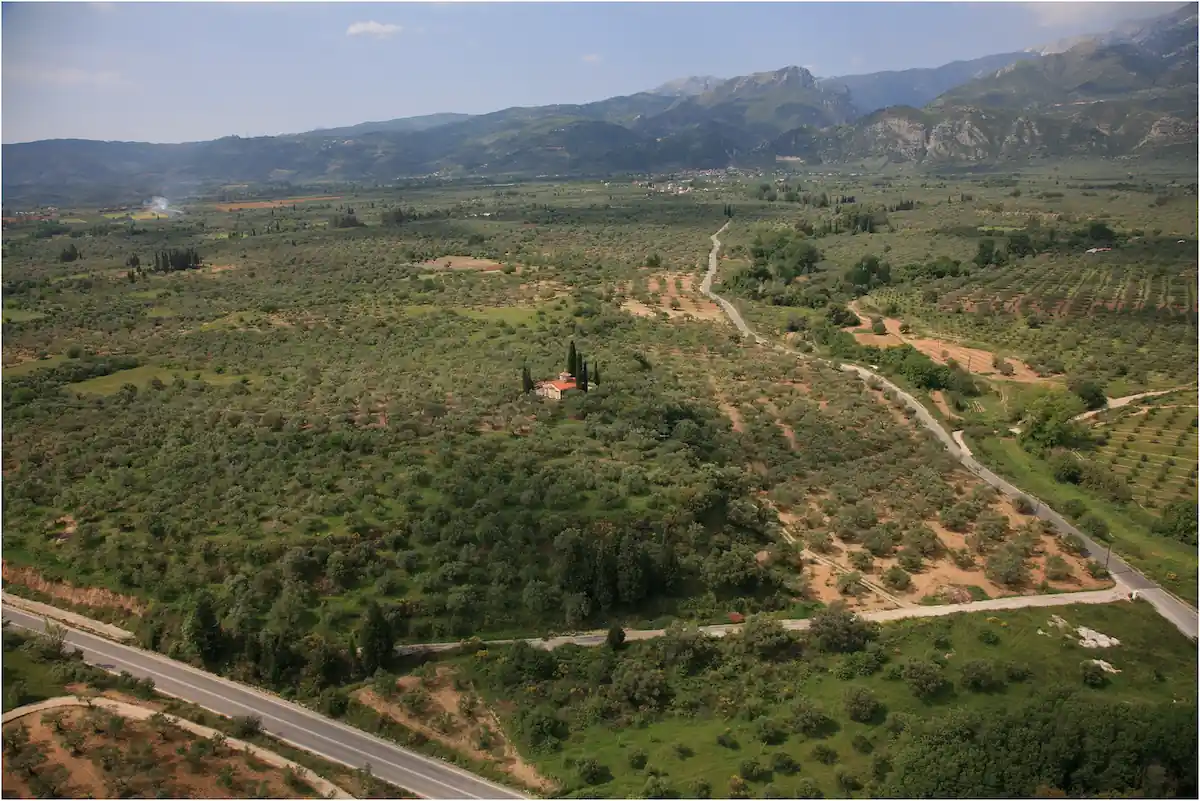
With the disappearance of the palace, Beck writes, Amyclae gradually absorbed the role of Lacedaemonian place of memory, instilling in people a vivid sense of belonging.
The Mystery of the Spartans
Here enters a third actor: the Spartans. Archaeology shows that the city of Sparta, the famous Sparta of the hoplites and the warrior women, has no physical continuity with the Bronze Age. On the Spartan acropolis, there are only a few fragments of Mycenaean pottery. And more strikingly: there is nothing from the Submycenaean period, between 1100 and 950 B.C.
The most plausible explanation is that the Spartans were not direct descendants of the Mycenaeans. They arrived later, in migratory waves during the Early Iron Age. Spartan tradition itself, recorded by the poet Tyrtaeus in the 7th century B.C., spoke of the Dorians (their ancestors) having conquered the region.
Was there war? The literary tradition, late and confusing, mentions a conflict between Sparta and Amyclae. Pausanias, the famous 2nd-century A.D. traveler, speaks of a death struggle of the Amyclaeans against the Dorians. But archaeologists see no break in the materials: pottery, offerings, and religious practices are continuous. There are no signs of violent invasion.
Beck proposes a more nuanced reading. There was no lightning conquest, but a process of assimilation. The Spartans arrived, settled, and over time established relationships with the Lacedaemonians already inhabiting the valley. They were not irreconcilable enemies. They were, in many ways, complementary.
The Sanctuary as a Meeting Point
The sanctuary of Apollo at Amyclae became the ideal setting for that encounter. There, Spartans and Lacedaemonians celebrated the Hyacinthia, one of the most important festivals of the calendar. For three days, the entire city of Sparta emptied out. Everyone went to Amyclae.
Ancient sources describe processions, sacrifices, athletic and musical competitions. But the most interesting thing is what they say about the songs. There were songs of different origins, not only Spartan. Young people sang “local compositions” from different places. That means the festival was not a Spartan imposition, but a shared space.
Beck puts it this way: The Lacedaemonians, from the central and lower Eurotas plains or the Parnon region, came to an ancient ceremonial center, a genuinely Lacedaemonian place, rich in tradition and meaning that spoke of their heritage. The Hyacinthia were, therefore, a privileged occasion for Spartans and Lacedaemonians to interact, each party approaching the conversation from a different starting point.
The Powerful Symbol of the Apollo Statue
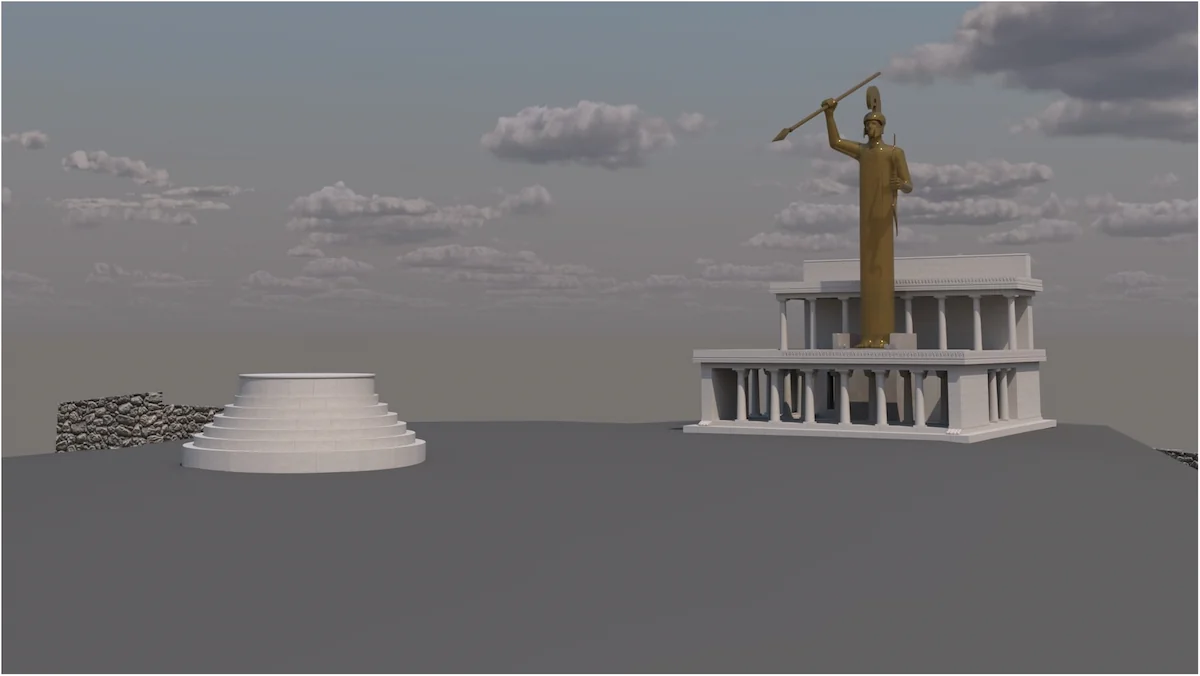
In the 6th century B.C., the Amyclaeans built a colossal statue of Apollo. It was 14 meters tall, made of polished bronze, and carried a helmet, spear, and bow. When the sun struck it, it became a beacon visible across the plain.
Visibility analyses conducted by the Amyclae Research Project show that the statue could be seen from dozens of kilometers around. It was a statement of intent: here, on this hill, the heart of the Lacedaemonians still beats.
The statue was not alone. At its feet, in a stone structure, the tomb of Hyacinthus was venerated, a hero older than Apollo, whose name already appears in Mycenaean texts. The fusion of both cults— the ancient local hero and the Olympic god— was a way of saying: this has deep roots, it comes from far back.
Was Amyclae Just Another District of Sparta?
One of the thorniest debates in Spartan historiography is whether Amyclae ended up integrated as the fifth kome (village) of Sparta. Sources mention that Sparta was made up of four nuclei: Cynosura, Limnae, Mesoa, and Pitana. Some authors have suggested that Amyclae was added later as a fifth territorial division.
Beck reviews the evidence with skepticism. The only document that explicitly calls Amyclae an “obe” (term equivalent to village) is an inscription from the 2nd or 1st century B.C., very late. Xenophon, in the 4th century B.C., speaks of the Amyclaeans as a military unit with its own identity, but that does not prove they were a Spartan district. Thucydides, in the 5th century, comments that Sparta seemed more like a collection of villages than a city, but his intention was to compare it with Athens, not to make an administrative map.
The author concludes that forcing a rigid constitutionalist reading does not help. What matters is not whether Amyclae was officially the fifth village, but that it functioned as a unique space of belonging. Amyclae nurtured the most distinctive, most differentiated local voice of all, he writes. Compared to other Spartan villages, it had a genuinely local voice: one that evoked a shared Lacedaemonian past and translated it into feelings of belonging in the present.
A Long Journey of Two Millennia
The story Beck tells spans from the 13th century B.C., with the Mycenaean palace, to the Roman era, when Amyclae was still a sacred place. Two millennia of profound changes: the collapse of the palaces, the arrival of the Dorians, the rise of Sparta as a military power, the wars against the Messenians, Spartan hegemony, its decline.
But throughout all that time, something persisted. The hill of Agia Kyriaki continued attracting people from the Eurotas valley. The Apollo sanctuary remained a point of reference. The Hyacinthia continued to be celebrated.
The article concludes with a reflection on the role of places in building communities: Places act dialectically to create the people who belong to that place. These qualities of sites and landscapes give rise to a feeling of belonging and rootedness, to a power to act and a power to relate that is both liberating and productive.
In times when there is so much talk of liquid identities and virtual communities, this research reminds us of something very ancient and very human: that human beings need places to meet. A palace destroyed 3,200 years ago. A hill where a bronze statue shone. Those places, even if they are no longer there, continue to tell us who we were and who we can be.
SOURCES
Beck H. Places of belonging: archaeohistorical encounters with the Lakedaimonians at the Mycenaean palace of Aghios Vasileios and the Sanctuary of Apollo at Amykles. The Annual of the British School at Athens. Published online 2026:1-27. doi:10.1017/S0068245426100343