
We were lucky to catch up with Maria Delaporta recently and have shared our conversation below.
Maria, so great to have you sharing your thoughts and wisdom with our readers and so let’s jump right into one of our favorite topics – empathy. We think a lack of empathy is at the heart of so many issues the world is struggling with and so our hope is to contribute to an environment that fosters the development of empathy. Along those lines, we’d love to hear your thoughts around where your empathy comes from?
Looking back, I think one of the earliest conditions that shaped my empathy was probably a survival instinct. For as long as I can remember, I could feel the emotions in a room, read people’s faces, and naturally empathise with them. Somewhere along the way, I realized I had developed this skill as a way to predict situations and feel some sense of control. It was only later in life that I understood that about myself.
I also believe that as women, we tend to come into the world with better odds of developing empathy. Partly because from a very young age, we’re dressed in so many “soft” characteristics: caring, emotional, nurturing. In a way, it almost feels like this part of my character was chosen for me by the world. And even so, I am forever grateful for it.
My parents played a big role too. I’d describe both of them as deeply empathetic, just in different ways. My mom can feel someone’s emotions and hardship almost effortlessly. Probably because she has a very rich internal emotional world that she shares with a select few. My dad, on the other hand, empathizes through stories; he’s a wonderful storyteller himself, so he has a natural curiosity for people’s experiences. Growing up in that home, I was taught early on that I am neither superior nor inferior to anyone around me. I think that, more than anything, was the foundation.

Let’s take a small detour – maybe you can share a bit about yourself before we dive back into some of the other questions we had for you?
I’m a composer, singer and qanun player, born and raised in Athens, Greece, and currently based in New York. It’s still difficult for me to categorize my music in specific genres, but I would say my musical output usually has a lot of jazz, pop, classical and Mediterranean influences. I’m very intrigued by lush harmonies and melodies that can tell stories in parallel and that carry a great emotional context.
I started playing guitar at the age of 7, hoping to become like Miley Cyrus and Taylor Swift, whom I admired back then. I loved how they were these young women standing confidently with their guitars and singing their songs. I think in retrospect that was how I was fantasising about my future self. My path with the guitar was short-lived, however. Only recently, I revisited the guitar as a way to write songs, and it’s wonderful!
Ι think what shaped my musicality before going to college was choosing to go to a Music Middle/High School in Athens alongside going to Philipos Nakas Conservatory. In both places, I got to meet some very important people whom, to this day, I consider my mentors, like Aggeliki Toumpanaki, Efi Zaitidou, and Orestis Ntantos. These wonderful people influenced my musicality greatly and helped me dive deep into the worlds of jazz, Greek traditional and Arabic music, and, of course, songwriting and arranging.
The next important stop in my musical journey was Berklee College of Music in Boston. After auditioning and receiving a scholarship, I was able to study there for about 3 years, majoring in Contemporary Writing and Production. I’ll be forever grateful for this opportunity that led me closer to myself and my musical identity and also gave me the chance to meet some wonderful humans and musicians. I think Berklee was a necessary step for me to broaden my creative limits and learn to embrace parts of my tradition that would later bring me closer to Greece and give me a sense of home.
I’m currently experimenting with my first body of work that will hopefully be released soon. I’m in a process of deep self-discovery, so open to trying out new things in music and collaboration, broadening my self-imposed limits!
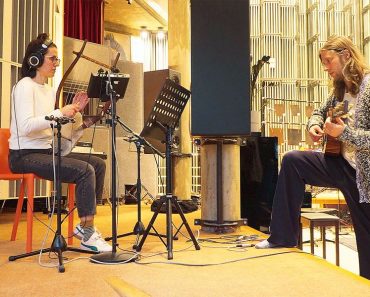
At the same time, I’m gigging around New York with my own projects as well as bands like the Kelepouri x Cafe Aman project and Ziv Kartaginer’s Middle Eastern Big Band. I’m also preparing for my first-ever solo show at Barzakh Cafe in Brooklyn on July 23rd, which will include personal compositions and my interpretations of Greek music that has left a mark on me, on qanun, voice, and electric bass!

If you had to pick three qualities that are most important to develop, which three would you say matter most?
I think I’m still actively learning a lot, so this is a hard question to answer. One skill I’m still cultivating today is being able to trust the process. I’m always urged to know what my next step is or if what I’m doing is enough, which I think is very common for artists. It’s sometimes hard to remember that everyone has their own journey and their own obstacles that they’re trying to overcome. It’s refreshing to remind myself that this will be a process whether I know what the next step is or I don’t. In any case, I think this unsettledness also comes from a better version of myself that knows I could be doing more. This feeling is definitely driving me forward, so I wouldn’t want to kill it. I think what is key is to work with what you already have while always pushing yourself into something scary, without letting it overwhelm you.
Another one would have to be learning how to be a team player. Music is shared with a crowd, but it’s also shared with the people producing it. Whether it is my bandmates, the engineers, or the arranger, I always need to have a nice environment around me. It’s like a small family, and we all know what happens when you’re around a family that produces constant negativity… I think it’s one of my priorities and responsibilities to be easygoing and fun to work with. However, of course, as a young woman, I also need to constantly make sure I’m not making myself smaller for anyone. There has to be a balance.
I don’t know how to encapsulate this into one skill, but I’m going to try my best to describe it. I realised somewhere along the way, probably when I moved abroad, how important self-growth is not only for me but for my art. I realised that the fear I had of going up to a salesperson and telling them they sold me the wrong thing was the same fear that made me not speak up for what I envision in music. I guess this is what maturing feels like. I strongly believe that everyone should constantly be trying to unlock their better selves so that they can live in peace and create unique art that stands without fear. I’m slowly realising that our brain is constantly chasing comfort and familiarity, and that sometimes suppresses any effort of unlocking our higher self. In short, I greatly believe that the further we are in our internal journey, the more meaningful and unique art we make.

What’s been one of your main areas of growth this year?
I’m one of those blocked artists, constantly searching for my artistic identity. This, I would say, has changed a great deal in the past 12 months.
I used to be able to create only when I had deadlines at school, and any other time would seem terrifying. At the same time, I knew I was enjoying creating music so much that I couldn’t understand why it was so hard for me to make time for it.
I slowly realised that I was so attached to the outcome and the acceptance of the people around me that I would automatically give up. I was terrified of starting anything because I thought it would have to be great or that it would have to fully represent who I am.
I’m not saying in any way that I have overcome this perfectionism, fear of being seen… I just realised that if I didn’t start doing something about it, it would keep me from feeling fulfilled by what I love.
What helped? Outside of therapy, I realised that in order to overcome a fear, you need to first experience the fear and all of its outcomes to demystify it. And that’s what I did. I started putting myself out there by uploading some of my most unfinished work on Instagram. Of course, the feedback I got helped me stay motivated.
I also realised that when it comes to art, whatever we make will solely reflect a specific version of ourselves. I’m not saying that we cannot make something that lives forever. I just mean that when we create, we are fully present. And since art is a product of the present moment, it reflects our growth up until that specific moment. Therefore, it is natural to look back at my first compositions and think: “Wow, this doesn’t hit the same way anymore”.
Alongside that, what became my mantra was: “I am meant to create in abundance; I am not meant to judge what I create”. I believe I read that in the book “The Artist’s Way” by Julia Cameron, an eye-opening mantra.
Last but not least, the present moment became my guide for everything. Meaning, I let go of the idea of what my song will sound like at the end, whether I’ll actually finish it, or if people are going to like it. The present moment and the process of making, of creating, is the whole point. And when I started practicing that, I noticed a huge difference in my mood and in my artistic process. Even if I spent 20 minutes developing a song, those 20 minutes would be worth it, even if I ended up throwing that song out at the end.
I wouldn’t have realised all of these without some of my newly favourite books: “Resonate” by Alex Wolf, “The Artist’s Way” by Julia Cameron, “Effortless Mastery” by Kenny Werner and “A New Earth” by Eckhart Tolle.
And the journey continues…
Contact Info:

Image Credits
Liri Agami
Adam Watstein
so if you or someone you know deserves recognition please let us know here.