

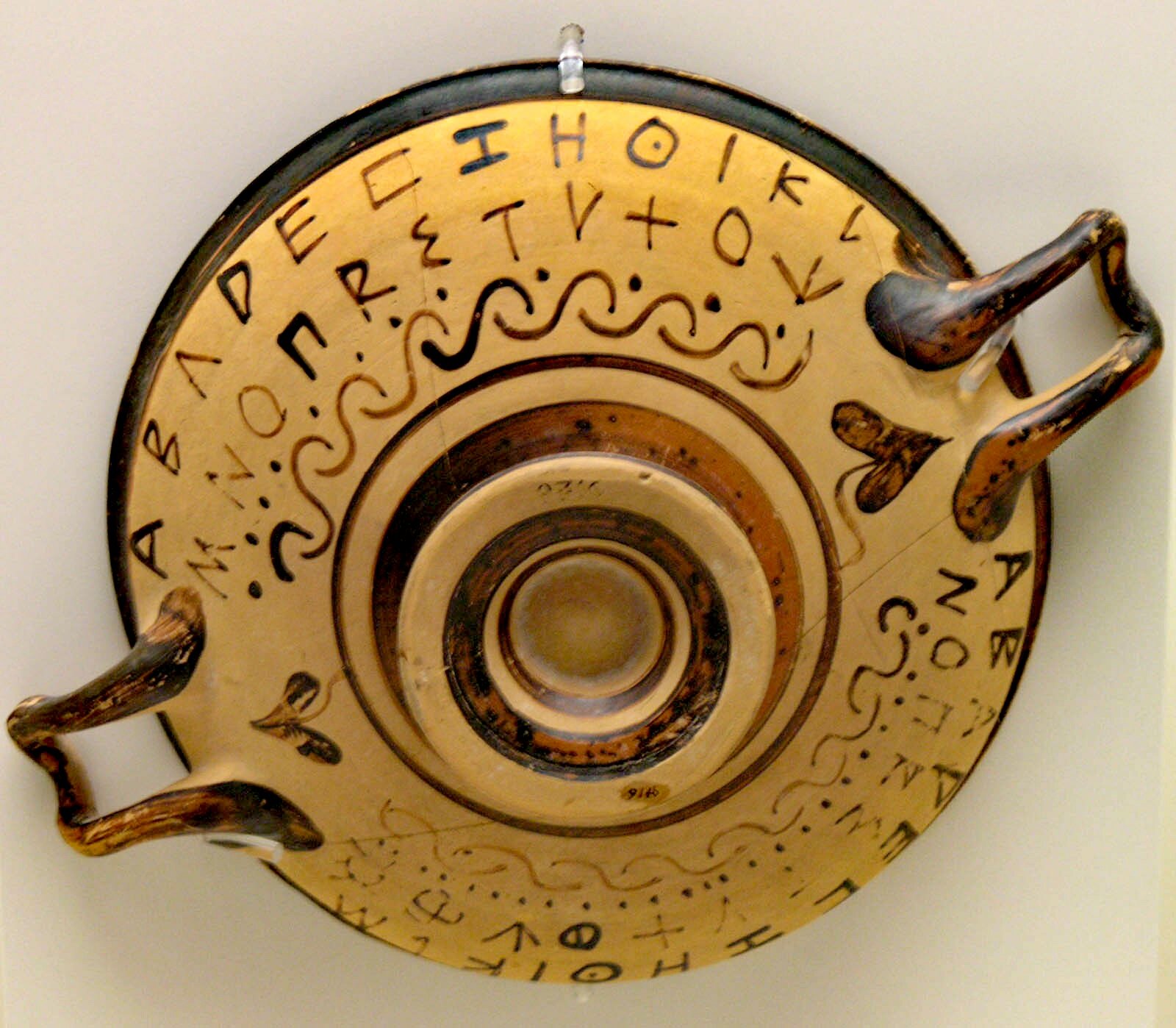
The Greek alphabet, traditionally believed to have emerged in the eighth century BC, is now undergoing reevaluation thanks to groundbreaking research at Leiden University. Associate Professor Willemijn Waal’s investigation aims to explore whether the Greek alphabet, initially recorded on perishable materials, might be centuries older.
“In the 1930s, the prevailing theory was of an ‘alphabetic bang,’” explains Waal. “It was thought that in the eighth century BC, the Greek alphabet as we know it today swiftly developed, spread, and diverged into other alphabets like those used in Anatolia and Italy, eventually leading to the Latin script.”
Carbon dating may help determine origins
However, new findings suggest a more gradual evolution and dissemination of the Greek alphabet. Carbon dating, a key tool in archaeological research, has revealed that the earliest Greek inscriptions found on pottery date back to the ninth or even tenth century BC, pushing its origins back by at least a century.
Moreover, the oldest surviving inscriptions are likely not the first texts ever written in the Greek alphabet, as alphabetic scripts were typically recorded on less durable materials such as papyrus and wood, which rarely survive over millennia.
This reevaluation challenges the notion of a long “Dark Age” of no alphabetic writing for about four centuries in Greece. It also prompts a reconsideration of ancient literacy in the Aegean region and potentially revises our understanding of cultural milestones such as those of Homer’s Iliad and Odyssey.
These epic poems, previously believed to have been orally transmitted for centuries prior to being put in writing in the eighth century BC, may have been influenced by earlier alphabetic traditions. Waal’s anticipation for her upcoming research is mixed with apprehension. “The longstanding belief that both the Greek alphabet and Homer originated in the eighth century BC has been widely accepted for nearly a century,” she reflects.
“Challenging this established knowledge will likely face resistance. Yet, questioning and evolving our understanding is what drives scientific discovery—it’s where the excitement lies,” Waal says. “Science is a continuous journey of learning.” In essence, her investigation promises to unravel long-held assumptions about Ancient Greek culture and the development of written language, introducing new avenues for understanding the origins and evolution of one of history’s most influential alphabets.
Greeks adopted Phoenician alphabet
According to Ancient Greek historians, the Greeks adopted the Phoenician alphabet after the arrival of Phoenician Prince Cadmus. The Phoenician alphabet was composed of only consonants. When the Greeks adopted it, they modified it to include vowels, a breakthrough that the Phoenician system lacked . This was a major step forward in the development of writing.
According to Plutarch, a Greek historian of the first century AD, there were originally sixteen Greek letters. However, Hyginus, an earlier writer, reports there were originally eighteen. In reality, it appears that neither version is correct. Physical evidence in the form of ancient inscriptions reveals that the earliest Greek inscriptions made use of all twenty-two letters in the Phoenician alphabet. However, four of these were for sounds which did not exist in Greek, so they were modified into vowels.
Related: The Lost Letters of the Greek Alphabet