
Getting your audio player ready…
A mosaic dating back to the Roman period has been uncovered in northern Turkey after unauthorized digging exposed part of a buried structure in a vineyard garden. Once the discovery was reported, teams from the Tokat Archaeology Museum stepped in, sealed off the area, and began a controlled excavation. What they are working through now is part of a Roman-era mosaic, laid down nearly two millennia ago.
Sections already exposed suggest the floor once belonged to a building of some standing. The scale, the care in the layout, the quality of the materials, all point in that direction. This was not a minor structure. Initial expert assessments suggest that the mosaic likely adorned the floor of a public building from the Roman period.
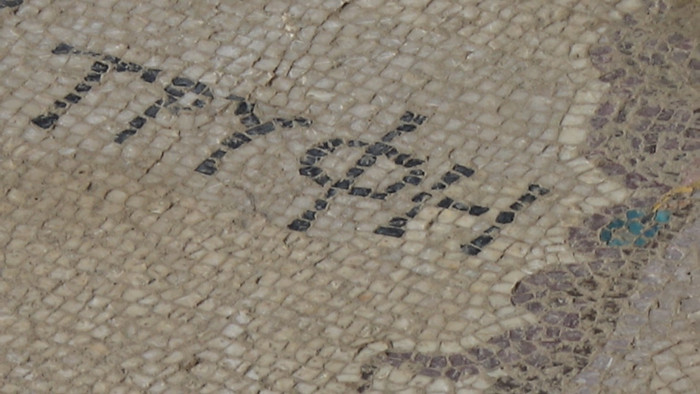
Detail of the Roman mosaic showing the Greek word ‘Tryphe’. (DHA / Daily Sabah)
The Meaning of “Tryphe”
One detail stands out immediately. Set within the design is a word in Ancient Greek: “ΤΡΥΦΗ” (Tryphe). It carries associations of comfort, luxury, a life lived with ease. Whether it describes the space, the owner, or the idea behind the artwork is not yet clear. The presence of vibrant green, yellow, blue, and white tiles, alongside inscriptions referring to abundance, prosperity, peace, and well-being, strongly indicate a public or communal function of the site.
Alper Yılmaz, who teaches at Ondokuz Mayıs University, has been examining the composition as it comes into view. He points to the way the surface is built—small, tightly placed stones forming detailed sections, set alongside larger pieces that hold the broader pattern together. That combination is typical of Roman mosaic work at a high level. It allows for fine detail without losing structural strength across the floor.
Echoes of the Gypsy Girl
There is also a visual echo of another, more famous piece: the so-called “Gypsy Girl,” displayed at the Zeugma Mosaic Museum. The Tokat mosaic does not reproduce that image, but there are similarities in the handling of form and detail, particularly in the figurative elements. At the center of the newly uncovered section is a female figure. Not a portrait, as far as researchers can tell. More likely a symbolic presence. Figures like this appear frequently in Roman interiors, standing in for ideas—fertility, prosperity, abundance.
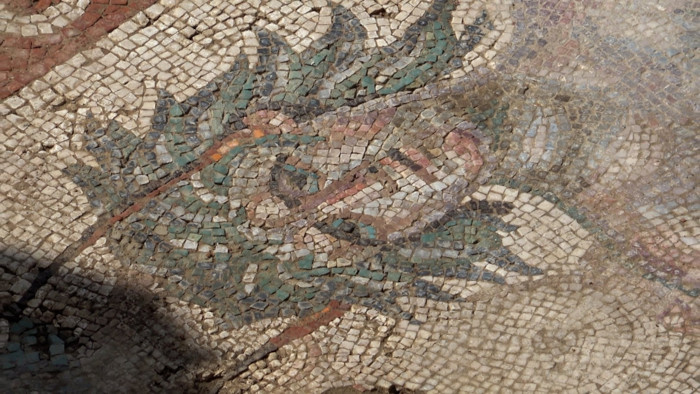
Image resembling the famous ‘Gypsy Girl’ mosaic at the Zeugma Mosaic Museum, Gaziantep, with which the new Tokat mosaic has been compared. (DHA)
The wider setting matters as well. Zile has long been tied to the Roman period. Historical sources place Julius Caesar in this region, where he is said to have marked a rapid victory with the words “Veni, vidi, vici” after defeating Pharnaces II, King of Pontus, at the Battle of Zela in 47 BC. Finds like this help fill in the everyday side of that history—the spaces people lived in, decorated, and used.
Ongoing Excavation and Preservation
For now, the work is slow. Soil is removed in thin layers. Each exposed section is recorded before anything else is done. Conservation begins almost immediately, as surfaces that have been buried for centuries can deteriorate quickly once exposed to air. There are open questions. How large is the mosaic? Does it extend beyond the current excavation area? Was it part of a villa, a bath complex, or another type of structure entirely? At this stage, there are no firm answers.
What is certain is that more remains below ground. The visible sections do not form a complete design, which suggests the mosaic continues further. Whether the rest has survived intact is something the next phase of excavation may reveal. Once fully uncovered, the mosaic will need careful stabilization before any decision is made about display.
Local officials have already pointed to the potential impact. If conserved and presented properly, the site could draw attention to Tokat’s Roman-era past, which is less widely known than other parts of the country. Murat Tekin, head of the excavation team at Zile Castle Ancient Theater and a faculty member at Tokat Gaziosmanpaşa University, believes that expanded excavations in the area will enhance understanding of the past and attract visitors. “If we expand our excavation efforts in the area where the mosaic was found,” he said, “it will not only enhance our understanding of the past but also attract visitors eager to explore Zile’s rich heritage.” As public awareness of the mosaic grows, there is hope that the site will soon become an officially recognized archaeological zone, contributing to Zile’s cultural tourism potential.
Top image: Aerial view of the Roman mosaic uncovered in Tokat, Turkey. Source: DHA
By Gary Manners
References
Buyukyildirim, O. 2025. Mosaic Discovered in Illegal Dig in Zile Points to Ancient Roman Public Structure. Arkeonews. Available at: https://arkeonews.net/mosaic-discovered-in-illegal-dig-in-zile-points-to-ancient-roman-public-structure/
Fraga, K. 2025. Smugglers In Turkey Caught Trying To Steal An Ancient Roman Mosaic Because They Livestreamed Their Excavation. All That’s Interesting. Available at: https://allthatsinteresting.com/zile-turkey-roman-mosaic-illegal-excavation
Milligan, M. 2026. Roman mosaic uncovered in Tokat after illegal digging exposes buried site. Heritage Daily. Available at: https://www.heritagedaily.com/2026/05/roman-mosaic-uncovered-in-tokat-after-illegal-digging-exposes-buried-site/157997
Daily Sabah. 2026. Ancient mosaic unearthed in Türkiye’s Tokat rivals iconic ‘Gypsy Girl’. Daily Sabah. Available at: https://www.dailysabah.com/life/history/ancient-mosaic-unearthed-in-turkiyes-tokat-rivals-iconic-gypsy-girl