
In an age when the almighty gods of Olympus were as real and tangible as the ancient olive groves that dotted the Greek landscape, one man, Xenophanes, who had an almost incomprehensible audacity, dared to suggest that the Greek gods weren’t what everyone imagined them to be.
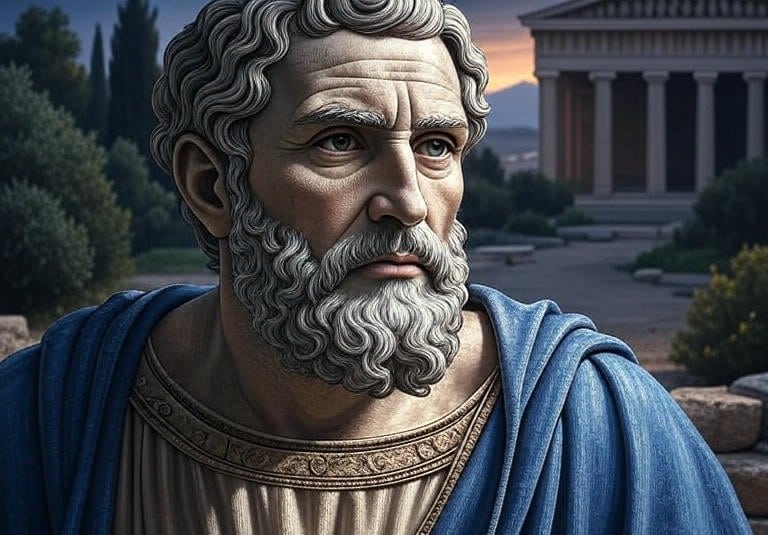
Xenophanes was a pre-Socratic philosopher from Colophon of Ionia, who is remembered for many things, but one thing in particular stands out. He was, namely, among the very first who audaciously questioned the human-like appearance of the deities Greek society venerated so much.
The reasons behind Xenophanes’ argument
Can you even fathom the sheer courage of making such a bold claim at the time? While almost every other person hoped for favors from Zeus and the gods in general, Xenophanes level-headedly made a radical (for the time) proposition: perhaps these mighty gods looked a lot like us—but only because we, guided by our own limited understanding, had fashioned them in our very own image.
Xenophanes’ observations were deemed shocking but didn’t stop at trying to alter the Olympian pantheon’s façade. He famously also argued that if horses, oxen, or even majestic lions possessed hands, they too would undoubtedly draw gods with equine, bovine, or leonine characteristics. This was a profound philosophical suggestion that questioned the deeply respected religious dogma prevalent across the ancient Greek world.
Born around 570 BC, Xenophanes was a wanderer, poet, rhapsode—a genuine intellectual nomad of his time—who traveled across the diverse ancient world. This constant exposure to a mosaic of various cultures and perspectives undoubtedly sharpened his already keen critical eye, allowing him to see beyond the conventional wisdom of his own people.
His critique was by no means based on atheism in the modern sense, as one might assume. Instead, it stemmed from a sophisticated skepticism provoked by the need for a more rational and unified understanding of the divine. Xenophanes actually envisioned a single, supreme god, who was fundamentally different in nature from mortals both in form and cognitive abilities.
This is quite different from the often narrow-minded, vengeful, and, frankly, all-too-human deities so vividly described by Homer and Hesiod in their dramatic myths, which formed the very bedrock of Greek religious understanding.
Xenophanes’ reasoning surpassed the realm of theological narratives, with his bold questioning of anthropomorphism laying the crucial foundations for later philosophical and scientific inquiries similar to that of today’s monotheistic religions of Judaism, Christianity, and Islam. In other words, it strayed significantly from the beliefs of the ancient Greek pantheon and effectively paved the path for more abstract conceptions of divinity and the development of early forms of naturalism.

It makes sense to (many) today. If gods are simply reflections of human nature, then what other cherished assumptions might be similarly flawed? Xenophanes sowed the first seeds of doubt which eventually blossomed into the rich, vibrant tradition of critical thinking now recognized as a defining characteristic of Western philosophy.
His daring insights continue to be relevant—subtly yet powerfully—in contemporary discussions on the fundamental nature of religion and the often profound influence of culture on our belief systems. They are likewise applicable to our attitudes towards and biases against artificial intelligence. In debating our own perspectives and examining how these shape our understanding of complex phenomena—from economic models to complex ethical questions—we are, in a very real sense, partaking in the type of analysis inspired by Xenophanes.
Why does Xenophanes’ opinion matter today?
Perhaps the most utterly fascinating aspect of Xenophanes’ groundbreaking propositions is how it compels us, even to this day, to consciously examine the way we perceive and understand God today. In other words, are our God, our most cherished ideals, and our very notions of truth simply elaborate reflections of ourselves, our societies, and our own limitations?
This ancient Greek philosopher, who with such simple clarity pointed out that Ethiopian gods were dark-skinned and snub-nosed, while Thracian gods were fair-skinned with striking blue eyes, wasn’t merely critiquing ancient mythology. He was, in essence, offering a profoundly timeless lesson in self-awareness and intellectual humility. He was simply pointing out the obvious discrepancies in people’s beliefs.
Hence, when we do come across depictions of the Divine which seem a little too…familiar and human, it would benefit us to take some time to think back to Xenophanes who posed the questions that, millennia later, are still relevant—and occasionally hard. It would be wise of us to challenge long-held beliefs, dig deeper than the obvious, and humbly acknowledge the profound and inescapable influences of our own humanity that we reflect onto Higher Powers.