
When asked what makes them proud of their country, many people around the world point to their national arts and culture, as well as their lifestyle. They also express pride in things like the history of their country or its food.
“I am proud of the art, the culture, the good food, the beauty of all places, and the creativity that people have in dealing with anything.”
– Woman, 47, Italy
These responses were collected as part of a survey conducted in the spring and summer of 2025. We asked over 30,000 adults in 25 countries to describe what makes them proud of their country, in their own words.
- People in Italy are the most likely to mention something related to their national arts and culture, while Greeks are exceptionally proud of their history.
- Spaniards and Australians are particularly likely to praise the way of life in their country.
- In many places, younger and more educated people express pride in the arts and culture of their country at higher rates than older people and those with less education.
For more on other sources of pride, read “What Makes People Proud of Their Country?” or specific analyses about pride in politics and the economy, people and those who say they are not proud. For the full, ordered list of topics by country, refer to the detailed tables in Appendix E.
Where is pride in arts and culture most common?
When it comes to pride in various aspects of cultural heritage – customs and traditions, national symbols, art and architecture – Italy stands out.
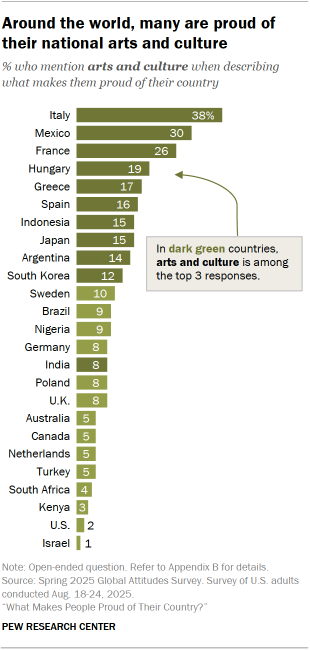
About four-in-ten Italians (38%) say they are proud of Italian arts and culture. This is the top source of national pride for Italians. And compared with all other surveyed countries, people in Italy are the most likely to list arts and culture as a source of national pride.
But pride in arts and culture is not limited to Italy: This is among the top three most common topics mentioned in 11 of the 25 countries surveyed. Roughly one-in-four or more in both Mexico (30%) and France (26%) point to their national arts or culture when asked what makes them proud.
Who is most likely to be proud of the arts and culture in their country?
When talking about what makes them proud of their country, younger people tend to mention arts and culture more often than older people. In fact, in many countries, those ages 18 to 34 are at least twice as likely as those 50 and older to be proud of their national culture.
“I think there are influences from other countries, but even taking them into consideration, I feel that this is a country where something connected as a single culture has been handed down.”
– Woman, 25, Japan
For instance, in Hungary, roughly a third (31%) of adults younger than 35 say they are proud of their national arts and culture. Only 12% of Hungarians 50 and older say this. Likewise, in France, the share of younger adults who mention something related to arts or culture is about double the share of older adults who do the same (37% vs. 19%).
One 23-year-old man in France said he was proud of the French “cultural influence,” including “cinema, literature, opera [and] theater.” A 24-year-old French woman agreed: “Culture, literature, cuisine. That’s all there is.”
In several countries, those with more education mention arts and culture as points of pride more often than those with less education. In Mexico, almost half (47%) of those with at least an upper secondary education say they are proud of some aspect of Mexican culture, compared with 16% of those with a lower secondary education or less.
“It is a culturally rich country,” said one Mexican man. “There is a lot of culture we have, like the antiquity of the Mayas,” a Mexican woman said. “Our roots [are] well defined.”
What aspects of arts and culture make people proud?
In some countries, people are proud of having rich and enduring traditions. This is common in Japan: One Japanese woman said she was proud that her country “values the old culture.” “We are preserving our culture from generation to generation,” said a Japanese man.
South Koreans, on the other hand, tend to be proud of their contemporary culture and its global reach. Many reference the growing popularity of “K-culture” around the world, including K-pop, K-dramas, K-beauty and Korean food. “A powerhouse in cultural content,” said one Korean woman.
In nearly every country surveyed, people express pride in their national customs and traditions. For many, this means holidays, festivals and public celebrations. Australians frequently mention “Australia Day,” while Mexicans praise their “Day of the Dead.” One Brazilian woman listed “Carnival, June festivals … and Círio de Nazaré,” a Catholic festival honoring Our Lady of Nazareth. In the Netherlands, a woman said she was proud of “Dutch celebrations, such as King’s Day or Sinterklaas.”
“Having Australia Day every year. To see Aussie flags flying, BBQs, the cricket on TV and everyone just having fun, a beer and enjoying themselves and being proud to be Australian.”
– Man, 60, Australia
Elsewhere, people are proud of cultural expressions like traditional clothes and dance. “Our folk dances and our folk costumes are beautiful, and I am very proud of that,” said a Hungarian woman. One man in Mexico said he was proud of the traditional “arrieros dance,” and several in Brazil mentioned “samba” and “capoeira.”
Some express pride in their national arts, including architecture, media, music and crafts. One Italian woman said she was proud of “the works in the churches, paintings, sculpture … most places in Italy have something beautiful.” “Italy is an open-air museum,” said an Italian man.
In Japan, many are proud of their traditional craftsmanship as well as more modern forms of art, like animation and video games. “Handmade things, delicate, dexterous and skilled craftsmanship that cannot be done by machines are amazing,” said one Japanese man. And in France, where many express pride in French know-how as well as their monuments, several praised “the craftsmen and craftswomen who rebuilt Notre Dame.”
“The tricolor flag that we have encompasses everything: Red is for the color of the blood our soldiers have shed … during the world wars, white represents democracy, green is for hope, because we Italians always manage.”
– Man, 56, Italy
In most countries, there are those who express pride in national symbols. For instance, some people are proud of their flag, especially in India and Turkey. “The flag of our country is recognized all over the world, hence I am very proud,” said one man in India. Another source of pride is national anthems. One American woman said she was particularly proud of “the stirring in our hearts when our national anthem is played.”
For some, national pride is tied to the language they speak. This is common in France, Greece and Poland – but especially in Hungary. “We can express ourselves better with Hungarian because it is more emotional than other languages,” said one Hungarian woman. “It’s the most wonderful and complex language in the world,” said a Hungarian man. And in South Korea, many say Hangul, the Korean alphabet, makes them proud.
In some places, including Canada, India, Indonesia, South Africa and Spain, people are proud that multiple languages are spoken in their country. One woman said she was proud of South Africa because “it’s the only country that has 11 official languages.” And in Spain, a man said he was proud because “we have three official languages; we are polyglots.”
For more on pride in diversity, read “Where in the world are people proud of their nation’s people and diversity?”
Where are people proud of their country’s food?
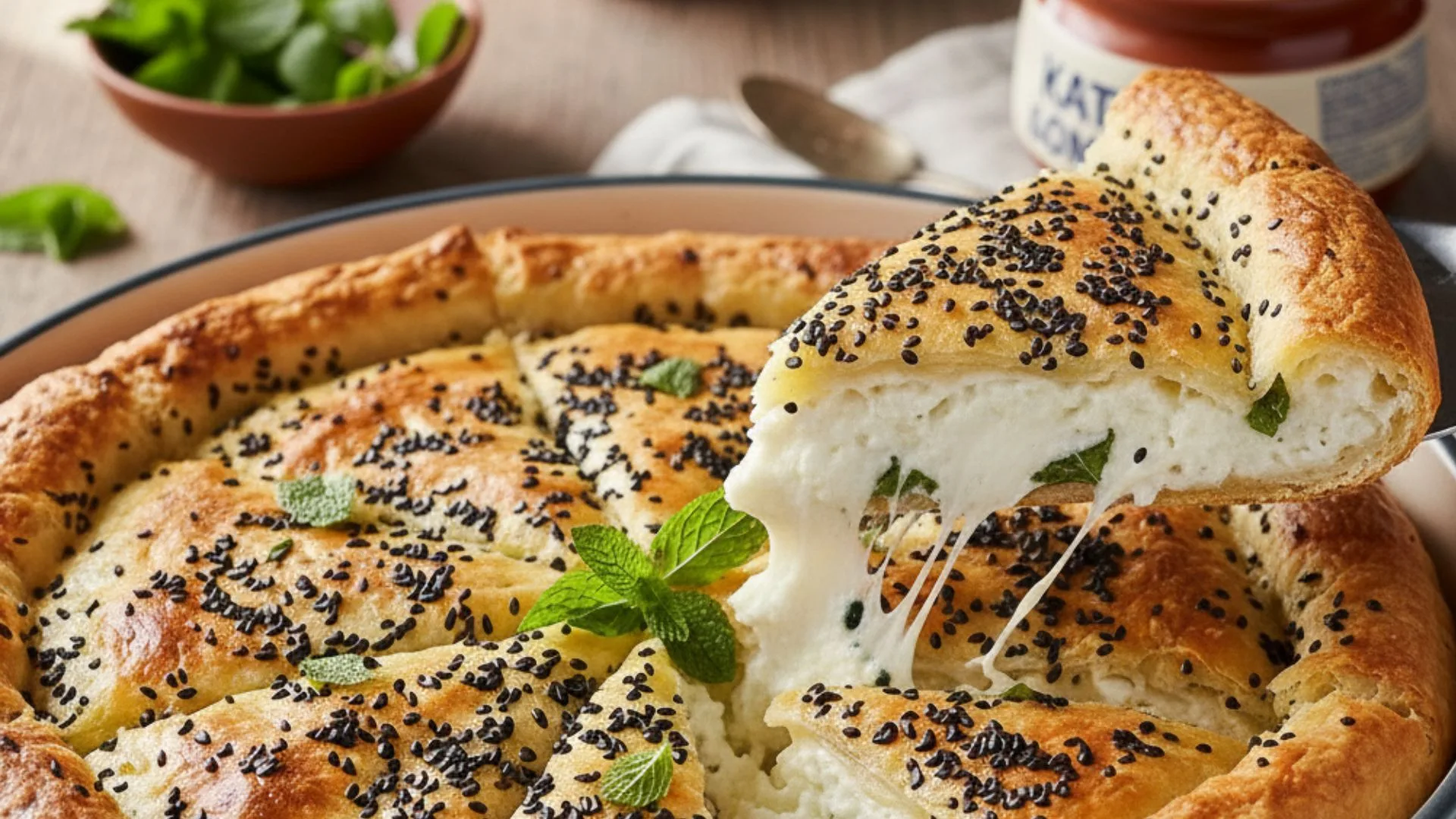
Another national symbol people are proud of is their country’s food. More than one-in-ten in Italy, France, Mexico and Spain say their national cuisine is a source of national pride. One Italian woman said that although she has little pride in Italy, she at least is proud of “tortellini, Parmigiano-Reggiano, Chianti wine and humble people.”
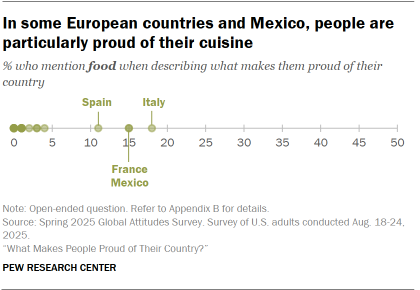
Italian wines are a common source of national pride, as are French wines and cheeses or, as one French man put it, “knowing how to enjoy good wine and cheese.” In Mexico and Spain, people are proud of traditional foods, including one Mexican woman who said she was proud of Mexican street food or “antojitos” and a young Spanish man who replied, “the flag of Spain and paella.”
In several places, people are proud not just of the food but the atmosphere surrounding it. “We can drink wine or beer on a terrace,” said one French woman; “Japanese food and alcohol culture,” said one Japanese woman; and an Argentine woman mentioned “drinking maté,” a regional caffeine-rich drink that serves as a national symbol for friendship.
Food is sometimes used as a counterweight for those who are dissatisfied with the general direction of their country. For instance, one Hungarian man said he was “proud of our goulash soup … but not of our current politics.”
For more on what people aren’t proud of in their country, read “Where, and why, people aren’t proud of their country.”
Where do people express pride in their country’s lifestyle?
“I am happy. I recognize that life is good and there are few places where I would like to live other than here.”
– Man, 51, Spain
As for pride in lifestyle, people in Spain and Australia are particularly likely to praise the way of life in their country (14% and 13%, respectively).
In Spain, for example, many say they enjoy a vibrant social life, with one man describing Spain as a place where people live well “because they go out … they don’t stay at home.”
Several other responses from Spain echo this sentiment. “We enjoy ourselves; we like to party,” said one Spanish woman, while another was proud of “our way of living life … we like to enjoy life, the sun, being with friends and family.” “There is joy,” a Spanish man said.
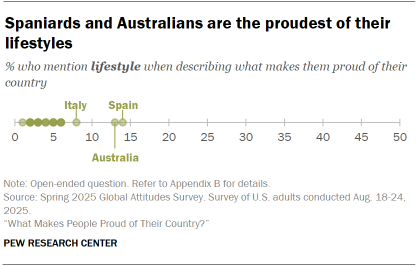
People in Australia express pride in the “relaxed” nature of their lifestyle. Some Australians are proud of “being able to live a relatively carefree life,” describing their lifestyle as “easygoing” and “laid-back.” Others call it “outdoor” or “healthy.” “I … feel Australia is a good place to live and raise children,” said one Australian man. “Happy place,” said another.
Italians tend to praise the “lifestyle that Italy allows” and “the ability to recognize and enjoy the important things in life.” And in France, people are proud of their “savoir-vivre” or “art of living.”
Other responses that mention lifestyle focus on the comfort and ease of everyday life. One man described Brazil as “a tranquil country.” Another Brazilian man offered, “I don’t worry about anything.” “I have a comfortable life. I don’t have very much outside pressure that I cannot manage,” a Canadian man said.
And in several countries, some say they are proud because they live better lives than people elsewhere. These responses are common in the Netherlands and Sweden. “People living in Sweden have good lives compared to so many other countries,” said one Swedish woman. And a Dutch woman explained, “With all the misery in the world, we cannot complain. We have it good.”
What parts of a country’s history make people proud?
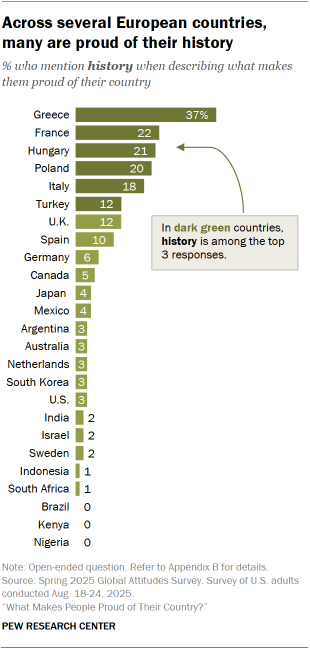
More than a third of Greeks (37%) are proud of their country’s history, especially their ancient history and its influence. “Our ancient origins are the birthplace of democracy, and [our] ancient philosophers are taught all over the world,” said one Greek man. Another said he was proud of “Socrates, Aristotle [and] the heroism of the ancestors,” and several Greeks mentioned “the golden age of Pericles.”
In France, too, many are proud of their country’s history and its impact on the world, citing its Declaration of the Rights of Man and of the Citizen. One French woman said she was proud of the “history and worldwide influence” of her country, specifically its “commitment to human rights.” And a French man praised the democratic legacy of the French Revolution, saying he was proud of “having guillotined [and] overthrown the monarchy.”
Some who are proud of their history mention their ancestors who survived through hard times, like a Polish woman who said, “Our nation has gone through a lot and, despite adversity, has dealt with it well,” or a Hungarian woman who said, “I’m proud of [Hungary’s] history, its traditions [and] the perseverance of our ancestors.”
Elsewhere, too, people are proud of their country for having overcome difficult periods in their history. One German man who said he is proud of “how we have defeated fascism and achieved reunification and succeeded economically.” “It makes me proud that Germany has faced up to its past and come to terms with it,” said a German woman. Similarly, in Spain, people are proud of “having passed from a dictatorship to a stable democracy.”
People often express pride in specific historical events. In Hungary and Turkey, people take pride in their national wars of independence, and in South Korea, several are proud of their “ancestors’ independence movement.” One Mexican man called Mexico “a heroic country” because of events like “the Battle of Puebla, the Pipila in Guanajuato [and] the siege of Cuautla with Morelos.”
Others are proud of specific historical figures, such as Ataturk in Turkey, Gandhi in India, or Napoleon and de Gaulle in France. Poles, for their part, are especially proud of composer Frédéric Chopin, Marie Curie and Pope John Paul II.
However, many who say they are proud of their national history are critical of the present day, like a Greek woman who, when asked what she was proud of, said: “Nothing anymore, only our history.” “I am proud of the U.S. because of our past. Not so much about the present,” said one American man, and another echoed: “I am proud only of what it used to be.”
For more on national pride in the United States, read “6 facts about national pride in the U.S.”