

“Vangelis as a musician was a paradox: he developed a sophisticated survival mechanism, thanks to which, and with complete indifference to fashion, his compositions endure over time far longer than many new, youthful, and dynamic music genres, which flash into existence before disappearing into the oblivion of record store bargain bins.”
These words at the beginning of the biography Vangelis: The Unknown Man, authored by Mark Griffin, give the reader a first impression of the iconic composer whose music traveled all the way into space.
“Vangelis as a person was quiet and introverted. Corpulent, weighing over 90 kilos, dark-haired and bearded, he gave the impression of a very imposing character,” notes the author, adding shortly after: “He was in a way a hermit and detested the egotism fostered by the music industry.” As he himself said, “I am a person who avoids publicity because I do not believe that personal life has any particular significance… It is a superfluous luxury.”

A Childhood in Notes
His parents understood very early that young Vangelis loved musical notes, writes Griffin in the biography of the famous composer, published by Barbounakis Editions. “When I started composing I was almost four years old, so I had no memory of music – it was too early. But I would sit at the piano and use whatever I could find at home as percussion. I don’t remember a time when I wasn’t composing. I never remember living without music.” Growing up and shortly after adolescence came the time for his first band and a success for which he was unprepared.
“The Forminx were a school band I attended and I was very young. They mainly played for fun, and they took me along. Eventually, we became stars all over Greece without really realizing what was happening.” As he later said, what they did then had nothing to do with music, even though the band quickly became the most popular in Greece.
The “Children of Aphrodite”
After their breakup in 1966, he met his future manager, Giannis Zografos, who recalls that “Vangelis was the first person in Greece to have a Hammond organ… He was a much better musician than me, and I had stopped playing.”
In early 1967, Aphrodite’s Child was formed with Vangelis’ cousin Demis Roussos as bassist and singer, Argyris Kouloris on guitar, and Loukas Sideras on drums. With the arrival of the dictatorship, the group decided to go to London, since working conditions in Greece became difficult for Vangelis and the other members, but due to a transportation strike in France, they ended up stuck in Paris, where they would thrive in the following years.
“I moved to Paris, where I ascended in the music industry to make enough money to start a studio,” Papathanassiou said decades later. “We had a record that sold millions, then another… I did some things I couldn’t endure at the time, but I don’t regret it.”
By the late 1960s and early 1970s, he recorded his first solo albums, such as L’ apocalypse des animaux, a precursor to new age music. At the end of 1970, Aphrodite’s Child recorded their final and most emblematic album, 666, but artistic differences among the band members grew.
The album’s content alarmed Mercury Records because of its satanic themes, and the company was particularly displeased with the track Infinity (which featured actress Irene Papas), viewing it as blasphemous. “That was the last album,” the composer said, noting: “Actually, I would have liked it to be the first, but first we had to go through the hit parade process to prove we could be commercial, sell, and stay on good terms with the record company. For me, Aphrodite’s Child was a vehicle to enter the field and earn enough money to later acquire my own studio.” Their breakup a few months later marked a turning point in Vangelis’ career, as it “signaled the beginning of a fertile and experimental period.”
Archery
The Greek composer’s reclusive nature is evident from the words of Keith Goodwin, who served as his press officer for a decade: “It’s not easy to function as a public relations manager when your client is an extremely closed character.” So closed that even his passion for archery he practiced at his Paris home, setting up a full-size target at one end of his large living room.
“He would retreat to the other end of the room,” says Goodwin, “choose a bow, and shoot arrow after arrow. To the left of the target was a very large bare wall covered in marks; to the right, a window that mostly remained open to avoid noise from broken glass.”
In the early 1970s, he married singer Vana Verouti, with whom he collaborated on various projects in the following years, while in 1973 he recorded the psychedelic album Earth, the last record he made in France, deeply disappointed by the attitude of the domestic music industry toward his music.
London
“It was a great period in my life,” the Oscar-winning composer would say years later, having signed a four-album contract with RCA and receiving an advance that helped him set up his own studio in the West End.
If it were up to him, he would not have released his works at all, writes Griffin, letting the composer’s own words explain why: “The only moment I felt music could become a career was when I realized there was no other way to survive and have my own studio, my own instruments, and all the rest. I found myself forced to engage with the music industry; otherwise, I think I would have continued doing exactly the same thing without releasing any music at all.”
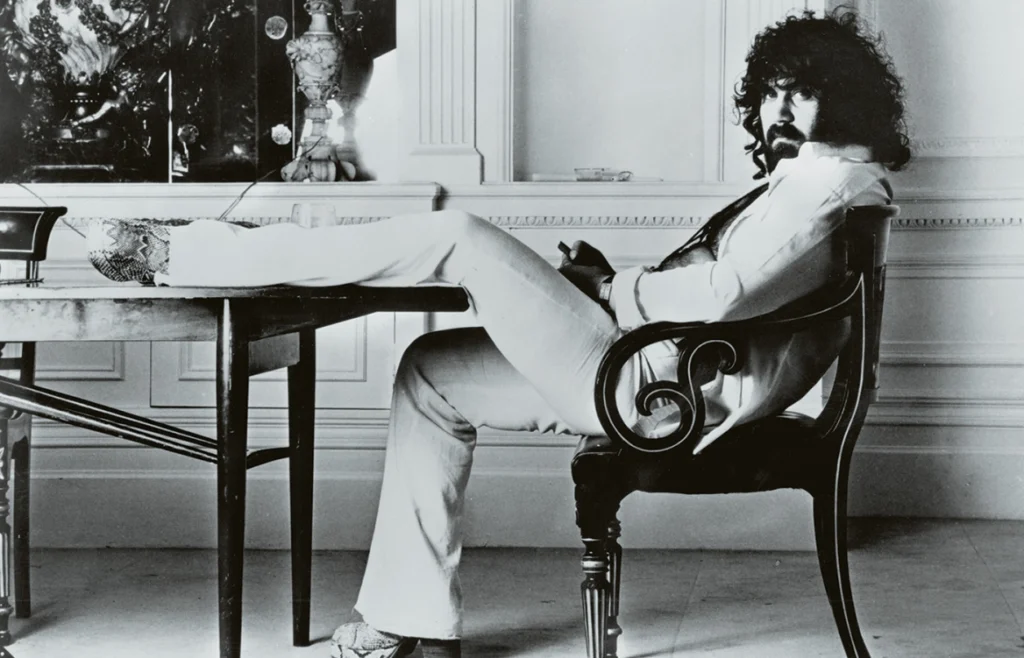
A fanatic collector of the strangest musical instruments, Vangelis also discovered his own, even when going shopping at Habitat, the well-known home goods store. Papathanassiou was fascinated by some heavy metal lamp shades, which he began hitting to hear the sound they produced!
The book reveals that Vangelis nearly became a member of Yes, when the band’s singer, Jon Anderson, whom he had known since his Paris days, approached him to take the place of keyboardist Rick Wakeman, who had just left.
“Bassist Chris Squire said that everyone was extremely excited about the potential collaboration, although in the following three weeks the Greek proved very difficult.”
“Yes were good, but…”
According to guitarist Steve Howe, the composer was quite imposing but avoided commitment, saying, “We weren’t very sure if he wanted to stay.”
Having entered other musical paths, Papathanassiou was no longer accustomed to working with a band, getting excited by drums, for example, and playing them frenetically as a virtuoso while the others waited to rehearse songs.
After three weeks, both sides agreed that the collaboration would lead nowhere, and reportedly, “Vangelis also did not want to compromise his work or face the pressures of fame, so he left.”
Later, the composer stated, “I never felt compatible with them. Yes were very good, but I never felt their music fit well with the way I think.”
In Contrast with Yes
Vangelis perfectly matched with the Greek band Socrates, as he not only produced the album Phos but also played keyboards and percussion and co-wrote one of the songs on the album.
In his personal life, photographer Veronique Skavinska had entered the picture, living with him in London, but he was so absorbed in his music that he had not separated from Vana Verouti, which happened at the end of 1976.
Passionate about synthesizers, when the polyphonic Yamaha CS-80 was released, he ordered it directly from Japan, and the instrument even traveled by train across Russia to arrive in London, where it was used extensively on his then-upcoming album Spiral. Despite his influences from foreign music, Papathanassiou never forgot his Greek roots and in 1978 decided to make an album of electronic adaptations of traditional Greek songs.
Every year he came to Athens for three months, and for this project, he enlisted his friend Irene Papas to perform pieces such as Saranta Palikaria.
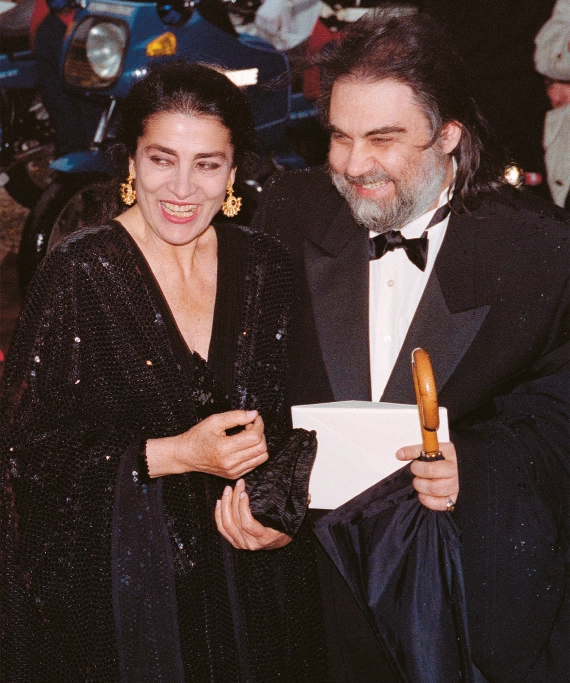
“She recorded the vocals in an astonishingly short span of two days, sitting next to Vangelis at the mixing console, with dimmed lights in the studio to create atmosphere, while Vangelis kept the synthesizer lines simple to enhance the traditional feel.”
Chariots of Fire
In 1981, the composer was commissioned to score a low-budget film produced by David Puttnam and directed by Hugh Hudson.
The film, titled Chariots of Fire, depicts the heroic struggle of two British athletes to win the Olympic gold medal in the 100-meter race at the 1924 Paris Games.
The director assigned the main theme to Vangelis, who, upon seeing a particular scene—the film’s opening—was inspired and completed it relatively quickly. According to Puttnam, however, “He kept complaining that he wanted to do something better, but things had reached a stage where the film was finished, a choice had been made, and the moving opening scene on the beach had been scored with another piece by Vangelis called ‘L’Enfant.’”
When the composer called him, he left his meal halfway through at a London restaurant and was picked up in a Rolls-Royce that even had a tape recorder.
Triumph and the “Door”
Papathanassiou pressed play, and the producer shivered hearing the piano melody, which was immediately added to the film’s opening and closing credits.
The film, which cost only £2 million, premiered in spring 1981 to very positive reviews and was nominated for seven Oscars.
On March 29, 1982, it won four, including Best Original Score, awarded to Vangelis on the day he turned 39.
As Vangelis later said, “What I see creates an emotion that comes out immediately. It might be the right one—the first—while the second and third are much more cerebral, which is an inferior choice.”
Regarding the piano part, “It was done in one take. For me, it’s the only way. Once the piano and rhythm were recorded, a few more things were added.” Despite the triumph, “the composer caused intense nervousness among Polydor Records executives, as he seemed to do very little to promote the single or album,” the author emphasizes.
He was pressured to travel to the U.S. for the glamorous awards ceremony, but Vangelis, who detested being pressured, refused to attend the biggest moment of his musical career.
“In the aftermath of the Oscar win in late March 1982, there is also the legendary story of Vangelis passing through the Polydor offices in London to collect his Oscar in early April.
The phone rings at the management offices. It’s the doorman: ‘I have a man here downstairs who says he has an appointment to collect some Mr. Oscar. Can you check if there is a Mr. Ellis registered? Some Mr. Frank Ellis?’ There was no appointment on the agenda for any Mr. Frank Ellis, and so a wealthy and talented Greek Oscar-winning musician was turned away at the entrance of his own record label, the atmosphere perhaps vibrating with Greek curses.”
The Rebellious Composer
After Chariots of Fire, the composer was in high demand to write film scores, but he remained selective. Although he agreed to score Blade Runner, he refused to release it on a record.
“They said I should release a record with Blade Runner,” he said at the time. “Why? I can’t write music every day and I can’t end up with 20 albums a year to satisfy some businessman. I do these things because I like it and release an album whenever I want.”
He hated airplanes, disliked flying, and traveled anywhere in Europe in his Rolls-Royce. When he went to America, he chose to travel by ship, even though he would get dizzy even when the vessel was docked. Thanks to his financial comfort, he sometimes did what some would call extravagant.
“While in Los Angeles, Vangelis bought a Jeep Wrangler, which was airlifted to Greece on a Boeing 747 and later used to transport keyboards (instruments) from the warehouse to the studio and to apartments around Athens.”
For a man who detested publicity, 1987 was certainly not his year, as he was accused of stealing a melody and appropriating it for the Oscar-winning Chariots of Fire.
The Dispute with Logaridis
Songwriter Stavros Logaridis, who had known Papathanassiou for years, accused him of stealing the melody of City of Violets and, together with EMI, filed a lawsuit against Vangelis in British courts, seeking £2 million in damages for copyright infringement.
“The trial lasted the first two weeks of February. It was presided over by 73-year-old Judge Whitford, who was extremely suited for the position as he was an accomplished trumpeter and at one point in the trial was given a Walkman and a cassette with the two melodies to compare the themes…”
Papathanassiou, hearing Logaridis’ claims at various stages of the trial, could not contain himself, “expressing his displeasure with exclamations, sighs, and head shaking, until his own lawyer had to impose silence.”
When called to explain his composition technique, Papathanassiou said: “I just think of a melody, and it comes immediately. I don’t exert much effort; it just comes. It’s quite boring actually.”
On the contrary, demonstrating this technique to the judge was far from boring, as “the courtroom was filled with audio equipment worth thousands of pounds, with the somewhat bewildered judge surrounded by electric pianos, synthesizers, mixing consoles, and other recording gear.” Vangelis played the piece—perhaps the most unexpected live performance of his life—witnesses testified, and on February 18, the judge issued the verdict.
“He described Chariots of Fire as a piece that exudes effort and unequivocally absolved Vangelis of the charge of consciously or subconsciously copying City of Violets.”
The Frugal Vangelis
He was so prolific that, as he said, “If I stopped playing or composing now (we’re talking about 1989) and never touched a keyboard again, I would probably have around 100 albums ready for release.”
Conversely, his live performances were extremely rare throughout his remarkable musical career, and when asked about it, he chose to respond with humor: “Look at these” (pointing to 14 synthesizers, three pianos, and a drum set), “it takes so long to set up, how can I do a concert!”
Equally frugal was he regarding his personal life, about which he never wanted to speak publicly. Thus, when it became known in September 1997 that he had a new relationship, he initially remained silent.
Vangelis was then 54 years old, and his beloved, whom he had likely met in the early 1990s, was 27-year-old Laura Metaxa, descendant of the well-known distilling family—“he admitted in 2005 that he was in his third long-term relationship.”
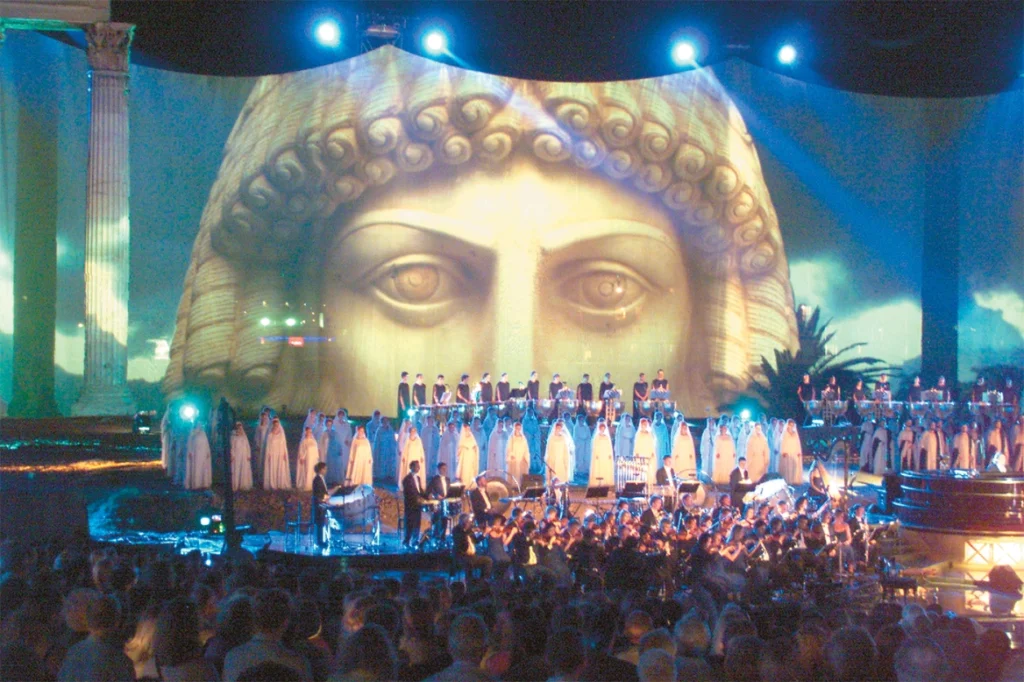
It would also be the last, in a life full of notes and a heart that stopped beating on May 17, 2022, in a Paris hospital where he was being treated for COVID-19. His funeral took place on Friday, June 3, at Père Lachaise Cemetery in Paris with minimal publicity and very few attendees due to the pandemic.
The Vangelis Research Foundation and his last partner, Laura Metaxa, took over the management of his estate—estimated at around €245 million—and his music. The words of American journalist Tim Grieving answer best the question of what Vangelis really was: “There was something otherworldly about this man, and it wasn’t just his music.”
Ask me anything
Explore related questions