
According to ancient Greek tradition, there is an important connection between the Trojan War and the city of Heracleion in Egypt. This city is perhaps most famous today for having sunk into the sea. However, Heracleion also had the distinction of being visited by Helen of Troy before the Trojan War and by Menelaus afterwards.
The city of Heracleion in Egypt
Firstly, let us see what Heracleion actually was. This was a city in ancient Egypt just next to the coast, founded in the eighth century BCE. It was at the end of the Canopic branch of the Nile River, which was on the western side of the Nile Delta.
For this reason, Heracleion was a vital city in ancient Egypt. Traders frequently visited it due to its convenient location. It eventually became the main port for international trade. The name ‘Heracleion’ was a reference to the Greek hero Heracles. The Greeks connected him to the city by his identification as Khonsu, an Egyptian god who had a massive temple in the city.
Its native Egyptian name was rendered in Greek as ‘Thonis’. For this reason, the city of Heracleion is sometimes called Thonis-Heracleion, or simply Thonis.
The connection between Heracleion in Egypt and the Trojan War
Now that we have a basic idea of what Heracleion was, what do we know about the connection that it had to the Trojan War? According to ancient Greek tradition, Helen of Troy visited the city before the conflict.
Herodotus, a fifth-century BCE Greek historian, related the story of her visit. He wrote the following:
“After carrying off Helen from Sparta, [Paris] Alexandrus sailed away for his own country; violent winds caught him in the Aegean and drove him into the Egyptian sea; and from there (as the wind did not let up) he came to Egypt, to the mouth of the Nile called the Canopic mouth.”
According to this, when Paris Alexander ran off with Helen from Greece, strong winds pushed his ship down to Egypt. Herodotus goes on to explain that some of Paris’ own servants informed the Egyptians of what had happened. This led to the Egyptians forcing Paris to appear before Proteus, the king of Egypt, to be judged.
The Egyptian judgment of Paris
The Judgment of Paris refers to when the Trojan prince Paris was asked to decide which of the Greek goddesses was the most beautiful. This ultimately caused the Trojan War. However, another ‘judgment of Paris’ was the judgment that he received in Egypt from King Proteus. According to Herodotus, this Egyptian king stated:
“If I did not make it a point never to kill a stranger who has been caught by the wind and driven to my coasts, I would have punished you on behalf of the Greek, you most vile man. You committed the gravest impiety after you had had your guest-friend’s hospitality: you had your guest-friend’s wife.”
In other words, this king who ruled over Heracleion just before the Trojan War gave a strong condemnatory judgment against Paris for running off with Helen. Nevertheless, Proteus did not kill Paris, due to his policy of not killing those who had been ‘caught by the wind and driven to his coasts’.
Heracleion after the Trojan War
This may not be the only connection that Heracleion has to the Trojan War. There is a tradition that likely connects this city to the aftermath of that event. Herodotus claimed that Menelaus visited this area after the Trojan War. He came here after having not found Helen at Troy itself.
By this point, after the Trojan War, Helen was no longer at Heracleion. She was in Memphis. Nevertheless, Heracleion was a prominent port city. Hence, it is likely that Menelaus arrived at this city before continuing to Memphis. There, he found Helen. However, due to strongly unfavourable winds, they were not able to leave again for quite some time.
The idea that Menelaus and Helen were in Egypt, near Heracleion, after the Trojan War does not only appear in Herodotus; Homer himself mentioned it in the Odyssey. While similar to Herodotus’ account, it is not the same.
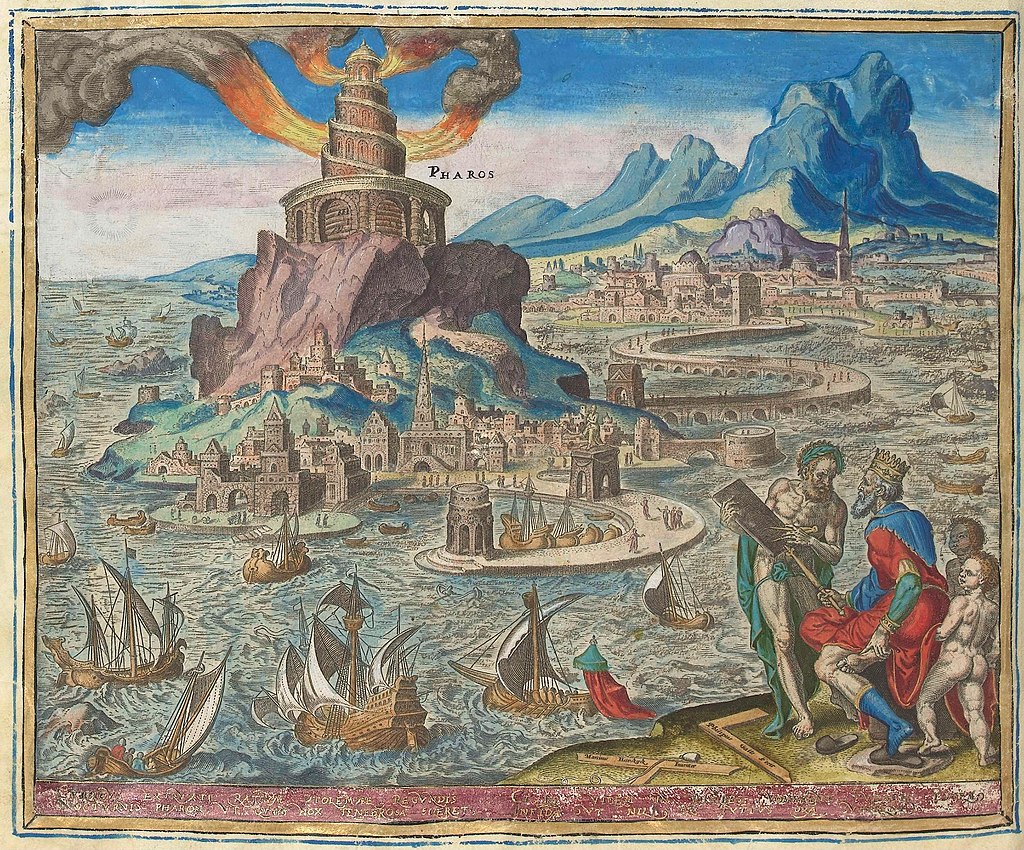
Homer explains that Menelaus’ ships had been blown ashore in Egypt while trying to return to Greece. According to this account, he was kept at Pharos on the coast of Egypt, right next to ancient Heracleion. Therefore, this makes it all the more likely that Menelaus landed at Heracleion, or somewhere nearby, after the Trojan War.