

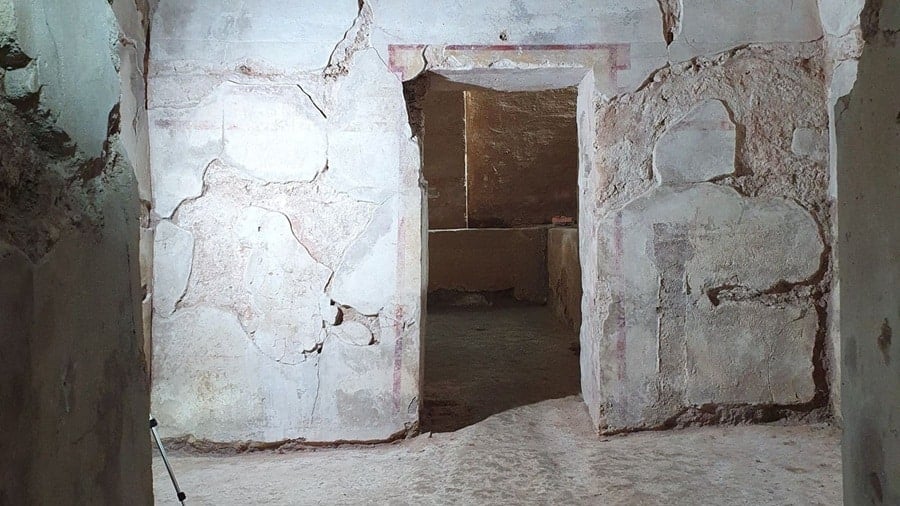
Beneath an apartment building in the heart of the Greek city of Drama, lies a Macedonian tomb—a stark reminder that the modern city is built upon layers of ancient history. Discovered in 1976 during excavation for a new building, this is the city’s first in situ Hellenistic monument, offering a rare glimpse into the burial customs and daily lives of ancient Drama’s inhabitants.
“This year marks the 50th anniversary of its discovery, an event that was entirely unexpected yet sparked immense admiration,” says Vasiliki Poulioudi, Head of the Ephorate of Antiquities of Drama. “When workers began digging the foundations, they never imagined they would stumble upon a monumental tomb, fully intact and adorned with impeccably preserved frescoes.”
The tomb, located on Troias Street, near the intersection with Palaiologou Street, consists of a stone-built entrance path with steps, an antechamber of porous stone blocks, and a burial chamber likely constructed from local clay bricks.
The artistry and ritual of the Macedonian tomb in Drama

The frescoes in the antechamber are breathtaking. Using the watercolor technique, the builders created a harmonious ensemble of architectural etchings, decorative bands featuring bucrania (ox-head motifs), and rosettes (ancient solar symbols).
“The meticulous detail reveals a monument of high social standing,” explains Ms. Poulioudi. “The presence of iron nails suggests that floral garlands and decorative ribbons once adorned the walls during burial rites.”
The burial chamber houses three Pi-shaped sarcophagi, coated in white plaster. Despite being disturbed by ancient grave robbers, the tomb yielded significant finds now housed in the Archaeological Museum of Drama, including:
- Jewelry: A gold necklace featuring carnelian beads and animal-head finials, and gold earrings depicting Eros
- Offerings: Terracotta unguentaria (perfume flasks), lamps, glass beads, and various vessels for ritual libations
- Currency: Numerous coins from Amphipolis, Thessaloniki, and Istiaia
A living witness to history

Dated between the late 3rd and mid-2nd century BC, the tomb belonged to a wealthy family and helped archaeologists define the boundaries of the ancient city.
Today, it remains a “living witness” of the Hellenistic era, nestled quietly among the dense modern housing of Drama. It serves as a poignant reminder that antiquity isn’t distant—it lives in the basements and foundations of our daily lives.
Related: Greece Restores Emblematic Byzantine Church in City of Drama