By Ross J. Robertson
Newly discovered wartime journals reveal how Greek Resistance members risked their lives to rescue two British airmen in 1943, while separate research into a sunken aircraft uncovered a remarkable connection to two Australians from Melbourne.
More than 80 years after two British airmen were forced to ditch their aircraft off the Greek island of Naxos during World War II, their extraordinary survival story has been brought to light through the discovery of a pilot’s wartime journals and historical research.
The account, reconstructed by authors Ross J. Robertson and Konstantinos Giannakos, reveals how ordinary Greek islanders, including two young shepherd boys, a village doctor and a former Greek Air Force officer, risked their lives under Nazi occupation to shelter and rescue the injured men.
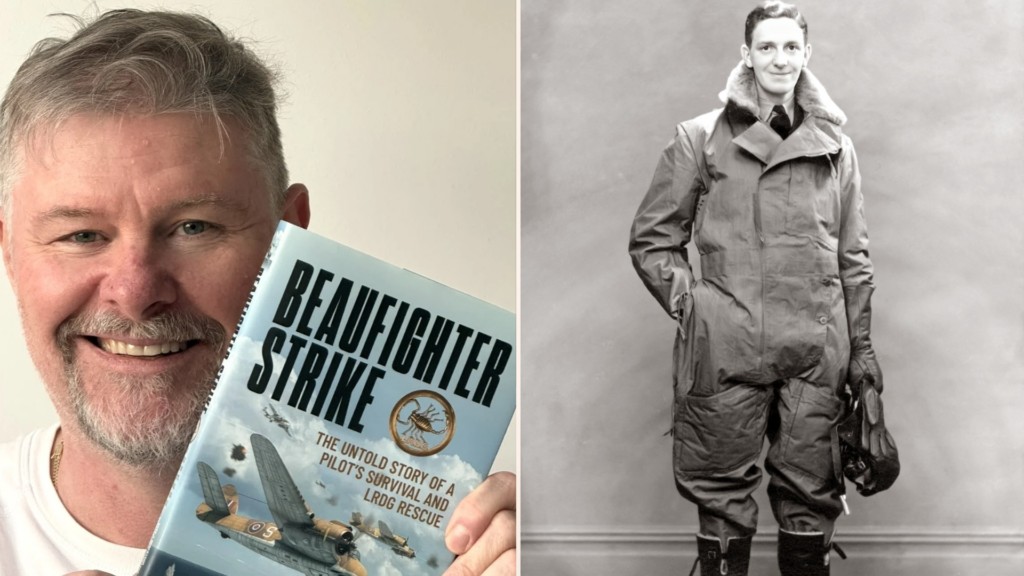
Their research, detailed in the book Beaufighter Strike, also uncovered a separate Australian connection involving two Melbourne airmen whose aircraft was shot down near Naxos just days later. The wreckage of that aircraft, discovered in 2007, had initially been mistaken for the British pilot’s plane.

The story offers a rare insight into the courage of the Greek Resistance, the dangers faced by Allied airmen in the Aegean and the wartime connections between Greece and Australia.
The research reconstructs the events that began on 30 October 1943, when Allied aircraft launched an attack on German shipping near Naxos.
The wartime journals that revealed a forgotten rescue
For Anne Timsit-Hayter, her father’s wartime experiences remained largely a mystery. She was just 15 when Bill Hayter died in the early 1970s. The family knew he had served in the Royal Air Force (RAF), and photographs offered glimpses of that earlier life, but he never spoke about the war.
One photograph had always held a special place in the family home. It showed Bill with Georgios Sideris, a former Royal Hellenic Air Force officer. Only decades later, when wartime journals came to light in her mother’s attic in France, did Anne, her siblings and their families begin to understand the significance of the man beside her father. Sideris had been part of the Resistance on Naxos and had helped save Bill’s life. Bill’s son, George, had even been named after him.
Writing in longhand in an old RAF Sight Log Book, Hayter recorded the events of 30 October 1943, when four aircraft operating from a base in Cyrenaica, now part of Libya, attacked German shipping in Naxos harbour. He was a Flying Officer at the controls of Bristol Beaufighter JM317 of No. 47 Squadron, with Warrant Officer Tom Harper as his navigator. Harper had been assigned to the mission from No. 603 Squadron. The raid formed part of the wider Allied campaign in the Aegean following Italy’s surrender in September 1943.

There is an unexpected moment in Hayter’s account. As the formation swept across the Aegean on its mission of destruction, he found himself captivated by the ancient islands below. Santorini was “perfectly white”, its monastery “in complete isolation far above us”. The Aegean seemed to belong to another age, “a magic age of fantasy half familiar and half mystery”.
His thoughts turned to the ancient world. “Apollo’s temple still crowns the isle of Delos,” he wrote, while the marble of Paros seemed to await “the master touch of a new Praxiteles”. The islands had made such an impression that, as he recalled, “So deep was the feeling that it took precedence in my mind over the attack.”
It is a remarkable reflection from a young pilot on the way to combat. But the beauty of the islands soon gave way to violence. An American B-25G gunship was hit by anti-aircraft fire and plunged into the sea between Naxos and Paros, killing its entire crew. Hayter’s Beaufighter was also critically damaged. Enemy fire had ripped through its wing, puncturing the main fuel tank and leaving the aircraft trailing a cloud of fuel.
Hayter and Harper were forced to ditch. Both suffered serious facial injuries but managed to reach a remote stretch of Naxos’ northern coast. Hayter set off in search of help, eventually approaching a dilapidated shack that appeared deserted. Inside were two young shepherd boys. Despite the language barrier, they quickly understood that the injured, bedraggled stranger needed help. They guided him to Georgios Sideris.
Naxos: Resistance and resolve

Image: HAYTER ARCHIVES
Following the German invasion of Greece in April 1941, Sideris was demobilised and returned to his village of Komiaki in northern Naxos. But he did not simply resume civilian life. He joined the Resistance, becoming a member of the Stratiotikon Tmíma Náxou (STN), or Military Detachment of Naxos.
Resistance on Naxos took a deliberately cautious form. An armed uprising without outside support would almost certainly have failed and brought devastating reprisals. Instead, the STN gathered intelligence, passed messages to Allied headquarters in the Middle East and, to Hayter and Harper’s good fortune, was prepared to shelter Allied personnel.
Sideris was a respected member of the organisation and also worked with the British Special Operations Executive (SOE) for a short time. His Resistance codename was Byron, after Lord Byron, whose support for the 1821 Greek War of Independence had made him a celebrated English figure in Greece. It was a fitting name for a man risking his life for his country’s freedom.

Once sheltered in Sideris’ remote farmhouse, the airmen were given medical attention after the Resistance network contacted Dr Emmanuel Bardanis. He treated their injuries and stitched their wounds with a needle and cotton thread, without the benefit of antiseptics or anaesthesia.
While following a wayward sheep, another shepherd boy inadvertently came across a Long Range Desert Group (LRDG) patrol gathering intelligence on German movements. He reported its presence to the Resistance, whose members did what they could to help, even offering the men food and wine despite their own severe shortages.


Resistance members acted as runners between Sideris’ farmhouse and the LRDG, helping arrange Hayter and Harper’s eventual evacuation to Leros. Their rescue depended on the cooperation of this clandestine network.
With the airmen safely away, Sideris became a wanted man. When German troops came to search and ransack his house, his adopted niece Varvara managed to warn him in time. He went into hiding, and the German commandant subsequently issued an execution order against him. With SOE assistance, Sideris was eventually evacuated to the Middle East.
Two Australians, another Naxos ordeal
While Hayter and Harper were convalescing in Cairo, their fellow airmen continued flying perilous missions across the Aegean. Losses in both No. 47 and No. 603 Squadrons were mounting at an alarming rate. When Hayter returned to active duty some three weeks later, he found that most of his close friends had been killed.
Among the aircraft lost during this period was Beaufighter LX998 of No. 603 Squadron, flown by two Australian airmen from Melbourne.

Their fate was uncannily similar to that of Hayter and Harper. On 6 November 1943, Pilot Officer Keith E. Hopkins and Warrant Officer Keith V. Roget took part in an attack on German shipping at Naousa harbour and Yanni Bay, off northern Paros.
Their Beaufighter came under heavy anti-aircraft fire and was engaged by Messerschmitt Bf 109 fighters and Arado 196 floatplanes. Critically damaged, it was forced to ditch off Naxos.
The two men escaped in an inflatable dinghy but were blown almost 30 nautical miles across the sea, passing Iraklia and Schinousa, before being rescued by an unlikely source: the Royal Navy submarine HMS Unrivalled.
They were taken to Malta and rejoined their squadron about a week later.
A well-preserved Beaufighter wreck discovered off Naxos in 2007 was initially believed to be Hayter and Harper’s aircraft, JM317. It was later identified as LX998, the aircraft flown by Hopkins and Roget.
A few recovered instruments later helped establish the location of JM317, but its remaining wreckage has long since been scattered and lost to the sea.
Friendships forged in wartime
The photograph on the Hayter family mantelpiece, along with the postwar correspondence between Hayter, Harper and Sideris, is a lasting testament to the bonds formed during those dangerous times on Naxos.
Hayter had first looked down on the Aegean with the wonder of someone encountering a landscape steeped in mythology and history. He could hardly have imagined that the same islands would become the setting for a desperate fight to survive, or that one of their inhabitants would become a lifelong friend.

The ancient world had captured his imagination; the generosity and courage of its people would leave an even more lasting impression.
The story of these events reminds us that the history of war is not measured only in battles, losses and political upheaval. It is also found in the actions of ordinary people who acted in defiance of the gods of war, knowing the dire risks.

The Naxos islanders, be they shepherd boys or former officers, doctors or ordinary villagers, were part of a larger, too often overlooked, history of Greek resistance to subjugation and oppression.
Their courage also reflected the enduring bonds between the Greek and British peoples, rooted in a shared history and strengthened by the struggle against a common enemy.
They deserve to be remembered in their own right.
Hayter’s remarkable account is explored in greater detail in Beaufighter Strike: The Untold Story of a Pilot’s Survival and LRDG Rescue, by Ross J. Robertson and Konstantinos Giannakos, published by Pen & Sword Books. The book is available through the publisher’s website.
Story via the original publisher. Read the original article