For many Greeks living abroad, the connection to their ancestral homeland begins long before they ever visit. It is passed down through family stories, traditions, photographs and the memories of grandparents who kept a piece of Greece alive wherever they settled.
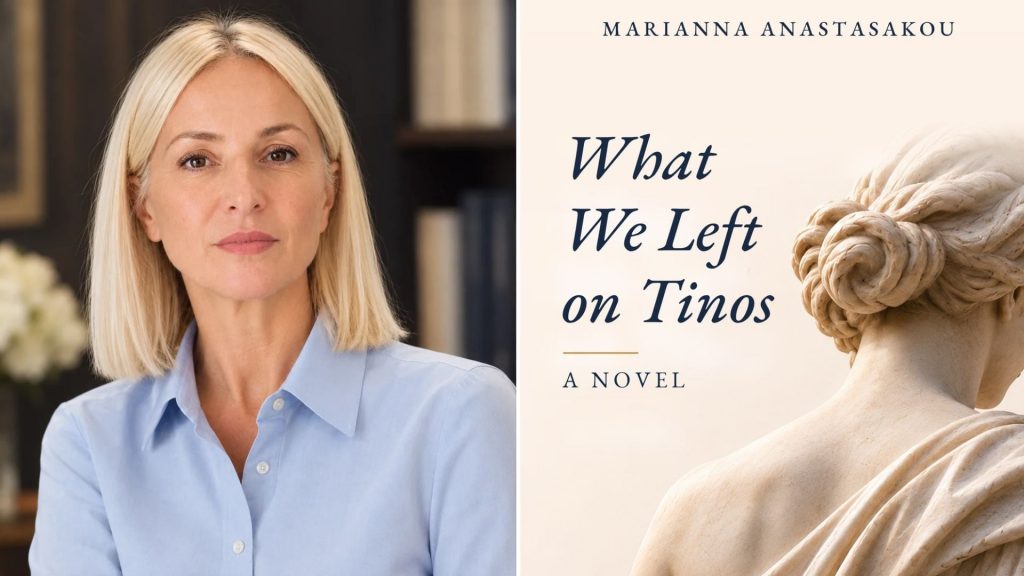
This sense of inherited belonging lies at the heart of What We Left on Tinos, a new English-language novel by Greek author Marianna Anastasakou, published in November 2026.
Blending an art-world mystery with themes of family, identity and cultural heritage, the novel takes readers from London to the marble-carving village of Pyrgos on the Greek island of Tinos.
Behind the fictional story is something deeply personal: Anastasakou’s relationship with her grandmother Maria, whose influence inspired the novel and to whom the book is dedicated.

A mystery carved in marble
The story begins when a conservator in London discovers unusual tool marks on a marble sculpture valued at more than four million euros, raising questions about its attribution.
Her investigation leads through the European art world and eventually back to Pyrgos, where generations of craftspeople have shaped the island’s artistic identity.
For Anastasakou, the setting was never simply a creative choice.
“I did not really choose Tinos. I inherited it,” she told The Greek Herald.
“My grandmother Maria came from the island, and some of my strongest memories of her are connected with Tinos, the Panagia, Pyrgos, her stories, the light, the landscape and that particular feeling of returning somewhere that somehow already knows you.”
In 2015, Tinian marble craftsmanship was inscribed on UNESCO’s Representative List of the Intangible Cultural Heritage of Humanity, recognising traditional skills passed between generations.
“In Pyrgos, art does not begin at the door of a museum. It is above the door. It is beneath your feet. It is in workshops, churches, cemeteries, lintels and fanlights,” Anastasakou explained.
“Marble is not simply an artistic material there. It is part of the language of the village.”
The grandmother behind the story
While the novel’s mystery revolves around art and historical attribution, its emotional foundation comes from Anastasakou’s grandmother, Maria.
A cultured woman who spoke French, played the piano, travelled extensively and loved art, Maria introduced her granddaughter to museums and the wider world while maintaining a deep connection to the Orthodox faith and traditions of Tinos.
“My grandmother shaped far more than this novel. She shaped me,” Anastasakou said.
“Through her, I never experienced art, faith, family and place as separate things. The same woman who stood beside me in museums stood beside me at the Panagia.”
Although the characters and plot are fictional, the grandmother-granddaughter relationship draws on experiences central to the author’s life.
Like other Greek creatives who have explored the influence of their grandmothers on their work, Anastasakou reflects on how much we truly know about the people who shaped us.
“We can know our grandparents completely in one sense and hardly at all in another,” she reflected.
“We know their voice, the chair they sat in, the prayers they taught us, the way they held our hand. But we may know almost nothing about who they were before we arrived in their lives.”
“Sometimes a family secret is not something somebody deliberately hid. Sometimes it is simply the question nobody asked in time.”

A story for Greeks around the world
Anastasakou deliberately wrote What We Left on Tinos in English, hoping to introduce international readers, particularly those of Greek heritage, to the island’s history, marble craftsmanship and cultural traditions.
Her exploration of belonging echoes themes found in other contemporary Greek diaspora fiction, including Emily Tsokos Purtill’s Matia and Maria Stefanidis’ The Invisible Thread, which examine the influence of heritage across generations.
“For Greeks abroad, Greece is often inherited in fragments. A grandmother’s accent. A village name. An icon in a house in Sydney. Easter in Melbourne. A photograph from an island,” Anastasakou said.
“You can love a place you have never lived in. Sometimes you can even miss a place you have never seen.”
Beyond the island’s picturesque landscapes, she hopes readers discover the deeper cultural richness of Tinos, from the marble workshops of Pyrgos to its religious traditions and generations of artisans.
“I would love a reader in Australia who has never visited Tinos to finish the novel wanting to see the island,” she said.
“But I would love something else even more. I would love them to close the book and think suddenly of their own yiayia or pappou.”
Ultimately, Anastasakou hopes the novel encourages readers to explore their own family histories and ask questions while they still have the opportunity.
“We always imagine there will be time to ask. There is not always time.”
For Anastasakou, What We Left on Tinos is more than a story about an island or a mysterious sculpture. It is a reminder that the most meaningful things we inherit are not always those we can hold.
“Ultimately, What We Left on Tinos is not only about an island. It is about the places, the people and the unfinished stories we carry inside us.”
What We Left on Tinos was published in November 2026 and is available internationally in paperback and Kindle editions through Amazon.
Story via the original publisher. Read the original article