
“The time will come when our silence will be more powerful than the voices you strangle today.” These were the last words of German-born anarchist August Spies as he faced the noose for the bloody events surrounding May Day in Chicago, 1886. It is likely that the 200 communists executed on May Day 1944 in Kaisariani had heard of the event through a strike, a workers’ theater performance, or a proletarian story. And if not this exact incident, then something very similar.
The mental and political makeup of the “Reds” in the interwar period rested on a fascinating paradox. The communist movement was profoundly materialist, rejecting any consoling notion of life beyond death. Yet, at the same time – an element that explains its enduring appeal – it offered a strong sense of purpose through one guiding belief: faith in history. Sacrifice for the collective cause promised the eventual emancipation of humanity from the chains of necessity. Within this framework, death – the “transformation of matter,” as Nikos Ploumpidis described it while awaiting execution – was inseparable from the future vindication of the oppressed.
Faith in history was not a mere theoretical exercise. It was forged in the shared life of a community of like-minded individuals – the “party” – which gave its members interpretive keys to understanding historical development through material political action. Interwar communism produced a distinctive human type: the one who raises a fist in the face of guns. Today, such a figure may provoke discomfort – the unease of confronting something alien – but it was ultimately a product of a historical era in which social conflict was often militarized. These individuals, or at least most of them, saw themselves as soldiers in a global struggle against the state and its mechanisms. They had endured severe social exclusion as workers and poor people, witnessed comrades fall at strike rallies, and spent years in prisons or in exile.
The collective biography of those executed in 1944 also reveals that many were not arrested by the occupying authorities but by the Greek state itself. Formed after the Asia Minor Campaign, the Greek state carried a clear ideological marker: anti-communism. This stance proved resilient over time, transcending the usual distinctions between democratic and authoritarian periods – from 1924, when Aegean islands hosted political exiles, to 1974.
Recognizing this continuity – and in state policies before and after the critical period of 1940-41 – helps us grasp the dual complexity surrounding the Kaisariani massacre. Those executed had been condemned by the Greek state as enemies of the nation – and after 1945, they remained so in the eyes of the state. They were not regarded as Greeks, but as “communists.”
The execution site itself remained under the ownership of the Hellenic Shooting Federation – a cruel historical irony – while each May Day, police orders limited commemorative ceremonies, leaving the documentation of events to the collective memory of the legitimate leftist party rather than the official state.
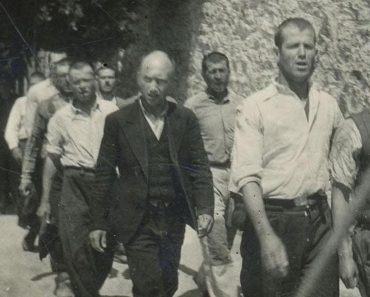
The long-term exclusion of the Kaisariani events from the nation’s collective memory, I believe, explains the intensity of the emotions sparked by the sudden emergence of photographs from 1944. What had existed only in imagination became tangible. This process is tied to the need for recognition, for identification, and ultimately for calling things by their proper names. These people were executed because they were communists – this was explicitly stated in the announcement of the occupying authorities. Acknowledging this fact allows us to reflect on the central conflict of 20-century Greece: Who was considered “Greek,” and by whom, and who was not – and by whom – at each historical moment. Avoiding this difficult discussion is possible, but it forces us continually to stumble over the material and symbolic remnants of a stubborn past.
Kostis Karpozilos is an assistant professor in the department of history and political science at Panteion University.