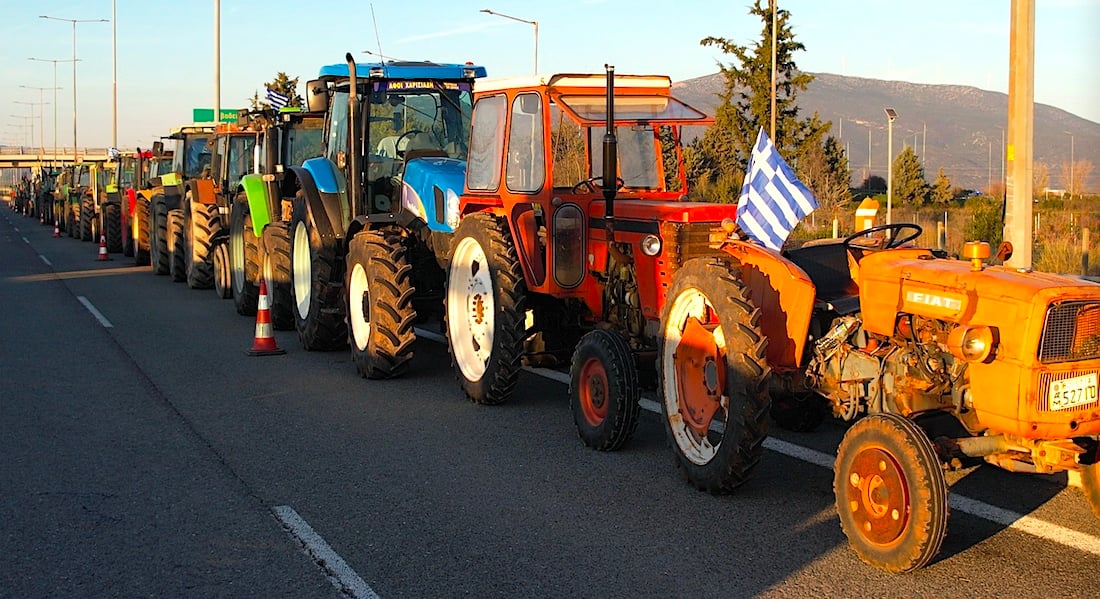
Greek farmers are deliberating over a “final” offer made by the government to decide whether they will continue their strike that includes blockades of major highways. The first reaction was strong dissatisfaction with the proposed measures.
The farmers are demanding concrete relief for soaring energy costs and guaranteed timelines for financial support payments to offset collapsing incomes. Earlier on Wednesday, Greek ministers offered a package of measures they argue would satisfy several demands of the nation’s farmers. Among the measures are:
- Fixed energy rates: The Public Power Corporation (PPC/ΔΕΗ) is extending the fixed-price coverage for a two-year period starting April 1, 2026. This move is designed to shield farmers from market volatility.
- Reduced pricing: For farmers with no overdue debts, the electricity rate is being slashed to 8.5 cents/kWh. This represents a significant reduction in operational overhead.
- Universal access: All new farmers are now eligible to participate in the program. Most established Greek farmers are already enrolled in the scheme.
Full coverage for Greek farmers’ losses
Greek ministers also announced a comprehensive overhaul of the agricultural insurance framework. These changes significantly increase payouts without placing additional financial burdens on producers and include:
- 100% compensation: Producers will now be compensated for 100% of the insured value of their production, an increase from the previous 80% limit.
- No premium hikes: This increase in coverage comes with no increase in insurance contributions (premiums) for the farmers.
- Increased compensation limits: The maximum compensation limit per individual has been nearly tripled, rising from €70,000 (about $81,780) to €200,000 (about $233,690). This ensures that larger-scale losses or high-value crops are adequately covered.
The government maintains that the provisions ensure that one hundred percent of the sector is automatically insured, preventing producers from remaining unprotected during climate-related disasters.
“Real farmers will win out,” says Greek government
“In 2025, payments of 3.82 billion euros were made. However, it is important that everyone knows some information related to the new system,” Deputy Prime Minister Kostis Hatzidakis said.
He also referred to the one-month delay in payments to farmers. “If we had paid without an agreement with the European Union, we would have risked new fines or a partial suspension for farmers,” he said, adding: “The country will receive exactly the same money from Brussels for direct agricultural payments.”
“The real farmers will win out, because the same funds will be distributed more fairly,” the Deputy Prime Minister noted. Hatzidakis stressed that of the 27 demands made by farmers, 16 have been met and four are being processed. He also added that the remaining seven demands lie outside the EU’s budgetary limit and framework.
Opposition Criticizes Government’s Treatment of Farmers
Opposition parties have criticized the government’s latest measures, arguing they fall short of addressing farmers’ real needs. SYRIZA in particular attacked the administration over the activation of the controversial “Plan B.”
Vasilis Kokkalis, SYRIZA’s spokesperson for agricultural development and food policy, said: “The government is taking even more from farmers and livestock breeders, beyond what is already owed. Not only are their basic demands left unmet, but they now face the threat of immediate legal action, fines, and criminal proceedings.”
The Communist Party of Greece (KKE) echoed the criticism, describing the government’s announcements as “light-years away from the actual needs of farmers.” The party dismissed the call for dialogue as largely symbolic, highlighting that while the government speaks of discussion, it simultaneously issues new orders for prosecutions and agricultural court cases.
Meanwhile, Kyriakos Velopoulos, leader of the Greek Solution party, commented: “The Supreme Court has once again shown that it operates blindly — but acts as a crutch whenever the government falters and needs support.”
The government, however, continues to emphasize its call for consensus, pointing to the multiparty committee proposed by the Prime Minister as a forum for discussion.
Government keen on opportunity for dialogue with farmers
Hatzidakis also described Prime Minister Kyriakos Mitsotakis’ proposal for a cross-party committee to promote a dynamic agricultural sector within the framework of the new CAP as “a great opportunity.”
The minister emphasized that the doors of the government and the Ministry of Rural Development are always open to Greece’s farmers, and agricultural trade unionists for discussions on structural issues, rural development concerns, issues related to the new CAP, and administrative matters. Government officials said they would proceed with the measures “whether farmers come to dialogue or not,” signaling that patience with the days-long disruptions is running thin.