
An international underwater expedition off the coast of Asini has uncovered evidence of a Roman-era port, shedding new light on ancient maritime activity in the eastern Peloponnese.
The research, carried out between September 29 and October 1, 2025, is part of an ongoing five-year project launched in 2022. The initiative builds on a pilot survey conducted in 2021 and has been conducted jointly by the Ephorate of Underwater Antiquities, the Swedish Institute at Athens, and Stockholm University, with additional contributions from University of Gothenburg and the Nordic Maritime Group.
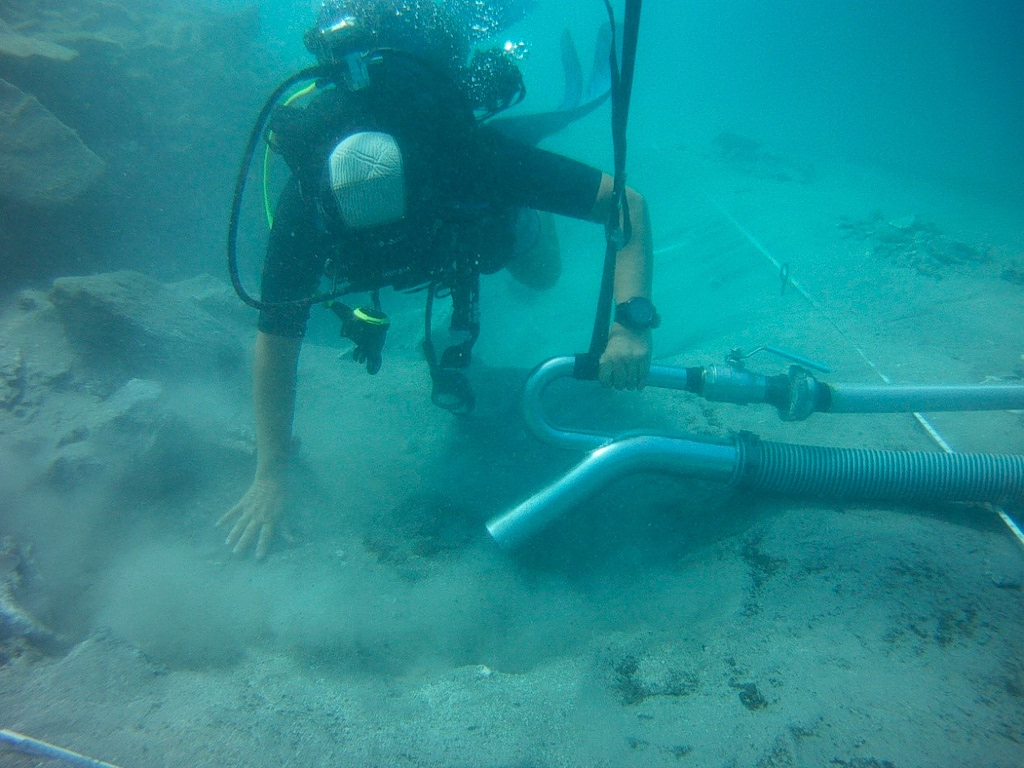
Photo: Niklas Eriksson / Greek Culture Ministry
Findings from the 2021-2025 surveys reveal the scale and complexity of a large artificial harbor facility located east of the Kastraki site. At its core lies a broad, man-made underwater plateau in shallow waters, likely a key structural element of the ancient port.
Although the plateau initially appears to be a simple accumulation of stones, detailed analysis tells a different story. Using high-resolution 3D models developed during earlier research phases, archaeologists identified distinct stone-built formations. These features stand out due to their consistent shapes and the uniform size of the materials used, indicating deliberate construction rather than natural formation.

The site’s strategic position near a naturally sheltered harbor with an elevated defensive hill explain its long history of habitation, going back to prehistoric times.
The primary goal of the 2025 expedition was to better understand the structures on the submerged plateau and determine their function within the port system. Ongoing analysis, including material dating and further study of digital models, is expected to provide deeper insight into how the harbor operated and evolved.
Researchers plan to publish their findings in Opuscula, the academic journal of the Swedish Institutes in Athens and Rome, as well as in other scientific publications.
The news comes after the release this week of results from another underwater study carried out around the Greek islands of Kasos and Karpathos.
Many of the finds, will for the first time in Greece, go on display at the Piraeus Museum of Underwater Antiquities, scheduled to open later this year at Greece’s largest port.