
In 1829, Lucien Bonaparte — Napoleon’s younger brother — unearthed a painted Greek amphora in Etruria and gifted it to the visiting Duke of Buckingham, unknowingly launching a nearly 200-year journey where art, law, and collecting converge, binding its beauty to a record of intriguing custodians — and ultimately, to a Duke Law student tasked with telling its story.
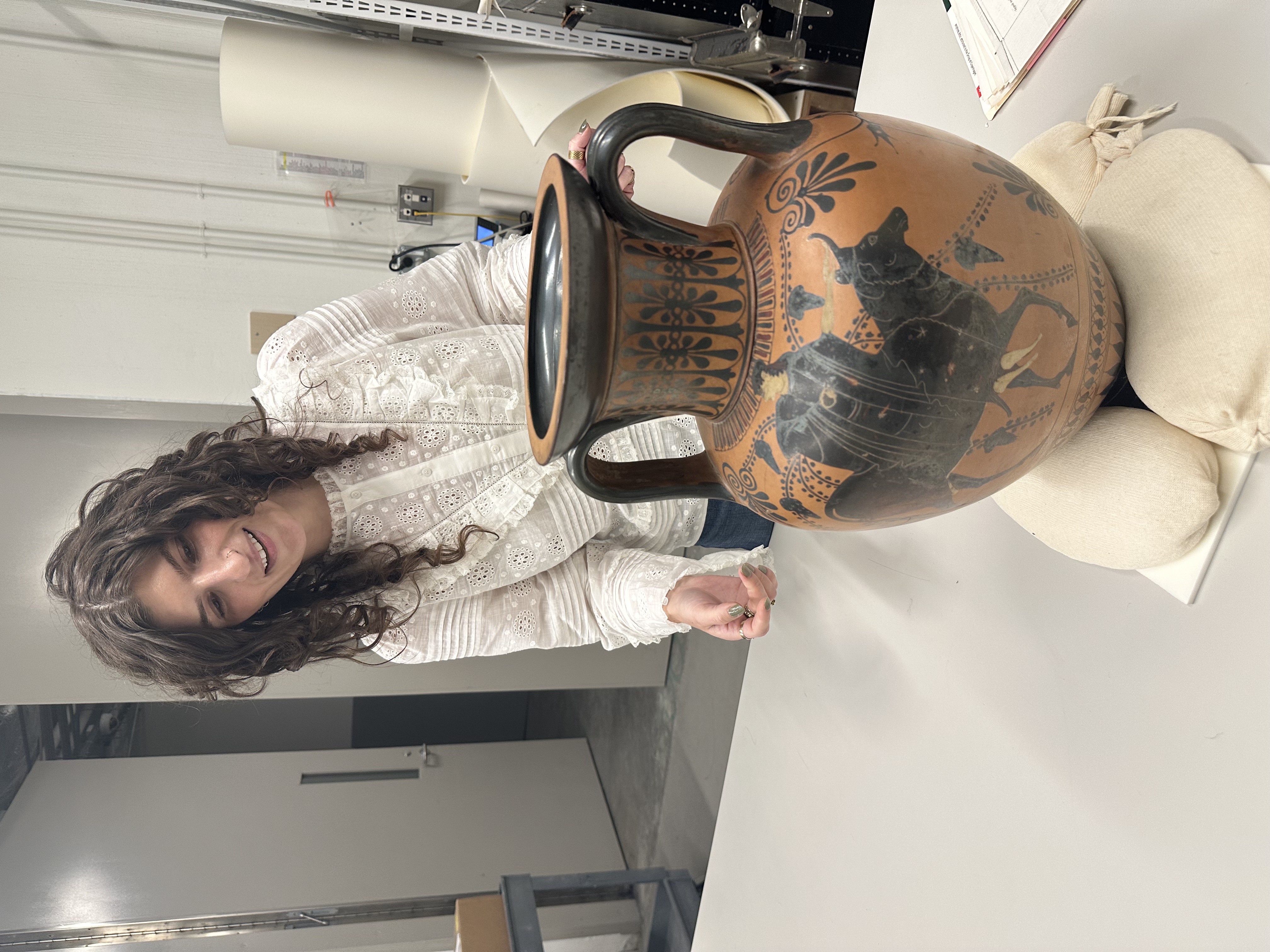
Nicole Braun JD ‘27 calls herself “a history nerd and art nerd.” She has always been into art. “When I was a kid, I loved art classes and making art. I was never very good at it, so I studied art history in college and loved it.” As an undergrad, she initially thought she might work as an art museum curator. “I realized quickly that wasn’t necessarily what I wanted long term, so I pivoted to law pretty early on while I was still in college.”
Fast forward to Duke Law, where as a 1L, Nicole talked to Professor Deborah DeMott, who teaches Art Law, about her interest in art and how she could incorporate it into a legal career. “I was aware of art law,” she said, “but I didn’t ever really think about it seriously as an option.” In the fall of her 1L year, professor DeMott presented an opportunity. “She emailed me saying, ‘Hey, you know, the Nasher Museum of Art reached out to me; they’re looking for somebody to do provenance research.” Braun jumped at the chance and has been working as an object provenance researcher at the Nasher ever since.
Provenance is the documentation of a museum object’s story, archival work that traces origin and chain of custody, cementing an object’s authenticity and anchoring it in its historical context. The process also establishes a museum object’s legal bona fides.
“Provenance is important not only because it reveals the fascinating pasts of museum collections, but it also ensures that objects have entered museum collections legally and ethically,” said Nasher associate curator Katherine Werwie, PhD who supervises Braun at the museum.
Provenance matters for all art, but it is especially critical for cultural heritage objects from ancient cultures. “The 1970 UNESCO Convention on the Means of Prohibiting and Preventing the Illicit Import, Export and Transfer of Ownership of Cultural Property has historically been the standard against which objects were assessed: an object must have left its home country by the date that country ratified the treaty or been legally exported after that date,” Werwie said. “Increasingly, however, museums are looking deeper into objects’ pasts to conform to higher ethical standards.”
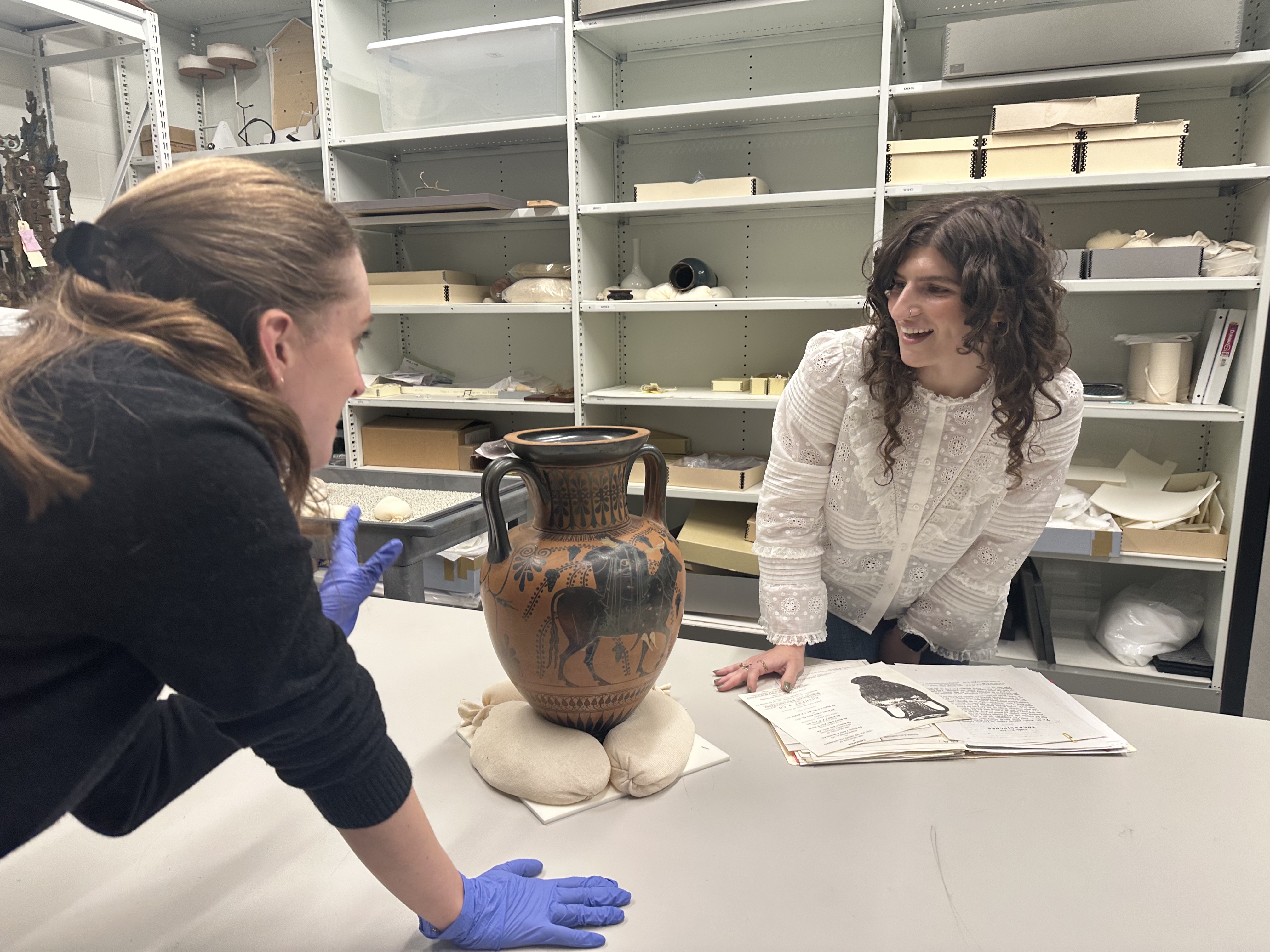
For Braun, provenance research allows her to apply and perfect the legal research skills she’s learning at Duke Law. “The first step is to lay down a foundation of all the laws that might come into play when you’re looking at objects from classical antiquities, and trying to learn about the UNESCO 1970 convention and different laws that apply, for instance, the laws about cultural heritage property in Italy and in Greece, and what happens when something is found or exported,” she said. At first, she found the international law research a bit daunting, “but my LARW research professor Michael McArthur was a huge help pointing me to resources. It ended up being fun, honestly.”
Next, Braun reviews all the files and documents that followed an object to the Nasher, records of when and where each object was acquired and from whom. “From these files, I compile a record of the known ownership history of each object, flagging objects with unknown provenance and making note of gaps in provenance for follow-up. It’s exciting because I get to find things I never would have stopped to look at, and they can have interesting stories. I feel like I get to be a fly on the wall for everyone else who has also wondered where this came from, or what does this mean?”
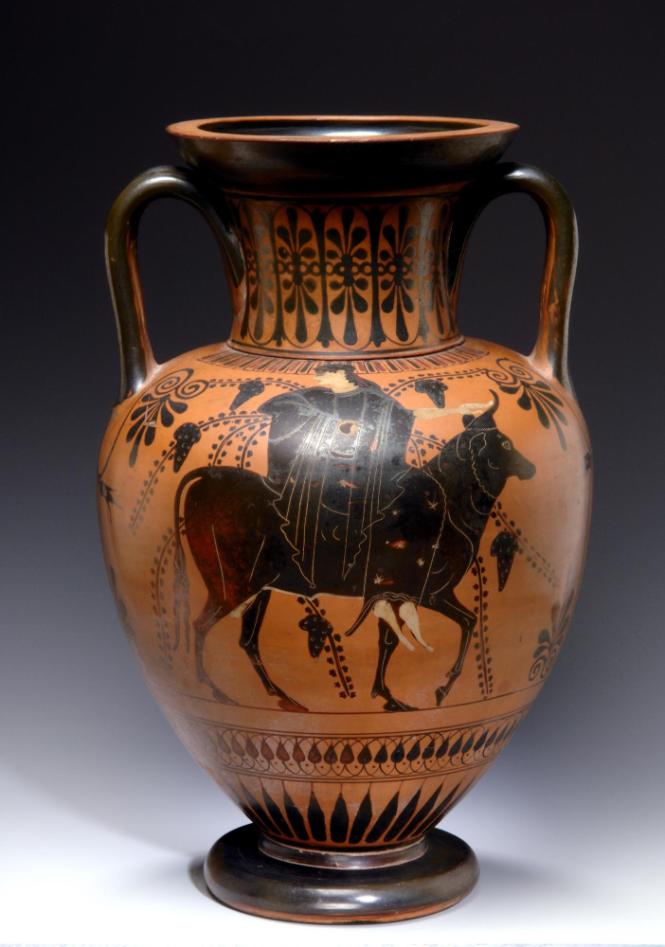
When it came to Object 2006.1.38 in the museum’s collection — an amphora (an ancient vase) painted with a scene from Greek mythology — the ownership trail Braun traced led through a winding path of law, history, and more than a few intriguing rabbit holes. She has documented the record as the vase passed from Lucien Bonaparte, through debt‑ridden English dukes, a 19th‑century reformer of asylums, a Scottish dog breeder, a Cuban count, members of the Duke Medical School community, and, finally, to the Nasher in 2006.
It is, she says, a little like unraveling a mystery. “I feel like Indiana Jones, except I’m working with files! But it’s a puzzle, which is also what I love about law — how you’re taking pieces and fitting the story together to tell what you’d like to prove.”
There’s one gap in the amphora’s provenance that remains to be solved. “In 1872, we know it was auctioned. We don’t know who bought it, so we don’t know where it went,” Braun said. But she hasn’t given up. “I’ve done as much as I can with the amphora and we’re in the process of waiting to follow through on some leads to track down that missing auction, but at this point, I’ve moved on to a new group of objects.”
Braun notes museums’ commitment to establishing provenance has fluctuated; she’s encouraged by the renewed emphasis many are now taking.
“I’m taking Art Law this semester. Often in decades past, there had to be somebody making a claim about an object for a museum to be prompted into action and doing some research just to ensure the claim was or wasn’t valid.”
But the approach to provenance has evolved and museums are being more proactive about filling gaps in their understanding of their collections.
“I’m reading in art law about how attitudes have changed. There’s a heartwarming side to something ending up where it belongs.”
And, says Braun, along with provenance, comes “an acknowledgement of a shared history that hurt some parties and served others, but that everyone today is committed to understanding and when necessary, correcting. I think the Nasher is doing great; I really appreciate that provenance is a priority there.”
In addition to the legal research and art law classes she has taken, Braun has explored her interest in art and found connections with other courses at the law school.
“So much of intellectual property law has a huge overlap with art law. So, I’ve talked to Professor Jenkins and Professor Buccafusco, and Professor DeMott, who is teaching the seminar on provenance next semester. I’m interested in looking at AI, what it’s going to look like for artists whose work is being appropriated by AI and what is fair use. A lot of decisions that are coming down right now might come up in a big law context.”
Her Nasher experiences also inform her work in other law classes.
“I’m taking comparative law this semester and writing about cultural heritage property laws in Greece and looking at how that interacts with conservation issues and how successful conservation efforts are. So much of that I learned through my research at the Nasher.”
Further on, Braun hopes to weave her interest in art law into her legal career; it has already shaped some of her summer work experience.
“Volunteer Lawyers for the Arts is an organization in New York that provides legal assistance for artists, musicians, and all types of creatives who need legal counseling. They partner with different big law firms in New York, and I was able to work on a case with them last summer.”
Potential employers have taken note of her interest in art and her work at the Nasher. “It came up a lot in all my recruitment conversations and interviews where the reactions were, ‘Oh, that’s different, what’s that about?’ Which is funny because I had 6 years previous work experience on my resume, but the art stuff is what got noticed. It is legal research, but it’s just not typical.”
As for what the future holds, Braun is open to how her goals and career trajectory may evolve, but she hopes to find ways to stay connected with the creative community as an attorney.
“The idea that I could get to be one of those people who really loves their job and feels both passionate about and energized by their work — and that their work is interesting and important and even potentially lucrative — is beyond my wildest dreams. I think and hope that art will be some part of it. I’m excited that I’m getting to do this now, while I’m still in law school, and hoping that it will open more doors down the line.”
Braun says the Nasher is interested in other law students who want to do provenance research. “I was able to connect some of my classmates to them and hopefully they’re going to start next semester in other areas of the collection. There could certainly be a lot more stories coming up, which I love.”
In the meantime, she looks forward to continuing her own work there. “It’s another way to get to apply so many of the skills that I’m learning. I’m definitely going to be doing it next semester. I know I will come back to the Nasher for as long as they will have me!”
Note: Look for the vase to be on view soon at the Nasher.