

The oldest known synagogue outside Israel was located on the Greek island of Delos—known as the island of the god Apollo in the Cyclades—and attests to the presence of a Jewish community.
Roman-Jewish historian Flavius Josephus (37-100 AD) mentioned the existence of Jews on Delos and is also referenced in the Books of the Maccabees.
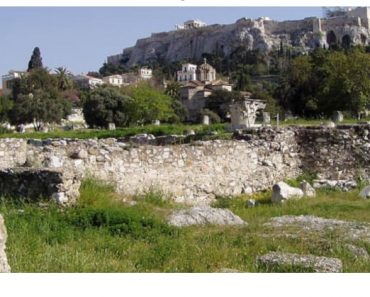
It was discovered by French archaeologists from the Athens School of Archaeology at the end of the 19th century, and is located southwest of the ancient stadium by the Aegean Sea, dating back to the first century BCE. Recognized as the oldest synagogue of the Jewish Diaspora, it was a two-room structure intended for religious use. Among the ruins, a finely sculpted marble armchair known as the Throne of Moses was found, sitting against a stone wall.
Several Greek inscriptions have been discovered around the ruins of the synagogue. One inscription bears the phrase ‘Theos Hypsistos’ (Supreme God), which is equivalent to the Hebrew ‘Shaddai’ (The All-Powerful).
The oldest Jewish synagogue
The original function of the synagogue building on Delos has long been contested. However, Archaeology Professor Dr. Monika Truemper conducted extensive fieldwork on the structure’s architectural history and determined it was a synagogue on the Greek island, the oldest in Ancient Greece.
Recent publications suggest that the structure could have been a private house, a meeting place for an association, or a pagan cult building. However, after studying the history of the construction, the German archaeology professor disagrees with these interpretations.
Dr. Truemper identified five construction phases, with two predating 88 BC. The remaining three occurred between 88 BC and the end of the 2nd century AD.
The structure features a large hall and a water reservoir facing east, situated in an isolated seaside location. These characteristics do not belong to a private house, a meeting place for an association, or a pagan cult building. Instead, they support her argument that it functioned as a synagogue from the beginning.
Dr. Truemper argues that the structure found on Delos was conceived and used as a synagogue on the Greek island from its initial construction at an unknown exact date and then continuously used as such until its abandonment at the end of the 2nd century AD.
The archaeology professor’s argument is based on the architectural features, the continuity of design, the absence of convincing alternative functions, the lack of exact parallels on Delos for any of the phases of modification and use, and the history of Jews and Samaritans on Delos.

Delos: The flourishing ancient Greek sacred island
Although a small, rocky island, no more than 5 km long and 1.300 m wide, it was the most sacred place for ancient Greeks because, according to Greek mythology, Apollo and Artemis, two of the most important deities of the Greek pantheon, were born there. Situated in the heart of the Aegean, it was inhabited since the 3rd millennium BCE.
The Temple of Apollo has stood since the 9th century BC and reached the peak of its glory during the archaic (7th-6th centuries BCE) and classical (5th-4th centuries BC) periods when Hellenes from all over the Greek world gathered to worship Apollo, the god of light, harmony, and balance, and Artemis, the goddess of hunting, animals, and childbirth, his twin sister.
Delos developed rapidly after 167 BC when it was declared a free port. All the commercial activity of the eastern Mediterranean was congregated on the isle. Rich merchants, bankers, and ship-owners from all over the world settled there, attracting builders, artists, and craftsmen who built luxurious houses for the rich, decorated with statues, frescoes, and mosaic floors. That was the time when the oldest synagogue was built on the Greek island
The small island became the maximum emporium totius orbis terrarum—the greatest commercial center of the world.
At the beginning of the 1st century BC, some 30,000 people lived on the little island, with thousands of tons of merchandise being moved through its ports yearly.
The island’s prosperity was also the cause of its destruction. Delos was attacked and looted twice: in 88 BC by Mithridates, the King of Pontus, and later, in 69 BC, by the pirates of Athenodorus, an ally of Mithridates. Since then, residents had gradually abandoned the island, and it fell rapidly into decline.
Other synagogues in Ancient Greece
Literary and epigraphic evidence suggests there were cities in Ancient Greece with synagogues. However, only a few archaeological remains besides those of the synagogue on the Greek island of Delos.
In Ancient Greece the remains of synagogues were found on the island of Aegina. On the mainland, two architectural fragments of a synagogue have been found in Corinth. One is a lintel with the crude inscription “Synagogue of the Hebrews”; the other is a head of a Corinthian column with three menorahs carved in relief.
Archaeologists argue that the reasons for the lack of synagogue remains in Greece are due to earthquakes, as the region is in an active seismic zone, and the fact that when Christianity prevailed, synagogues were confiscated and churches were built over them.
In Byzantine times, while the state offered legal protection to its Jewish citizens under the Theodosian Code, opposition to the operation of synagogues surfaced periodically. Synagogues were the target of furor as the visible symbol of the Jewish community. Christian writers such as John Chrysostom (c. 347–407 CE) wrote eight homilies against
the Jews.